

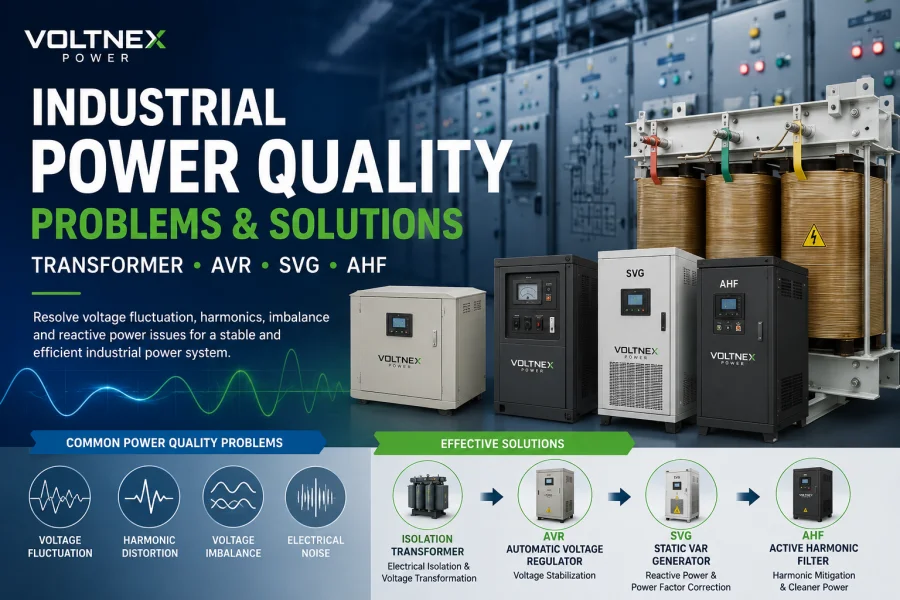
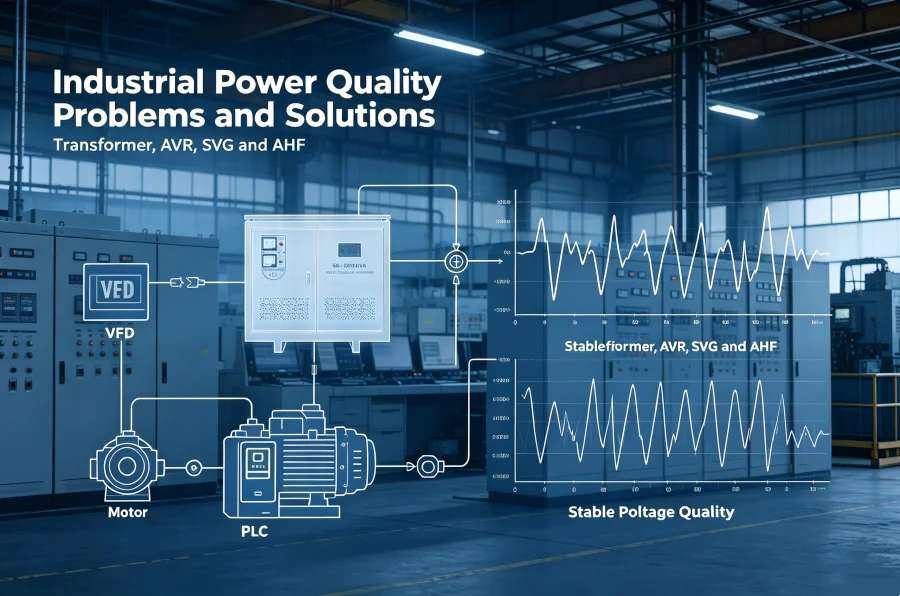
Industrial electrical systems require stable, reliable and high-quality power to keep motors, VFDs, transformers, automation equipment and production lines operating efficiently. However, many factories experience power quality problems such as voltage fluctuation, harmonic distortion, voltage imbalance, low power factor, reactive power and electrical noise.
These problems can affect equipment performance, increase electrical losses, cause overheating and lead to unexpected VFD or control-system trips.
The right solution depends on the actual electrical problem. An isolation transformer can provide electrical isolation and voltage transformation, while an AVR or industrial voltage stabilizer is mainly used to regulate voltage fluctuations. An SVG provides dynamic reactive power compensation, and an AHF or active harmonic filter is designed to reduce harmonic distortion.
This guide explains the most common industrial power quality problems, how to identify them, and how to select the appropriate industrial power quality solutions for factories, commercial facilities and other electrical systems.
What Is Industrial Power Quality?
Industrial power quality describes the condition and stability of electrical power supplied to equipment and electrical networks.
Important power quality parameters include voltage stability, current waveform, frequency, phase balance, harmonic distortion, power factor, reactive power and electrical disturbances.
In an ideal electrical system, equipment receives stable voltage and frequency with minimal waveform distortion. In real industrial environments, however, large motors, VFDs, welding machines, compressors, rectifiers and other nonlinear loads can affect the electrical network.
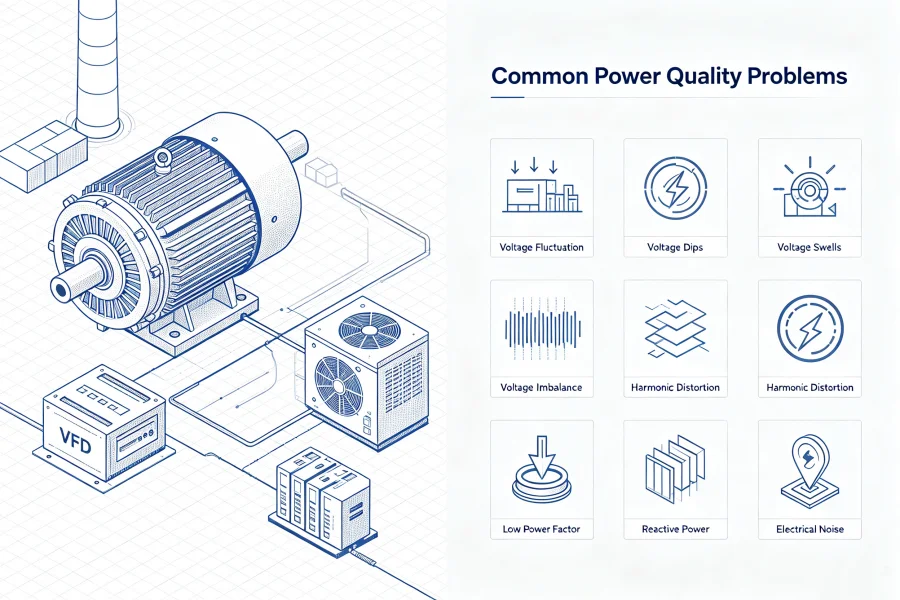
Common power quality problems include:
- Voltage fluctuation
- Voltage dips and swells
- Voltage imbalance
- Harmonic distortion
- Low power factor
- Excessive reactive power
- Electrical noise
- Transient disturbances
Poor power quality can cause motor overheating, transformer losses, VFD trips, PLC resets, communication problems and production interruptions.
For this reason, power quality should be considered as part of the overall electrical design rather than as an isolated equipment problem.
Common Industrial Power Quality Problems
Different industrial facilities can experience different combinations of power quality problems. Identifying the actual problem is the first step toward selecting the correct solution.
| Power Quality Problem | Typical Causes | Possible Effects |
|---|---|---|
| Voltage fluctuation | Utility instability, changing loads | Equipment malfunction, unstable operation |
| Voltage dips | Motor starting, faults, switching | VFD trips, control-system interruptions |
| Voltage swells | Switching or sudden load changes | Equipment stress |
| Voltage imbalance | Uneven phase loading | Motor heating and losses |
| Harmonic distortion | VFDs, rectifiers, nonlinear loads | Heating, losses and interference |
| Low power factor | Motors and inductive loads | Higher current and system losses |
| Electrical noise | Switching equipment, grounding issues | Control and communication problems |
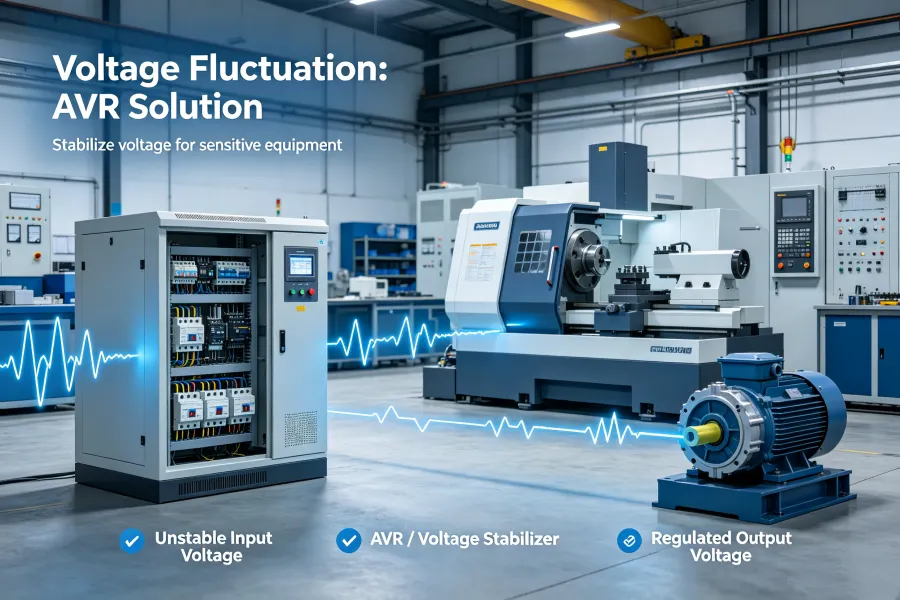
Voltage Fluctuation
Voltage fluctuation is common in factories with large motors, compressors, pumps, welding equipment and rapidly changing loads.
For example, a facility may have a nominal three-phase supply of 400 V, but the actual voltage may continuously move above or below the desired level.
Excessive voltage variation can affect motors, control systems, CNC machines, PLCs and other sensitive equipment.
For sustained or relatively slow voltage variations, an automatic voltage regulator (AVR) or industrial voltage stabilizer can help maintain a more stable output voltage.
Harmonic Distortion
Harmonics are increasingly important in modern industrial power systems because many machines use power electronic converters.
Typical harmonic-producing equipment includes:
- Variable frequency drives
- UPS systems
- Rectifiers
- Welding machines
- Battery chargers
- Switching power supplies
- Industrial converters
Harmonic currents can increase losses and heating in transformers, cables and motors and can also affect capacitors, protection systems and sensitive equipment.
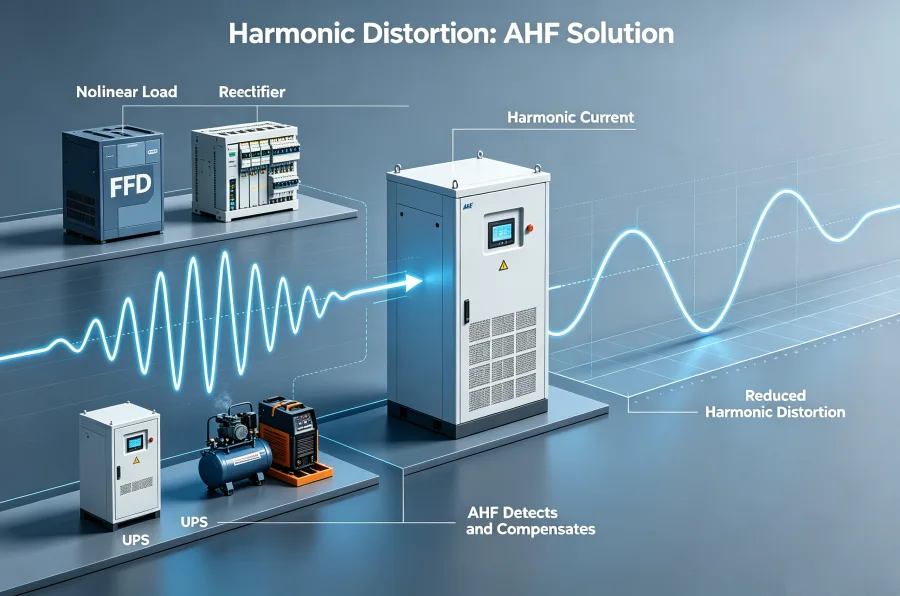
An active harmonic filter (AHF) can dynamically detect and compensate harmonic currents.
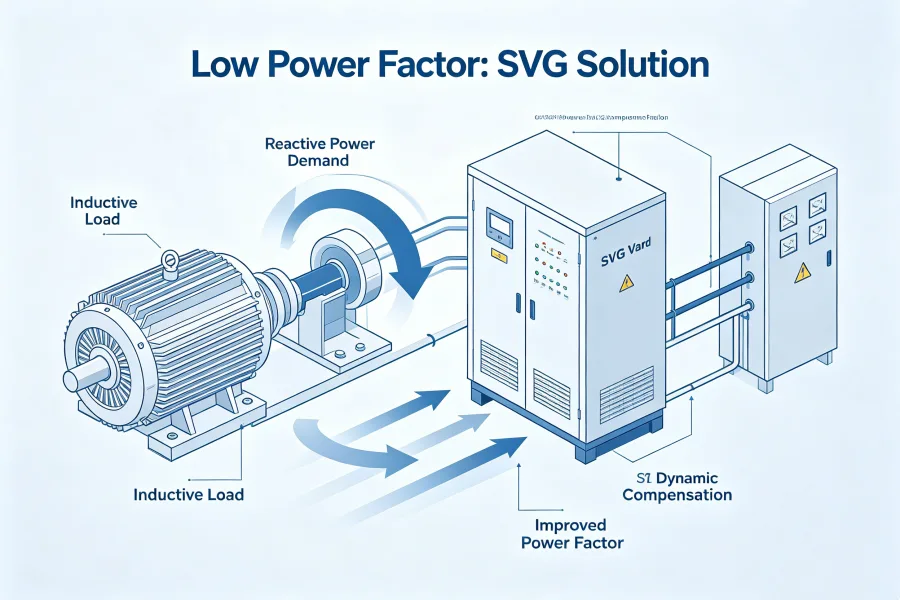
Low Power Factor and Reactive Power
Induction motors, transformers and other inductive equipment consume reactive power. When reactive power demand is high, the facility power factor can decrease.
A low power factor can increase current flowing through transformers and cables and reduce the effective utilization of electrical infrastructure.
An SVG (Static Var Generator) can dynamically compensate reactive power and help improve power factor, particularly in systems with rapidly changing loads.
Electrical Noise and Disturbances
Electrical noise can originate from switching equipment, power electronics, grounding problems and electromagnetic interference.
Sensitive automation systems, instrumentation and control equipment can be particularly affected.
Depending on the nature of the disturbance, electrical system improvements may include appropriate grounding, shielding, filtering, isolation transformers or other dedicated power quality equipment.
How Do You Diagnose Power Quality Problems?
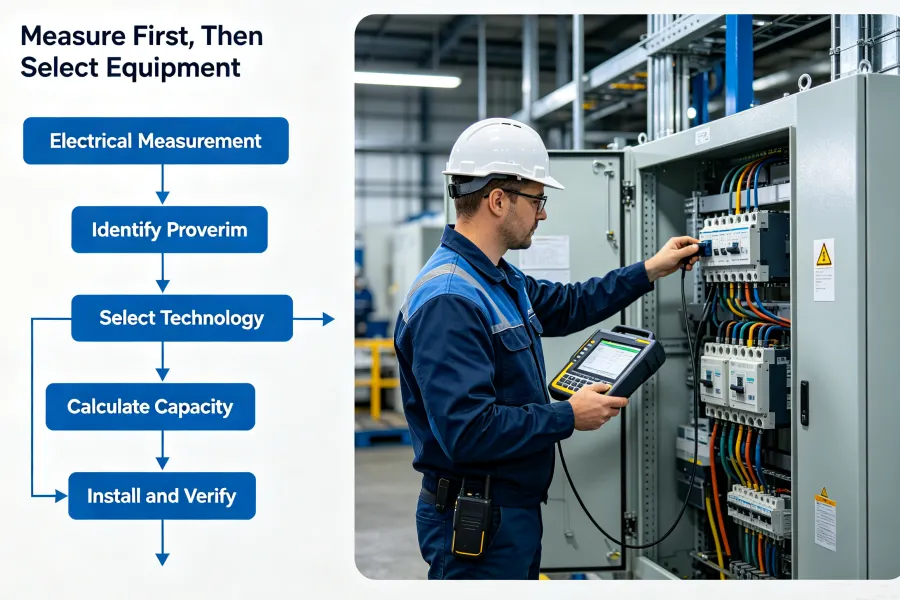
The most important rule when selecting a power quality solution is:
Measure first, then select the equipment.
It is not always correct to assume that unstable equipment operation is caused by voltage fluctuation. A VFD trip, for example, may be related to harmonics, undervoltage, overvoltage, motor overload, grounding or another electrical issue.
A power quality assessment may include:
- Input voltage
- Output voltage
- Voltage variation
- Three-phase voltage balance
- Load current
- Peak current
- Frequency
- Power factor
- Reactive power
- Total harmonic distortion (THD)
- Individual harmonic levels
- Load profile
- Equipment operating conditions
A power quality analyzer can help determine whether the primary problem is voltage regulation, harmonics, reactive power, imbalance or another disturbance.
The general process is:
Electrical Measurement
↓
Identify the Power Quality Problem
↓
Determine the Severity and Load Characteristics
↓
Select the Appropriate Technology
↓
Calculate Equipment Capacity
↓
Install and Verify Performance
This approach is more reliable than selecting equipment based only on the nameplate rating of the connected load.
Industrial Power Quality Solutions: Which Equipment Solves Which Problem?
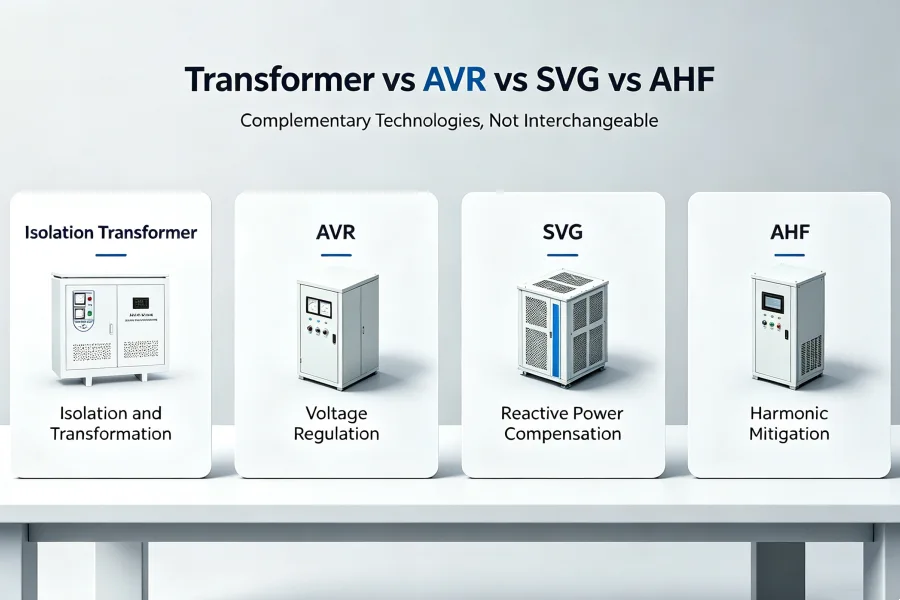
Different power quality devices have different functions. They should not be treated as interchangeable products.
| Equipment | Main Function | Typical Application |
|---|---|---|
| Isolation Transformer | Electrical isolation and voltage transformation | Sensitive equipment, industrial distribution |
| AVR | Automatic voltage regulation | Voltage fluctuation |
| SVG | Reactive power compensation | Low power factor and dynamic reactive loads |
| AHF | Harmonic compensation | Harmonic distortion and nonlinear loads |
Understanding these differences makes it easier to select the correct industrial power quality solution.
Isolation Transformer for Industrial Power Systems
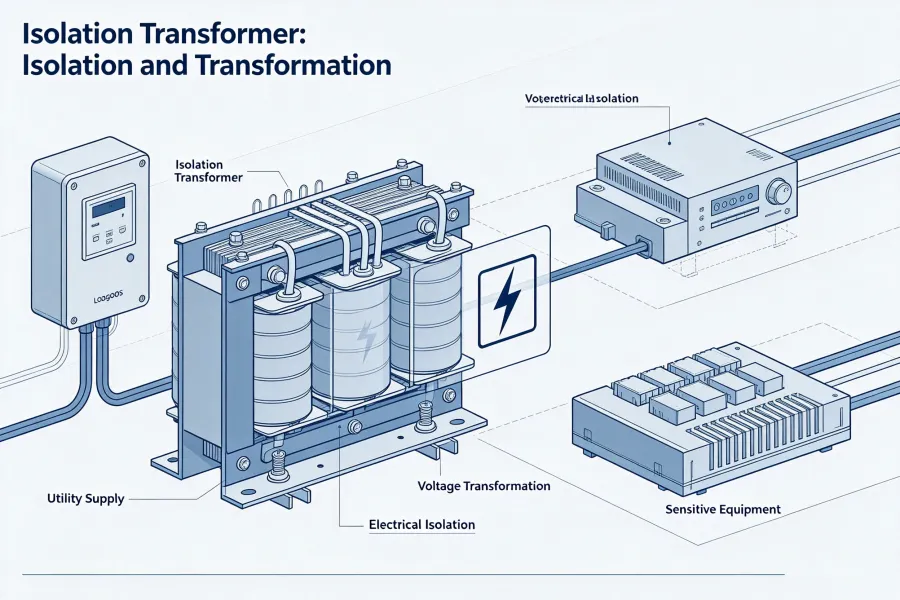
An isolation transformer transfers electrical energy between primary and secondary windings while providing electrical separation between the two circuits.
Industrial isolation transformers are commonly used when a facility requires:
- Electrical isolation
- Voltage transformation
- Separation of sensitive equipment
- Improved control of grounding arrangements
- Reduction of certain common-mode disturbances
- A dedicated power supply for specific equipment
Typical applications include:
- Industrial machinery
- Automation systems
- CNC equipment
- Control systems
- Sensitive electronics
- VFD-related equipment
- Manufacturing equipment
An isolation transformer can be an important part of a power quality strategy, but it should not be considered a universal solution for every power quality problem.
For example, serious harmonic distortion generally requires dedicated harmonic mitigation equipment such as an AHF or another appropriate filter.
Read More:What Is an Isolation Transformer? Working Principle, Benefits and Industrial Applications
AVR and Industrial Voltage Stabilizer
An Automatic Voltage Regulator (AVR), also commonly called an industrial voltage stabilizer, is designed to regulate output voltage when the incoming supply varies within the equipment’s specified operating range.
The basic concept is:
Unstable Input Voltage
↓
AVR / Voltage Stabilizer
↓
Regulated Output Voltage
AVRs are commonly used in industrial environments where utility voltage changes or load variations can affect equipment operation.
Typical applications include:
- Manufacturing plants
- Production lines
- CNC machines
- Pumps
- Compressors
- Industrial motors
- Automation equipment
- Testing equipment
An AVR can be particularly useful when the main problem is sustained or relatively slow voltage fluctuation.
However, very fast voltage sags, transients or interruptions may require other specialized power protection technologies. Therefore, the speed and severity of the voltage disturbance should be evaluated before selecting an AVR.
SVG for Reactive Power and Power Factor Compensation
An SVG (Static Var Generator) is a power electronic device designed to provide dynamic reactive power compensation.
Industrial facilities with many induction motors, transformers or other inductive loads may have significant reactive power demand.
The basic operating concept is:
Inductive Load
↓
Reactive Power Demand
↓
SVG Detection and Control
↓
Dynamic Reactive Compensation
↓
Improved Power Factor
Unlike traditional fixed capacitor compensation, an SVG can dynamically respond to changing load conditions.
SVG systems can be used in:
- Manufacturing plants
- Large motor systems
- Welding facilities
- Cranes
- Rolling mills
- Production lines
- HVAC systems
- Industrial distribution systems
The required SVG capacity should be determined from measured reactive power demand and the desired compensation level rather than simply from the total motor kW.
AHF Active Harmonic Filter
An AHF (Active Harmonic Filter) is designed to reduce harmonic distortion caused by nonlinear electrical loads.
The basic operating principle is:
Nonlinear Load
↓
Harmonic Current
↓
AHF Detects Harmonic Components
↓
Compensation Current
↓
Reduced Harmonic Distortion
VFDs, rectifiers, UPS systems, welding machines and switching power supplies can generate harmonic currents.
An AHF continuously monitors the electrical system and generates compensation currents to counteract selected harmonic components.
Typical applications include:
- VFD-based factories
- Manufacturing plants
- Data centers
- Welding facilities
- Industrial automation
- Semiconductor equipment
- Commercial buildings
- Large production systems
The required AHF capacity depends on the actual harmonic current, system configuration and desired compensation performance.
Transformer vs AVR vs SVG vs AHF: What Is the Difference?
Although these products are often discussed together under industrial power quality solutions, their functions are different.
| Feature | Isolation Transformer | AVR | SVG | AHF |
|---|---|---|---|---|
| Electrical isolation | Yes | No | No | No |
| Voltage transformation | Yes | Application dependent | No | No |
| Voltage regulation | Not its primary function | Yes | No | No |
| Reactive power compensation | No | No | Yes | No |
| Power factor improvement | No | No | Yes | No |
| Harmonic compensation | Limited/application dependent | No | Not its primary function | Yes |
| Main purpose | Isolation and transformation | Voltage stability | Reactive power | Harmonic mitigation |
angeable products.
The correct equipment depends on the measured electrical problem.
How to Build an Integrated Industrial Power Quality Solution
Real industrial facilities often have several power quality problems at the same time.
For example, a manufacturing plant may have:
- Fluctuating utility voltage
- Large induction motors
- Multiple VFDs
- Sensitive automation equipment
- Low power factor
- Harmonic distortion
Using only one device may not solve every problem.
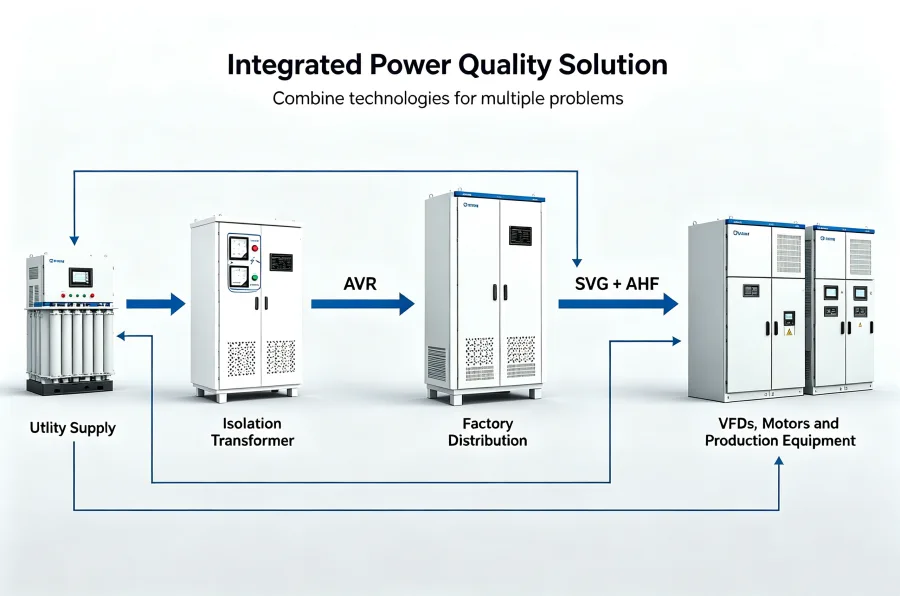
An integrated system could be configured as:
Utility Power
↓
Isolation Transformer
↓
AVR / Voltage Stabilizer
↓
Industrial Distribution
↓
SVG + AHF
↓
VFDs + Motors + Production Equipment
In this configuration, each device has a specific responsibility.
The isolation transformer provides electrical separation or voltage transformation where required.
The AVR regulates sustained voltage variation.
The SVG compensates reactive power.
The AHF addresses harmonic currents.
This approach allows the electrical system to address multiple power quality problems without expecting one product to perform every function.
Industrial Power Quality Solution Example
Consider a manufacturing factory with a 400 V, three-phase electrical system.
The facility operates:
- Large induction motors
- Multiple VFDs
- CNC machines
- Automated production lines
- Compressors
- Pumps
The electrical assessment identifies three major issues:
Problem 1: Voltage fluctuation
The utility voltage changes significantly during periods of changing plant load.
Solution: AVR
An appropriately sized industrial voltage stabilizer can regulate the supply voltage within its specified operating range.
Problem 2: Low power factor
Large induction motors create substantial reactive power demand.
Solution: SVG
An SVG can dynamically compensate reactive power and improve the facility power factor.
Problem 3: Harmonic distortion
Multiple VFDs and other nonlinear loads produce harmonic currents.
Solution: AHF
An active harmonic filter can compensate selected harmonic currents and reduce harmonic distortion.
If sensitive equipment also requires electrical isolation, an isolation transformer can be incorporated into the appropriate section of the distribution system.
The resulting architecture could therefore be:
Utility Supply
→ Isolation Transformer
→ AVR
→ Factory Distribution
→ SVG + AHF
→ Industrial Loads
This example demonstrates why power quality design should begin with an electrical assessment rather than with a particular product.
How to Select the Right Power Quality Solution
When selecting power quality equipment for an industrial facility, consider the following steps.
1. Identify the Main Problem
Determine whether the primary issue is:
- Voltage fluctuation
- Harmonic distortion
- Low power factor
- Reactive power
- Electrical isolation
- Voltage imbalance
- Transient disturbance
2. Measure the Electrical System
Collect actual electrical measurements rather than relying only on equipment specifications.
Important measurements include voltage, current, power factor, reactive power, THD and load variation.
3. Determine the Required Capacity
Different products use different sizing parameters.
An isolation transformer and AVR are commonly specified in kVA.
SVG capacity is generally specified in kvar.
AHF capacity is commonly related to the required compensation current and harmonic spectrum.
4. Consider Load Characteristics
Evaluate:
- Motor load
- VFD load
- Nonlinear loads
- Peak demand
- Load variation
- Operating hours
- Starting conditions
5. Check Installation Conditions
The equipment should also be selected according to:
- Ambient temperature
- Altitude
- Indoor or outdoor installation
- Cabinet requirements
- Cooling method
- IP protection
- Available space
- Maintenance requirements
6. Decide Between Individual and Integrated Solutions
If the factory has only voltage fluctuation, an AVR may be sufficient.
If the facility has both harmonics and low power factor, an AHF and SVG may be combined.
If several problems exist simultaneously, an integrated power quality system may provide a more complete solution.
Read More:How to Select a VFD for an AC Motor? Complete Sizing Guide
Benefits of Improving Industrial Power Quality
A properly engineered power quality system can provide several operational benefits.
These may include:
- More stable voltage
- Reduced harmonic distortion
- Improved power factor
- Lower electrical losses
- Reduced equipment stress
- More stable motor operation
- Fewer nuisance trips
- Improved automation reliability
- Better utilization of electrical infrastructure
- More reliable production
The actual results depend on the original electrical conditions, equipment sizing and system design.
Power quality improvement should therefore be based on measured electrical conditions and clearly defined performance requirements.
Frequently Asked Questions
What are the most common industrial power quality problems?
Common problems include voltage fluctuation, voltage dips and swells, voltage imbalance, harmonic distortion, low power factor, reactive power and electrical noise.
What equipment is used for voltage stabilization?
An AVR or industrial voltage stabilizer is commonly used to regulate sustained input voltage fluctuations within its specified operating range.
What is the difference between an AVR and an isolation transformer?
An AVR primarily regulates voltage, while an isolation transformer provides electrical isolation and can also transform voltage. They solve different electrical problems and may be used together in some systems.
What does an SVG do?
An SVG dynamically compensates reactive power and can improve power factor. It is particularly useful for industrial facilities with changing inductive loads.
What is an AHF harmonic filter?
An AHF, or Active Harmonic Filter, detects harmonic currents and generates compensation currents to reduce harmonic distortion in an electrical system.
Can SVG and AHF be used together?
Yes. SVG and AHF perform different functions. SVG primarily addresses reactive power and power factor, while AHF primarily addresses harmonic currents. They can be integrated when both problems exist.
Can an isolation transformer eliminate harmonics?
An isolation transformer can provide electrical isolation and may reduce certain disturbances depending on its design and system configuration. However, it should not be considered a complete harmonic mitigation solution. Dedicated harmonic filtering may be required.
How do I choose the right power quality solution for my factory?
Start by measuring voltage, current, power factor, reactive power, harmonic distortion and phase balance. Then identify the main problem and select the appropriate equipment based on the measured conditions, load characteristics and required capacity.
Conclusion
Industrial power quality problems can affect almost every part of a modern electrical system, from motors and transformers to VFDs, PLCs and automated production equipment.
The correct solution depends on the specific problem.
Voltage fluctuation → AVR / Voltage Stabilizer
Electrical isolation and voltage transformation → Isolation Transformer
Reactive power and low power factor → SVG
Harmonic distortion → AHF
For facilities experiencing multiple problems, these technologies can be combined into an integrated industrial power quality solution.
The most effective approach is to measure and diagnose the electrical system first, then select and size the appropriate equipment according to actual voltage, current, harmonic, reactive power and load conditions.
With properly engineered transformers, automatic voltage regulators, SVG systems and active harmonic filters, industrial facilities can create a more stable electrical environment for motors, VFDs, automation systems and production equipment.
Voltnex Power provides customized industrial power quality equipment and electrical solutions, including isolation transformers, industrial transformers, automatic voltage regulators, voltage stabilizers, SVG and AHF systems for a wide range of industrial applications.