

Introduction
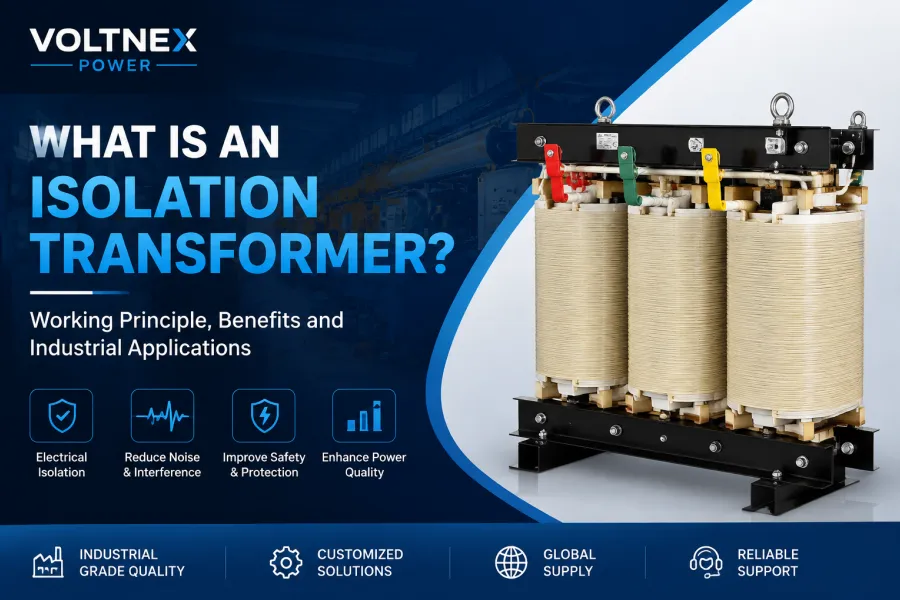
An isolation transformer is a specially designed electrical transformer that provides electrical separation between the input power supply and the output load while transferring energy through electromagnetic induction.
Unlike standard transformers that are mainly used for voltage conversion, an isolation transformer is designed to improve electrical safety, power quality, noise reduction and equipment protection.
In modern industrial environments, sensitive electrical equipment such as CNC machines, automation systems, medical devices, laboratory instruments and control systems require stable and clean power. Isolation transformers help reduce electrical interference, protect equipment from voltage disturbances and provide a safer operating environment.
As a professional industrial transformer manufacturer, Voltnex Power supplies customized isolation transformers, including dry type isolation transformers, three phase isolation transformers and industrial power isolation solutions for global applications.
What Is an Isolation Transformer?
An isolation transformer is an electrical transformer with a separate primary winding and secondary winding that transfers electrical power without a direct electrical connection between the input and output circuits.
The primary purpose of an isolation transformer is:
- Provide galvanic isolation between power source and equipment
- Improve electrical safety
- Reduce electrical noise and interference
- Protect sensitive electrical devices
- Improve power quality in industrial systems
The input and output voltage can be:
- Same voltage isolation
Example: 480V input → 480V output - Voltage conversion isolation
Example: 480V input → 220V output - Custom voltage isolation
Example: 400V input → 415V output
How Does an Isolation Transformer Work?
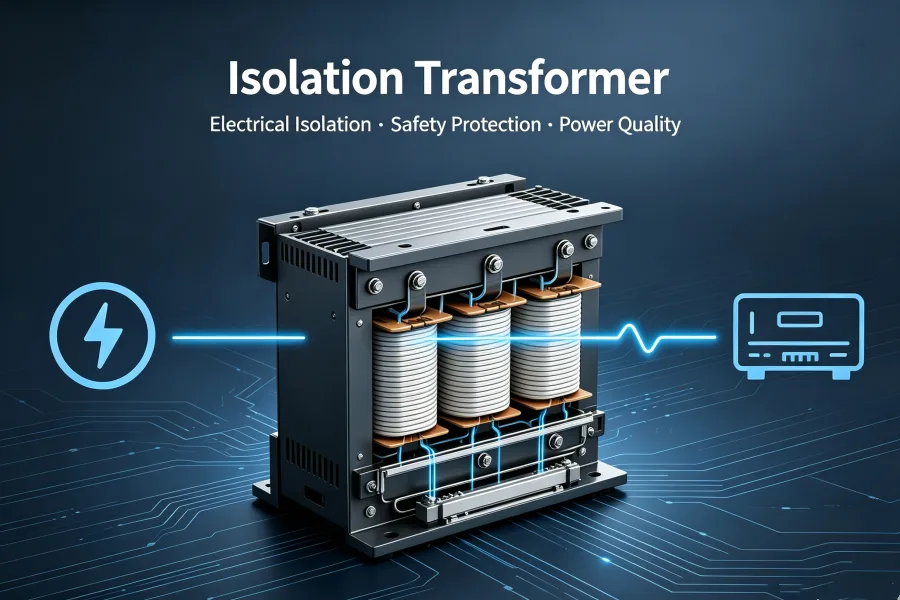
The working principle of an isolation transformer is based on electromagnetic induction.
The basic process includes:
1. Input Power Enters the Primary Winding
The AC power supply is connected to the primary winding.
When alternating current flows through the primary coil, it creates a changing magnetic field inside the transformer core.
2. Magnetic Field Transfers Energy Through the Core
The magnetic flux generated in the core transfers energy from the primary winding to the secondary winding.
Because the two windings are electrically separated, there is no direct conductive path between input and output.
3. Secondary Winding Provides Isolated Power Output
The secondary winding generates a new AC voltage that supplies power to connected equipment.
The output power maintains the same frequency:
- 50Hz systems
- 60Hz systems
while providing electrical isolation protection.
Isolation Transformer Structure
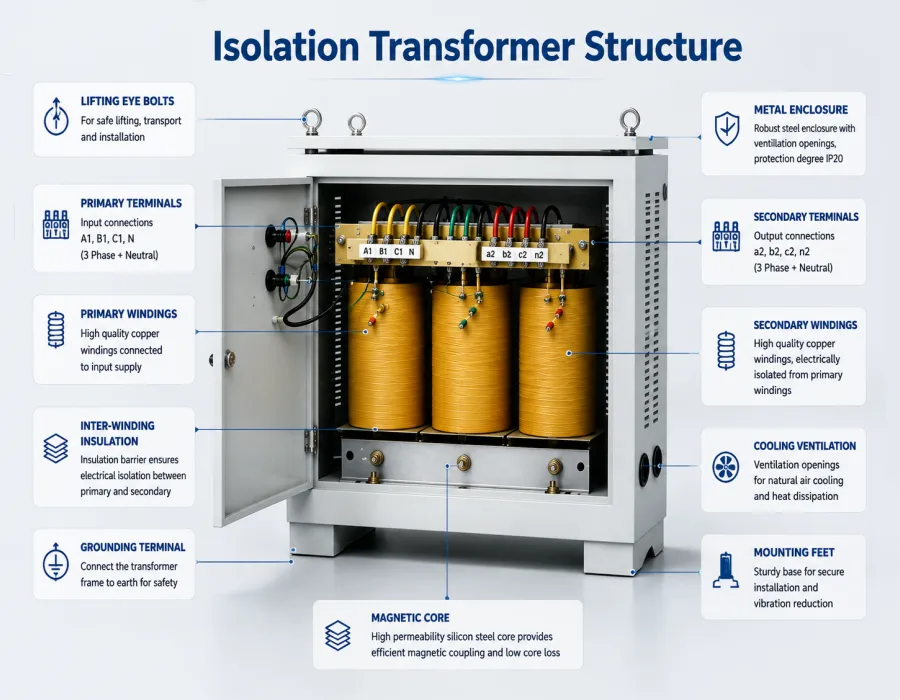
A typical industrial isolation transformer consists of several key components:
| Component | Function |
|---|---|
| Primary Winding | Receives incoming AC power |
| Secondary Winding | Provides isolated output power |
| Magnetic Core | Transfers electromagnetic energy |
| Insulation System | Separates primary and secondary circuits |
| Enclosure | Provides mechanical protection |
| Cooling System | Maintains safe operating temperature |
For industrial applications, Voltnex Power isolation transformers use high-quality electrical materials and optimized winding designs to ensure reliable long-term operation.
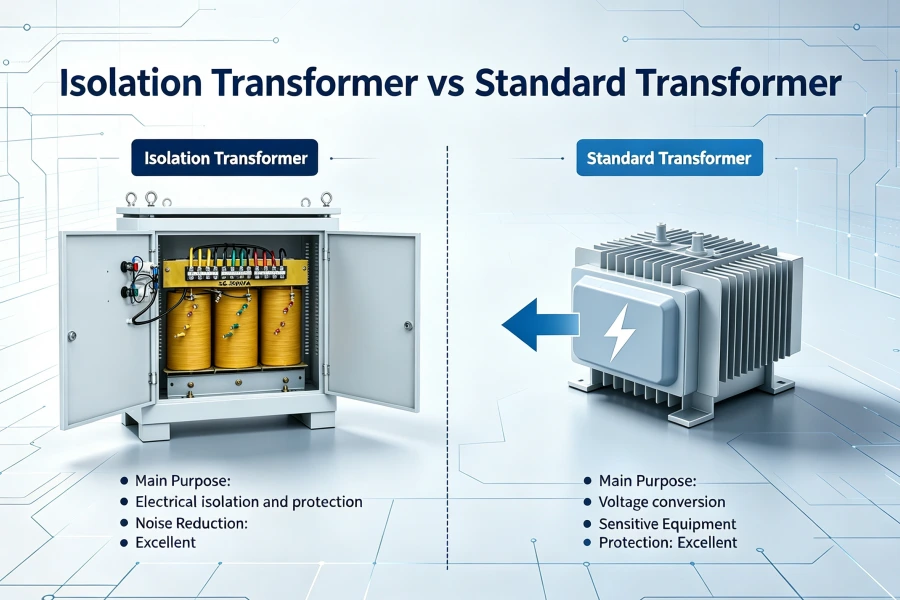
Isolation Transformer vs Standard Transformer
Although both devices use electromagnetic induction, their purposes are different.
| Feature | Isolation Transformer | Standard Transformer |
|---|---|---|
| Main Purpose | Electrical isolation and protection | Voltage conversion |
| Electrical Connection | No direct connection between circuits | Usually connected through transformer system |
| Safety Protection | High | Normal |
| Noise Reduction | Excellent | Limited |
| Sensitive Equipment Protection | Excellent | Depends on design |
| Industrial Applications | Automation, CNC, Medical, Laboratory | Power distribution |
Key Benefits of Isolation Transformers
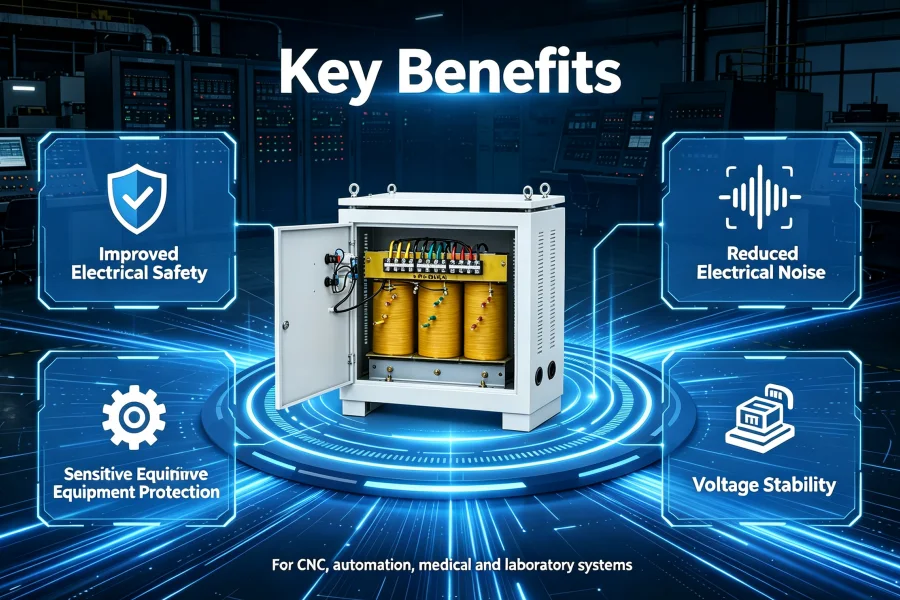
1. Improved Electrical Safety
The biggest advantage of an isolation transformer is electrical separation.
By isolating the equipment from the main power source, it helps reduce risks caused by:
- Ground faults
- Leakage current
- Electrical disturbances
This is especially important for:
- Medical equipment
- Laboratory systems
- Industrial control panels
2. Reduce Electrical Noise and EMI Interference
Industrial equipment often generates electrical noise through:
- Variable frequency drives
- Motors
- Switching power supplies
- Automation controllers
Isolation transformers help reduce:
- Common mode noise
- Electrical interference
- Harmonic disturbance impact
This improves the stability of sensitive control systems.
3. Protect Expensive Industrial Equipment
Many industrial machines require stable power quality.
Isolation transformers help protect:
- CNC machines
- PLC systems
- Robotics equipment
- Testing instruments
- Communication systems
by reducing the impact of abnormal power conditions.
4. Improve Voltage Stability
Isolation transformers can provide customized voltage matching:
Examples:
- 480V to 480V
- 480V to 400V
- 400V to 220V
- 380V to 415V
This allows equipment from different countries and voltage standards to operate safely.
Dry Type Isolation Transformer Advantages
Modern industrial facilities increasingly use dry type isolation transformers because they provide safer and cleaner operation.
Advantages include:
Fire Safety
Dry type transformers do not use transformer oil, reducing fire risks.
Low Maintenance
No oil replacement or leakage inspection is required.
Indoor Installation
Suitable for:
- Factories
- Data centers
- Laboratories
- Commercial buildings
Environmental Friendly
No oil contamination risk.
Three Phase Isolation Transformer Applications
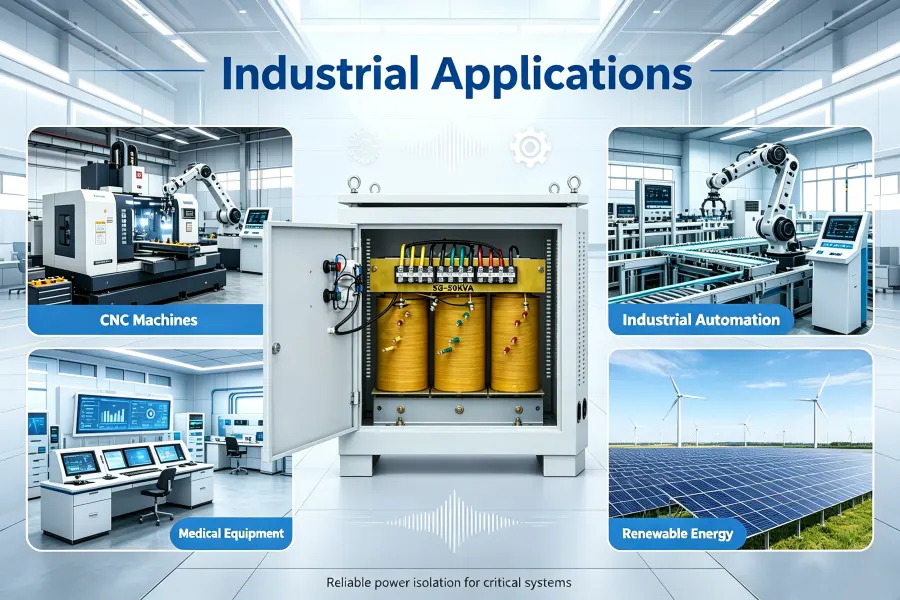
Three phase isolation transformers are widely used for high-power industrial loads.
Typical applications include:
CNC Machine Power Supply
CNC equipment requires stable and clean power to maintain:
- Precision machining
- Control accuracy
- Equipment lifetime
Industrial Automation Systems
Used for:
- PLC systems
- Robots
- Production lines
- Control cabinets
Medical Equipment
Provides reliable isolated power for:
- Imaging equipment
- Testing systems
- Hospital electrical systems
Data Centers
Helps protect:
- Server systems
- UPS equipment
- Network infrastructure
Renewable Energy Systems
Used in:
- Solar power systems
- Energy storage systems
- Industrial power conversion
Get More:Three Phase Isolation Transformer: Applications, Benefits and Industrial Guide
How to Select the Right Isolation Transformer?
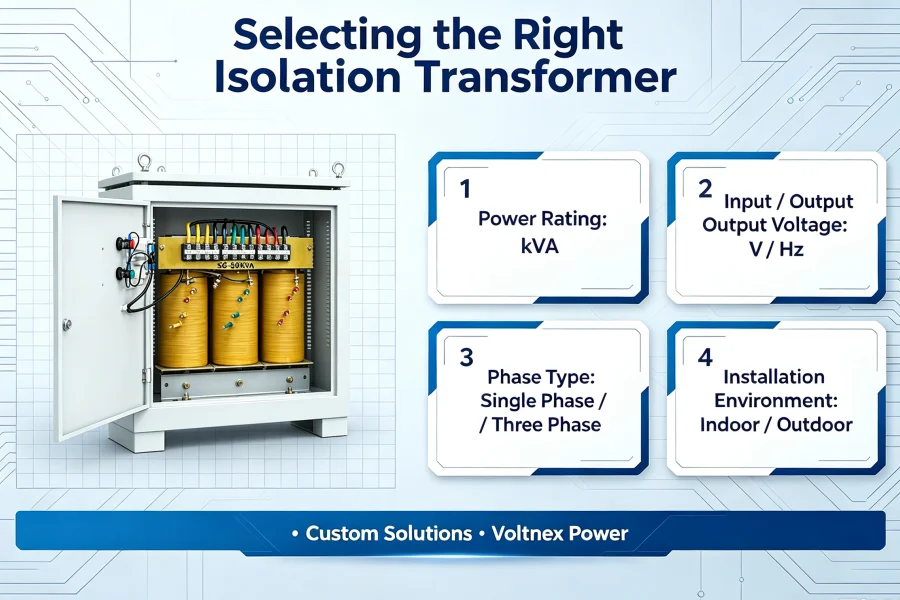
Before purchasing an isolation transformer, customers should consider:
1. Power Capacity
Transformer capacity is measured in:
- kVA
Common industrial ratings:
2. Input and Output Voltage
Confirm:
- Input voltage
- Output voltage
- Frequency
Examples:
- 480V / 60Hz
- 400V / 50Hz
- 415V / 50Hz
3. Phase Type
Choose:
Single Phase
Suitable for:
- Small equipment
- Laboratory devices
- Control systems
Three Phase
Suitable for:
- Industrial machinery
- Motors
- Automation systems
4. Installation Environment
Consider:
- Indoor or outdoor installation
- Temperature
- Humidity
- Protection level
Why Choose Voltnex Power Isolation Transformers?
Voltnex Power designs and manufactures industrial isolation transformers for global customers.
Our solutions include:
✅ Dry Type Isolation Transformers
✅ Three Phase Isolation Transformers
✅ Industrial Power Transformers
✅ Customized Voltage Solutions
✅ OEM & ODM Manufacturing
With flexible specifications:
- Power rating customization
- Voltage customization
- Frequency customization
- Enclosure design
- Global export support
Voltnex Power provides reliable transformer solutions for industrial applications worldwide.
FAQ About Isolation Transformers
1. What is the main purpose of an isolation transformer?
The main purpose is to provide electrical isolation between the power source and equipment while improving safety and power quality.
2. Does an isolation transformer change voltage?
Yes. An isolation transformer can provide the same voltage output or customized voltage conversion depending on the winding design.
3. What is a dry type isolation transformer?
A dry type isolation transformer uses air cooling and solid insulation instead of transformer oil, making it safer for indoor industrial applications.
4. Where are isolation transformers used?
They are widely used in:
- Factories
- CNC machines
- Medical systems
- Laboratories
- Automation equipment
- Data centers
5. Can Voltnex Power customize isolation transformers?
Yes. Voltnex Power provides OEM and ODM solutions including custom voltage, capacity and enclosure designs.
Conclusion
Isolation transformers play an important role in modern industrial power systems by providing electrical isolation, improved safety, reduced interference and reliable equipment protection.
For factories, automation systems, CNC equipment and sensitive electrical applications, selecting the right isolation transformer can significantly improve system reliability and operating efficiency.
Voltnex Power manufactures customized dry type isolation transformers and industrial isolation transformer solutions for customers worldwide.