


























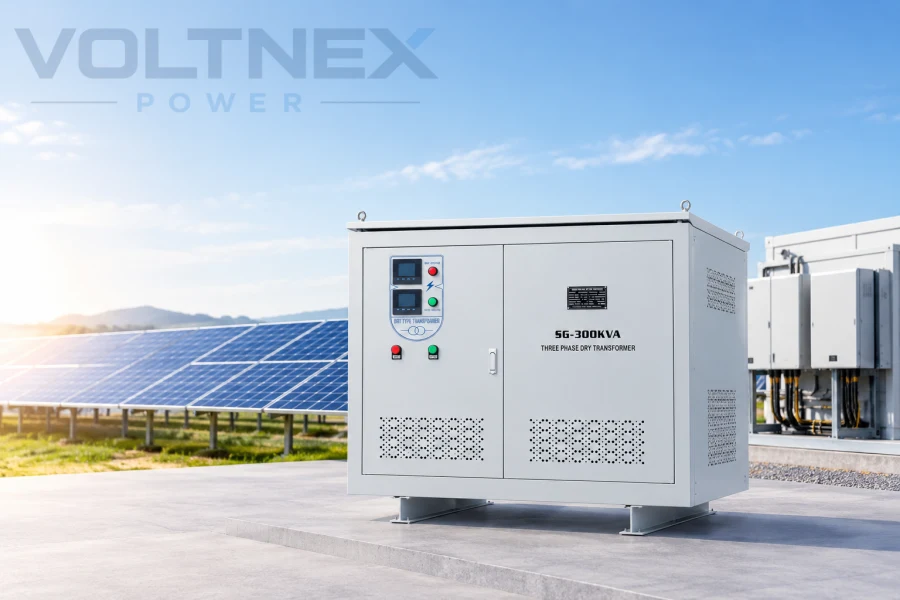
Solar photovoltaic systems require reliable electrical equipment to convert, isolate, distribute and transmit the electricity generated by PV modules. A PV transformer is an important part of this electrical infrastructure, connecting solar inverters with low-voltage distribution systems, medium-voltage collection networks or utility grids.
A solar PV transformer, also known as a solar transformer, photovoltaic transformer oder solar power transformer, is designed according to the electrical and operating requirements of a photovoltaic power generation system. For commercial, industrial and utility-scale solar projects, dry type PV transformers provide a practical solution where low maintenance, electrical safety, flexible installation and reliable operation are important.
Voltnex Power provides customized solar transformers for photovoltaic, renewable energy and solar + BESS applications, with support for custom voltage, capacity, frequency, winding configuration, impedance, insulation and enclosure requirements.
What Is a PV Transformer?
A PV transformer is typically installed between a solar inverter and the electrical distribution or grid connection system. Solar panels generate DC electricity, while the solar inverter converts the DC power into AC electricity. The transformer then changes the AC voltage to the level required by the facility, collection system or utility grid.
A typical photovoltaic power system can be represented as:
Solar Panels → DC Combiner → Solar Inverter → PV Transformer → AC Grid
Depending on the project architecture, the transformer may perform step-up or step-down voltage conversion, electrical isolation, voltage matching and power distribution.
For example, a solar inverter may generate AC power at 400V, 415V, 480V or 690V, while the solar collection system or utility connection requires a higher voltage. In this situation, a solar step up transformer can increase the inverter output voltage to the required medium-voltage level.
Typical applications may include:
400V → 10kV
480V → 13.8kV
690V → 20kV
The actual voltage ratio must always be selected according to the inverter specifications, electrical system and local grid requirements.
Dry Type PV Transformer for Solar Power Systems
A dry type PV transformer uses air instead of liquid insulation and cooling. Dry type construction is widely considered for commercial buildings, factories, rooftop solar systems, inverter rooms and renewable energy installations where fire safety, maintenance and installation flexibility are important.
A dry type solar transformer can be used in commercial and industrial PV systems, solar farms, microgrids, factory solar power systems and solar + battery energy storage projects.
Compared with liquid-filled transformer construction, dry type transformers can be convenient for indoor electrical rooms because they do not require oil containment or routine oil-related maintenance. They can also be configured with different enclosure and cooling arrangements for specific installation environments.
However, transformer selection should not be based on construction type alone. Capacity, voltage, temperature, altitude, cooling requirements, environmental conditions, harmonic content and project standards should all be evaluated before the final design.
Solar Transformer Sizing and Voltage Matching
The capacity of a solar transformer is normally specified in kVA, while solar inverter output is commonly specified in kW. For a three-phase system, apparent power can be calculated using:
kVA = √3 × Voltage × Current ÷ 1000
When selecting a solar power transformer, the inverter’s maximum continuous AC output should be considered together with power factor, ambient temperature, loading conditions, harmonics and possible future expansion.
For example, a PV system with approximately 500kW of AC inverter output may initially be considered with a transformer around the 500kVA range when operating close to unity power factor. The final rating, however, should be determined from the actual inverter output, load profile and project engineering requirements.
Both undersizing and unnecessary oversizing should be avoided. An undersized transformer may operate continuously at excessive loading and temperature, while an oversized transformer can increase project cost and may not provide an economic benefit.
For larger solar installations, transformer capacity can range from several hundred kVA to several MVA depending on the number of inverter blocks and the overall grid connection design.
PV Isolation Transformer and Inverter Compatibility
Some photovoltaic systems require electrical isolation between the inverter and downstream electrical network. In these applications, a PV isolation transformer can provide galvanic isolation while also performing voltage conversion.
Transformer impedance is another important parameter for solar applications. It affects voltage regulation, short-circuit current and the interaction between the transformer, inverter and protection system. The selected impedance should therefore be coordinated with the solar inverter, switchgear, protection equipment, grid requirements and short-circuit calculations.
Modern inverter-based PV systems can also introduce harmonic currents. The transformer design should take the inverter characteristics into account so that thermal performance and power quality requirements can be properly evaluated.
Depending on the project, the transformer may be configured with copper or aluminum windings, different insulation classes, customized vector groups, impedance values and cooling systems.
Solar Transformers for Commercial, Industrial and BESS Applications
Solar transformers are used across a wide range of photovoltaic installations. Commercial buildings and factories may use a solar transformer to connect rooftop PV systems with their internal distribution network. Industrial facilities can require customized transformers for higher power levels, specific voltage combinations and demanding operating environments.
In utility-scale solar farms, multiple inverter blocks may connect to a medium-voltage collection system through individual or centralized transformers. The transformer configuration can be designed according to the number of inverters, output voltage and grid connection architecture.
Solar PV is also increasingly integrated with Batterie-Energiespeichersysteme (BESS). A typical system may connect the PV inverter and battery PCS to a common AC bus before the power passes through the transformer to the grid. Depending on the project design, separate transformers or coordinated transformer configurations may be required.
Environmental conditions should also be considered. Installation sites may experience high temperature, humidity, dust, coastal salt exposure or high altitude. Indoor and outdoor installations may require different enclosure, cooling and protection configurations.
Custom Solar Transformer Manufacturer in China
Solar projects often have different inverter outputs, grid voltages, installation conditions and technical standards, so a standard transformer may not always meet the project requirements.
Voltnex Power ist ein Solar Transformer Manufacturer and China Solar Transformer Factory providing customized dry type transformers for photovoltaic and renewable energy applications. Our solar transformer solutions can be configured according to project requirements, including:
- Capacity from customized kVA ratings
- Primary and secondary voltage
- 50 Hz oder 60 Hz Frequenz
- Single-phase or three-phase configuration
- Copper or aluminum winding
- Insulation class
- Cooling method
- Vector group
- Transformer impedance
- Indoor or outdoor enclosure
- Installation configuration
As a China-based transformer manufacturer, Voltnex Power supports OEM/ODM manufacturing, custom transformer design, factory-direct supply and wholesale orders for solar developers, EPC contractors, distributors, system integrators and industrial users.
Our transformer solutions can support photovoltaic and renewable energy projects in North America, South America, Europe, Asia, Africa and other international markets.
Learn More:How to Select a Transformer for a Battery Energy Storage System
How to Select the Right Solar PV Transformer
Before requesting a quotation for a PV transformer, buyers should provide the solar inverter rated power, total PV capacity, primary and secondary voltage, frequency, required impedance, installation location, ambient temperature, cooling method, enclosure requirements and grid connection voltage.
Providing complete technical information allows the manufacturer to properly coordinate the transformer core, winding, insulation, impedance, cooling and protection configuration with the photovoltaic system.
The right solar PV transformer should not simply match the nominal kVA rating. It should be engineered as part of the complete PV electrical system, taking into account inverter characteristics, voltage conversion, grid connection, environmental conditions and long-term operating requirements.
Conclusion
A PV transformer is an essential component in many photovoltaic power systems, providing voltage conversion, isolation and electrical connection between solar inverters, distribution systems and utility grids. Dry type PV transformers are particularly suitable for many commercial, industrial and renewable energy applications where low maintenance and flexible installation are required.
Voltnex Power ist ein China solar transformer manufacturer and factory specializing in customized solar transformers, photovoltaic transformers, solar power transformers, solar step up transformers and PV isolation transformers. With OEM/ODM engineering, custom manufacturing and factory-direct wholesale supply, we can develop transformer solutions according to specific solar project requirements.
Need a custom PV transformer for your solar project? Contact Voltnex Power for technical specifications, engineering support and a project quotation.
Email: inquiry@voltnexpower.com