

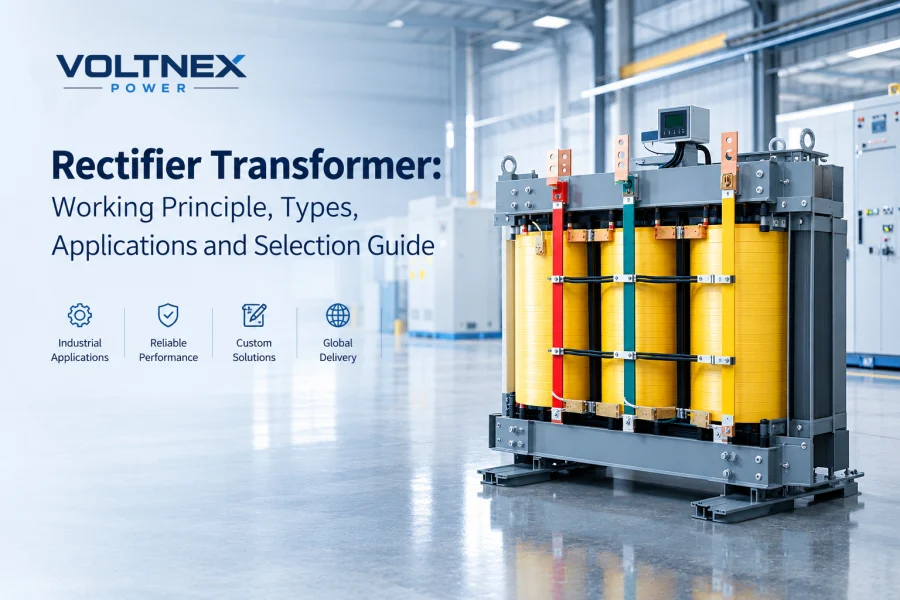
A rectifier transformer is a special-purpose transformer designed to supply power to a rectifier system that converts AC electrical power into DC power. Unlike a conventional power or distribution transformer, a rectifier transformer is designed around the requirements of the downstream rectifier, including DC voltage, DC current, pulse number, harmonic performance, phase shifting and load characteristics.
Rectifier transformers are widely used in industrial power conversion systems where a stable and high-current DC supply is required. Typical applications include electrolysis, electroplating, battery charging, DC drives, electric traction, metal processing, aluminum production and other industrial processes that depend on controlled DC power.
Depending on the application, a rectifier transformer can be designed as a three-phase rectifier transformer, dry-type rectifier transformer, oil-immersed rectifier transformer, 6-pulse rectifier transformer or 12-pulse rectifier transformer. The correct design depends on the required AC input, DC output and characteristics of the connected rectifier.
What Is a Rectifier Transformer?
A rectifier transformer is a transformer specifically designed to work together with a diode or thyristor rectifier. Its primary function is to provide the required AC voltage and current to the rectifier while electrically isolating and adapting the power supply to the DC conversion system.
The transformer does not itself convert AC into DC. Instead, it provides the appropriate AC supply for the rectifier, which performs the actual AC-to-DC conversion.
This distinction is important when selecting a transformer for a rectifier. The transformer and rectifier should be considered as one electrical system because the rectifier creates a nonlinear load and can introduce harmonic currents into the transformer and upstream power network.
Industrial rectifier transformers may therefore include special winding arrangements, phase-shifting connections, increased thermal capability and mechanical reinforcement to accommodate the electrical stresses produced by rectifier loads. Hitachi Energy, for example, describes rectifier transformers as being combined with diode or thyristor rectifiers for applications ranging from aluminum electrolysis to other industrial processes.
How Does a Rectifier Transformer Work?
The basic working principle is the same as a conventional transformer: electromagnetic induction.
AC power enters the primary winding and creates an alternating magnetic field in the transformer core. This magnetic field induces voltage in the secondary winding according to the transformer turns ratio.
The secondary winding then supplies AC power to the connected rectifier. The rectifier uses semiconductor devices such as diodes or thyristors to convert the AC waveform into a pulsating DC output.
The overall process can therefore be simplified as:
AC Power → Rectifier Transformer → AC Supply at Required Voltage → Rectifier → DC Power → Industrial Load
The transformer determines the voltage and current available to the rectifier, while the rectifier determines how that AC power is converted into DC power.
For industrial systems, the transformer must be designed for the actual rectifier configuration rather than treated simply as a standard step-down transformer.
Why Use a Rectifier Transformer?
A standard transformer may not always be suitable for a high-power rectifier system. Rectifier loads can produce harmonic currents and additional thermal and electromagnetic stresses. The transformer therefore needs to be designed with the rectifier’s operating conditions in mind.
A properly designed rectifier transformer can provide several important functions. It can match the utility voltage to the required rectifier input voltage, provide electrical isolation, support high-current operation, accommodate phase-shifting requirements and help control the electrical characteristics of the overall power conversion system.
For high-power applications, the transformer connection can also be selected to support multipulse rectifier systems that reduce certain low-order harmonics.
6-Pulse Rectifier Transformer
A 6-pulse rectifier transformer is used with a six-pulse rectifier, one of the most common configurations for three-phase AC-to-DC conversion.
Six-pulse rectifiers can use diode bridges or thyristor bridges depending on whether uncontrolled or controlled DC output is required. They are relatively simple and widely used in industrial drives and power conversion systems.
However, a conventional six-pulse rectifier produces characteristic low-order harmonic currents on the AC side. For applications with strict power-quality requirements, additional harmonic mitigation may therefore be required.
ABB identifies the six-pulse diode bridge as a common rectifier configuration, while also noting that its input current contains significant low-order harmonics compared with higher-pulse arrangements.
12-Pulse Rectifier Transformer
A 12-pulse rectifier transformer is designed to supply two six-pulse rectifier bridges with the appropriate phase relationship.
A typical 12-pulse transformer uses multiple secondary windings with a phase shift, commonly 30°, so that the harmonic currents produced by the two rectifier bridges partially cancel each other on the primary side.
This configuration can provide lower harmonic distortion than a conventional six-pulse system and can also support higher power levels through parallel or series converter arrangements.
The trade-off is that a 12-pulse system requires a more specialized transformer and additional electrical equipment, making it more complex and generally more expensive than a basic six-pulse system. ABB documentation describes a 12-pulse system as two six-pulse rectifiers supplied by a dedicated three-winding transformer with a 30° phase shift.
For demanding industrial power conversion systems, the additional transformer complexity can be justified when harmonic performance and power capacity are important design requirements.
Rectifier Transformer vs Conventional Transformer
The main difference between a rectifier transformer and a conventional transformer is not simply the voltage ratio. The rectifier transformer is specifically engineered for the electrical behavior of the rectifier load.
A conventional transformer may be designed primarily around voltage transformation, efficiency, insulation and thermal performance under relatively normal AC loading. A rectifier transformer must additionally consider harmonic currents, pulse number, phase-shifting requirements, short-circuit forces, DC components where applicable and the thermal effects of nonlinear loading.
This is why using a standard transformer without checking the rectifier requirements can result in an unsuitable design for demanding industrial applications.
Dry-Type Rectifier Transformer
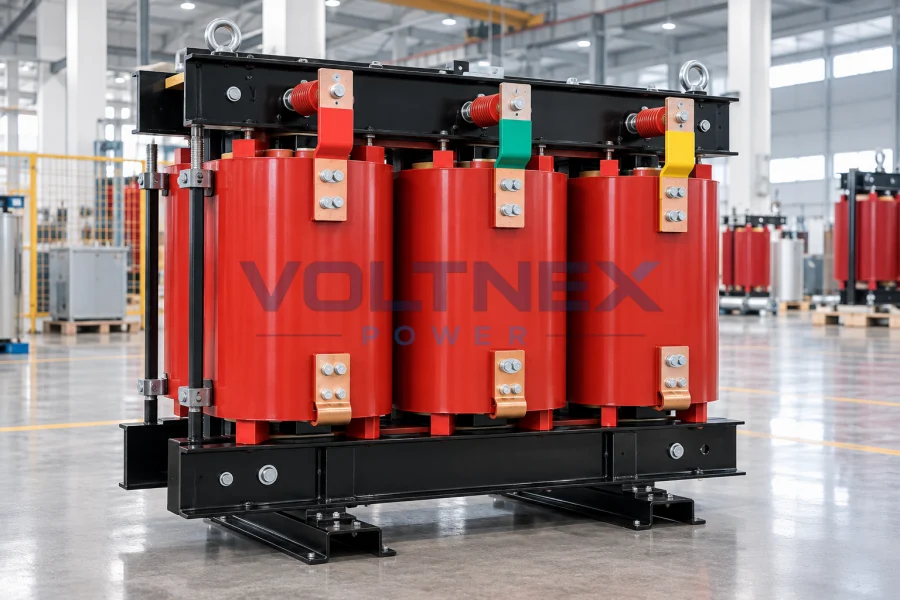
A dry-type rectifier transformer uses solid insulation rather than liquid insulating oil. It can be designed with air cooling or forced-air cooling depending on the capacity and application.
Dry-type rectifier transformers are attractive for indoor industrial installations, manufacturing plants, power electronics systems and facilities where liquid-free transformer construction is preferred.
Modern dry-type designs can also be engineered with multiple secondary windings and phase-shifting connections for multipulse rectifier systems. Dry-type rectifier transformers are currently used in demanding industrial power-conversion applications, including hydrogen electrolysis projects.
The selection between dry-type and oil-immersed construction depends on capacity, installation environment, cooling requirements, fire-safety considerations and project specifications.
Common Rectifier Transformer Applications
Rectifier transformers are used wherever an industrial process requires substantial and reliable DC power.
Electrolysis
Electrolysis systems require controlled DC power to drive electrochemical reactions. Rectifier transformer systems are used to provide the AC input required by the rectifier that supplies DC power to the electrolyzer.
This is particularly relevant to industrial hydrogen production and other electrochemical processes. Modern hydrogen projects use rectifier transformer and power-conversion systems to supply large electrolyzer loads.
Electroplating
Electroplating processes require controlled DC current to deposit metal onto a workpiece. A rectifier transformer can provide the electrical isolation, voltage transformation and high-current capability required by the plating rectifier.
Battery Charging
Large battery charging systems can require substantial DC power and controlled voltage. Rectifier transformers can be integrated with rectifier equipment to provide the required AC-to-DC power conversion.
DC Drives
DC motor drives require controlled DC power for industrial motors. Rectifier transformers can be used as part of the power supply system for large DC drive installations.
Metal Processing and Metallurgy
Metal processing applications often require high DC currents. Rectifier transformer systems can provide the high-current electrical supply needed for processes such as electrochemical treatment and other metallurgical operations.
Electric Traction
Certain traction and industrial transportation systems use rectifier transformers to convert AC utility power into DC power for traction equipment.
Large-scale rectifier systems are also used in demanding processes such as aluminum electrolysis, where specialized rectifier transformer and rectifier combinations are engineered for very high DC currents.
How to Choose a Rectifier Transformer
Selecting the correct rectifier transformer requires coordination between the transformer manufacturer, rectifier supplier and system designer.
The first consideration is the required input and output voltage. The transformer primary voltage must match the available AC supply, while the secondary voltage must be selected according to the rectifier and required DC output.
The required current and power rating are equally important. A rectifier transformer may operate continuously at high current, so the thermal design must account for the actual rectifier load rather than only the nominal AC rating.
The pulse number is another important factor. A 6-pulse system may be suitable for many standard applications, while 12-pulse or higher-pulse configurations can be considered when harmonic performance and power-conversion requirements demand them. Higher pulse numbers can reduce certain low-frequency harmonics, although they also require more complex transformer and rectifier arrangements.
Other important specifications include:
- Primary and secondary voltage
- DC voltage and DC current requirements
- Transformer kVA or MVA rating
- 6-pulse, 12-pulse or higher-pulse configuration
- Diode or thyristor rectifier
- Phase-shifting requirements
- Winding connection and vector group
- 50Hz or 60Hz frequency
- Dry-type or oil-immersed construction
- Cooling method
- Insulation class
- Short-circuit impedance
- Indoor or outdoor installation
- Enclosure and protection requirements
- Applicable IEC or other project standards
For high-current rectifier systems, the rectifier and transformer should be engineered as a coordinated package. Industrial rectifier systems can involve very high DC current and voltage ratings, making transformer sizing and cooling particularly important.
Custom Rectifier Transformer Solutions
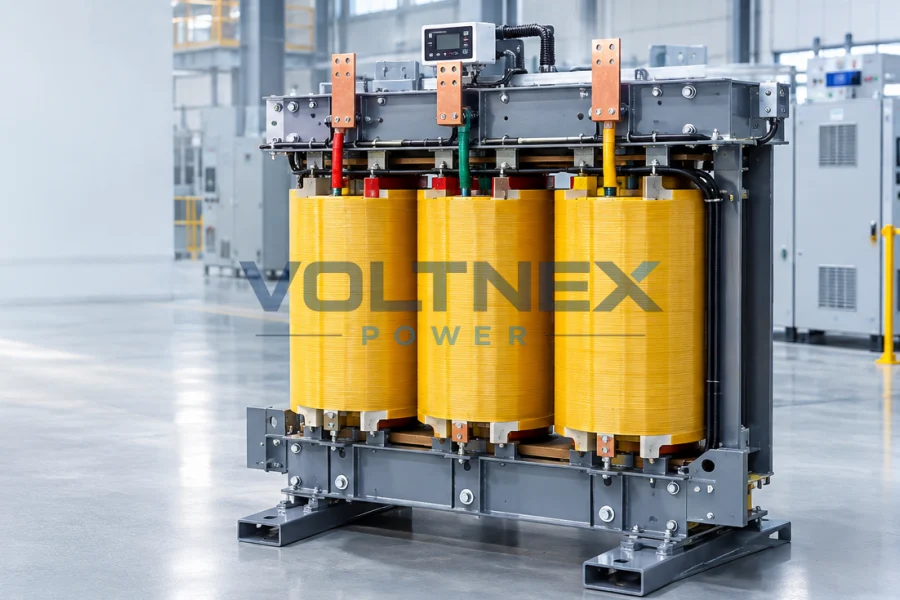
Voltnex Power provides rectifier transformer solutions for industrial power conversion and AC-to-DC applications. Our ZSG Series three-phase dry-type rectifier transformers can be engineered for different voltage, capacity, frequency, winding and rectifier configurations.
Depending on the project, a rectifier transformer can be customized for applications such as electroplating, electrolysis, battery charging, DC drives, electric traction, excitation and industrial power conversion.
Custom designs can include different primary and secondary voltages, multiple secondary windings, phase-shifting connections, insulation systems, cooling arrangements and enclosure configurations.
For OEM and industrial projects, the transformer should be specified according to the complete electrical system rather than selected only by kVA rating. Providing the rectifier type, required DC voltage, DC current, pulse number, input voltage, frequency and installation environment allows the transformer manufacturer to develop a more suitable design.
Conclusion
A rectifier transformer is a specialized transformer designed to work with a rectifier for industrial AC-to-DC power conversion. It provides the required AC voltage and current to the rectifier while supporting the electrical, thermal and mechanical requirements created by nonlinear rectifier loads.
The most common configurations include 6-pulse and 12-pulse rectifier transformers, while larger or more demanding systems can use higher-pulse arrangements. Rectifier transformers are available in dry-type and oil-immersed designs and can be engineered with different winding configurations, phase shifts and cooling systems.
From electrolysis and green hydrogen to electroplating, battery charging, DC drives, electric traction and metal processing, rectifier transformer technology plays an important role in modern industrial power systems.
For a custom rectifier transformer, the key specifications are not limited to voltage and kVA. The rectifier configuration, DC voltage, DC current, pulse number, phase-shifting requirements, cooling method, insulation system and installation environment should all be considered together to achieve a reliable and suitable power-conversion solution.