

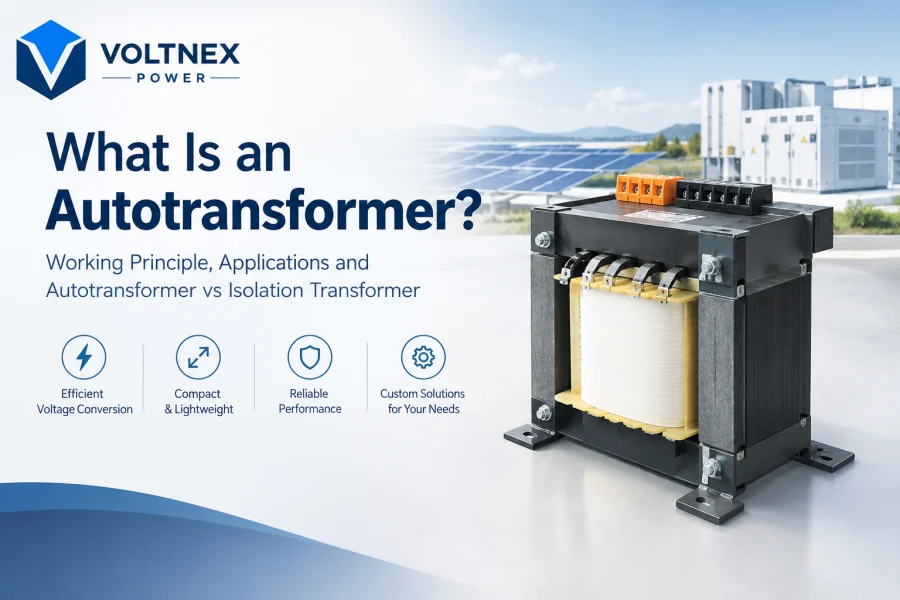
An autotransformer is a transformer that uses a single continuous winding with one or more taps to change AC voltage. Unlike a conventional two-winding transformer, part of the winding is shared by the input and output circuits.
This design makes an autotransformer smaller, lighter and highly efficient for certain voltage conversion applications. However, it does not provide electrical isolation between the input and output.
For industrial equipment, motors, automation systems and power distribution, understanding this difference is important when choosing between an autotransformer and an isolation transformer.
What Is an Autotransformer?
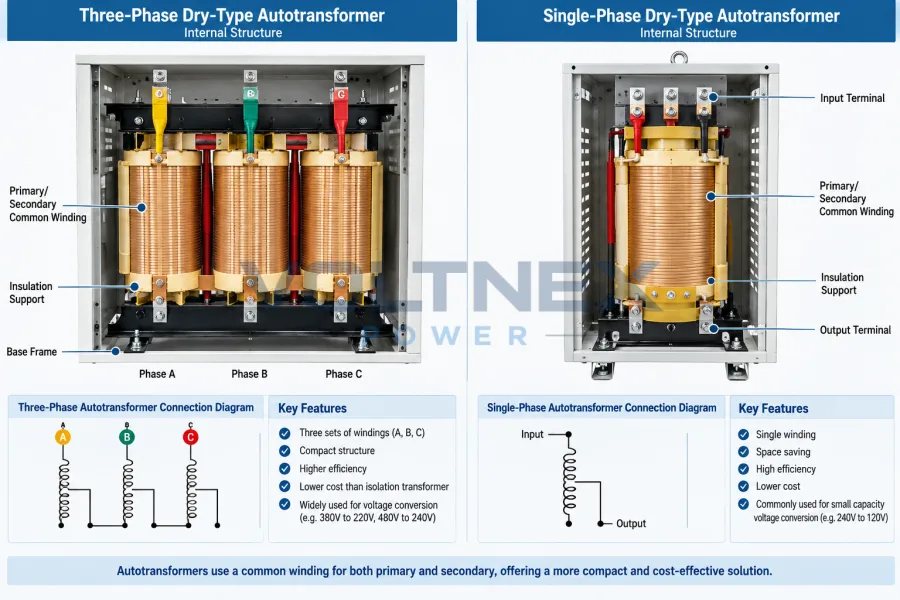
An autotransformer uses one continuous winding for both the primary and secondary circuits. Different connection points on the winding provide the required input and output voltage.
For example, a 480V-to-240V autotransformer uses a tapped winding to provide the lower voltage. Because part of the winding is shared, electrical energy can be transferred both magnetically and through the common winding.
The main advantages are:
- Compact construction
- Lower material consumption
- High efficiency
- Lower weight
- Suitable for voltage conversion with relatively close voltage ratios
The main limitation is that the input and output are electrically connected.
How Does an Autotransformer Work?
The operating principle is based on electromagnetic induction.
When AC voltage is applied to the winding, it produces a magnetic flux in the transformer core. The voltage developed across each section of the winding depends on the number of turns.
The basic voltage relationship can be expressed as:
V₁ / V₂ = N₁ / N₂
Where:
- V₁ = input voltage
- V₂ = output voltage
- N₁ = number of input-side turns
- N₂ = number of output-side turns
For example, if an autotransformer is designed for 480V to 240V, the output voltage is approximately half of the input voltage based on the winding ratio.
Because the primary and secondary share part of the winding, an autotransformer generally requires less copper and core material than an equivalent two-winding transformer.
Read More:How Do Low Voltage Transformers Work? Types, Voltages and Applications
Autotransformer vs Isolation Transformer
The most important difference is electrical isolation.
An autotransformer has a common electrical connection between the input and output. An isolation transformer uses separate primary and secondary windings, so the two circuits are electrically separated. Schneider Electric defines this distinction in the same way.
Which One Should You Use?
If the main requirement is efficient voltage conversion with a relatively small voltage difference, an autotransformer can be suitable.
If the application requires electrical isolation between the source and load, an isolation transformer is the appropriate transformer type.
For example:
480V → 240V motor supply
If the motor system only requires voltage conversion and does not require galvanic isolation, an autotransformer may be considered.
480V → 240V CNC control or sensitive industrial equipment
If the system requires electrical separation between the input and output circuits, a dry type isolation transformer is more suitable.
The choice should therefore be based on the actual voltage, load, grounding arrangement, protection requirements and whether electrical isolation is required.
Main Applications of Autotransformers
Autotransformers are commonly used in industrial and electrical systems where compact voltage conversion is important.
Motor Starting
Autotransformers can be used in reduced-voltage motor starting systems. The motor receives a lower starting voltage, helping reduce starting current compared with direct-on-line starting.
Industrial Voltage Conversion
Autotransformers can convert one voltage level to another, such as:
- 480V to 400V
- 480V to 240V
- 400V to 230V
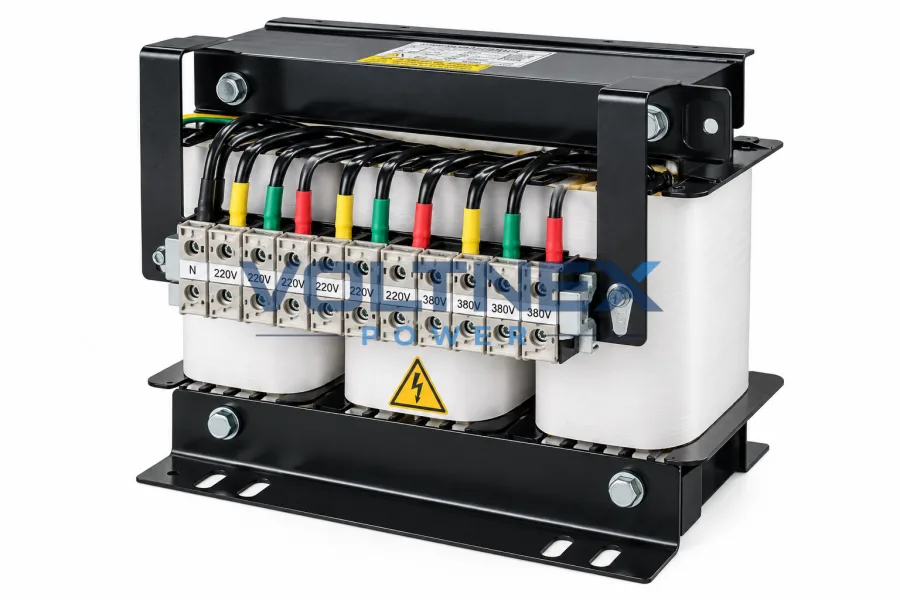
- 380V to 220V
The actual configuration depends on the equipment and electrical system.
Power Distribution
Autotransformers can be used in power systems where voltage levels are relatively close and electrical isolation is not required.
Industrial Automation
They can also be applied to certain automation, machinery and electrical equipment where compact and efficient voltage conversion is required.
Practical Example: 480V to 240V
Consider an industrial facility with a 480V three-phase power supply and equipment requiring 240V.
An autotransformer can be designed to convert 480V to 240V using a shared winding configuration.
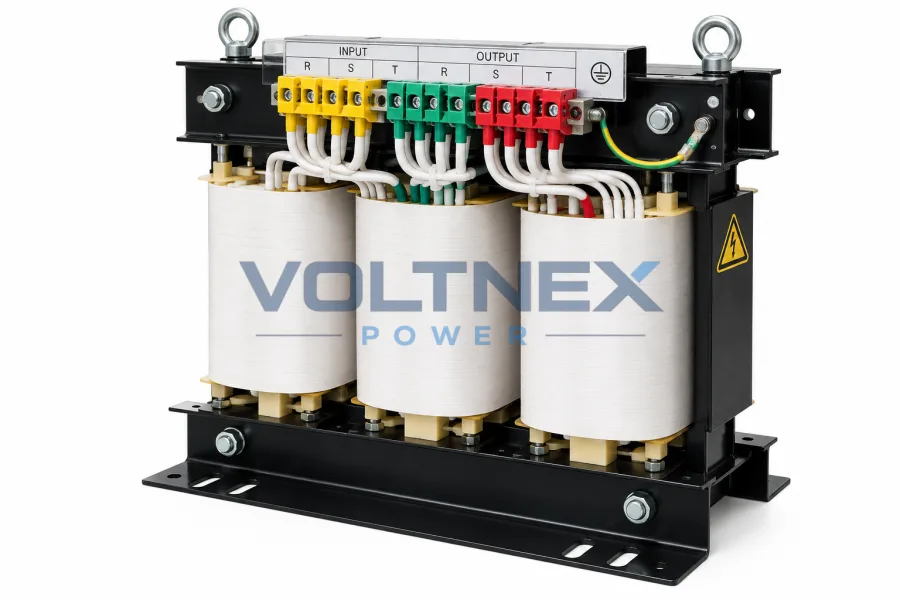
However, if the equipment requires electrical isolation from the 480V source, simply changing the voltage is not enough. A three-phase dry type isolation transformer with separate primary and secondary windings should be considered instead.
This is why transformer selection should not be based only on the input and output voltage.
Advantages and Limitations of Autotransformers
Advantages
- High efficiency
- Compact size
- Lower weight
- Reduced copper consumption
- Suitable for close voltage ratios
- Cost-effective for suitable applications
Limitations
- No galvanic isolation
- Input and output share an electrical connection
- Not suitable when complete electrical separation is required
- Application must consider grounding and protection requirements
The compact design and lower material requirements are major reasons autotransformers are widely used for suitable voltage-conversion applications.

How to Choose the Right Transformer
Before selecting an autotransformer, consider:
1. Input voltage: What is the available supply voltage?
2. Output voltage: What voltage does the equipment require?
3. Load capacity: Determine the required kVA based on the connected load and starting conditions.
4. Phase: Select single-phase or three-phase according to the electrical system.
5. Electrical isolation: If the input and output must be electrically separated, use an isolation transformer rather than an autotransformer.
6. Installation: Consider indoor or outdoor installation, enclosure, cooling, insulation class and environmental conditions.
Voltnex Power Autotransformer & Isolation Transformer Solutions
Voltnex Power provides custom dry type transformers for industrial voltage conversion, electrical isolation and power conditioning applications.
Depending on your system requirements, we can provide:
- Single-phase and three-phase transformers
- Autotransformers
- Dry type isolation transformers
- Step-up and step-down transformers
- Custom input and output voltages
- Custom kVA ratings
- OEM/ODM transformer solutions
If you are unsure whether your project requires an autotransformer or isolation transformer, send us your input voltage, required output voltage, kVA, phase and application.
Our engineering team can help you determine the appropriate transformer configuration for your equipment.
Need a Custom Transformer?
Contact Voltnex Power for a transformer quotation.
Send your electrical specifications and application requirements to us for a custom transformer solution, technical recommendation and factory quotation.
Request a Quote → Contact Voltnex Power