

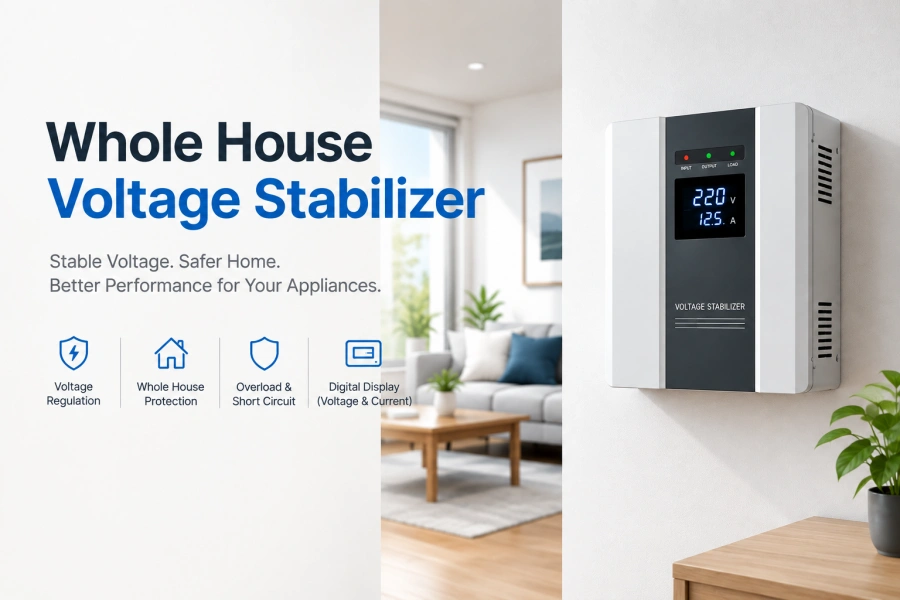
A whole house voltage stabilizer is designed to regulate unstable incoming electricity before it reaches the electrical circuits and appliances throughout a home. It helps correct voltage fluctuations, including low voltage and overvoltage, providing a more stable power supply for residential equipment.
Unlike a basic surge protector that mainly protects against short-duration voltage spikes, an automatic voltage stabilizer continuously monitors the incoming AC voltage and adjusts the output when the supply moves outside the desired range.
For homes located in areas with unstable utility power, frequent voltage drops or voltage surges, a whole-house automatic voltage stabilizer can provide centralized voltage regulation for appliances and electrical equipment.
What Is a Whole House Voltage Stabilizer?
A whole house voltage stabilizer, also called a home voltage stabilizer, automatic voltage regulator (AVR), or automatic voltage stabilizer (AVS), is installed between the utility power supply and the home’s electrical distribution system.
It continuously detects changes in the input voltage and automatically adjusts the transformer output to maintain a more stable voltage.
For example, when the utility voltage drops significantly, the stabilizer can increase the output voltage toward the required level. When the input voltage becomes too high, it reduces the output accordingly.
This makes it different from a simple surge protector or voltage converter, which may provide protection or voltage conversion without continuous automatic regulation.
How Does a Whole House Voltage Stabilizer Work?
A whole-house voltage stabilizer generally consists of a voltage sensing circuit, control system, transformer and protection components.
The operating process is simple:
- The stabilizer monitors the incoming AC voltage.
- The control system detects voltage fluctuations.
- Relay or servo control adjusts the transformer output.
- The stabilizer provides regulated voltage to the home’s electrical system.
- Protection functions respond to overload, short circuit and abnormal voltage conditions.
Relay vs. Servo Voltage Stabilizer
Relay voltage stabilizers regulate voltage in discrete steps by switching transformer windings. They are suitable for standard residential loads where moderate regulation accuracy is sufficient.
Servo voltage stabilizers use a motor-driven mechanism to continuously adjust the transformer winding position. They provide smoother and more precise voltage regulation and are suitable for sensitive electronic equipment.
For general residential applications, relay control can provide a practical and economical solution. For homes with sensitive electronics or demanding voltage stability requirements, servo regulation can be considered.
Why Use a Whole House Voltage Stabilizer?
Unstable voltage can affect refrigerators, air conditioners, televisions, computers, networking equipment and other household electrical devices.
A whole-house stabilizer provides centralized voltage regulation rather than requiring separate voltage protection devices for individual appliances.
Key benefits include:
- Stable household voltage for connected appliances
- Protection against voltage fluctuations
- Centralized voltage regulation at the main electrical supply
- Overvoltage and undervoltage protection
- Overload and short-circuit protection
- Improved protection for sensitive electronics
- Reduced need for multiple point-of-use stabilizers
A digital voltage and current display can also provide useful information about the incoming voltage and household load, helping users identify abnormal operating conditions.
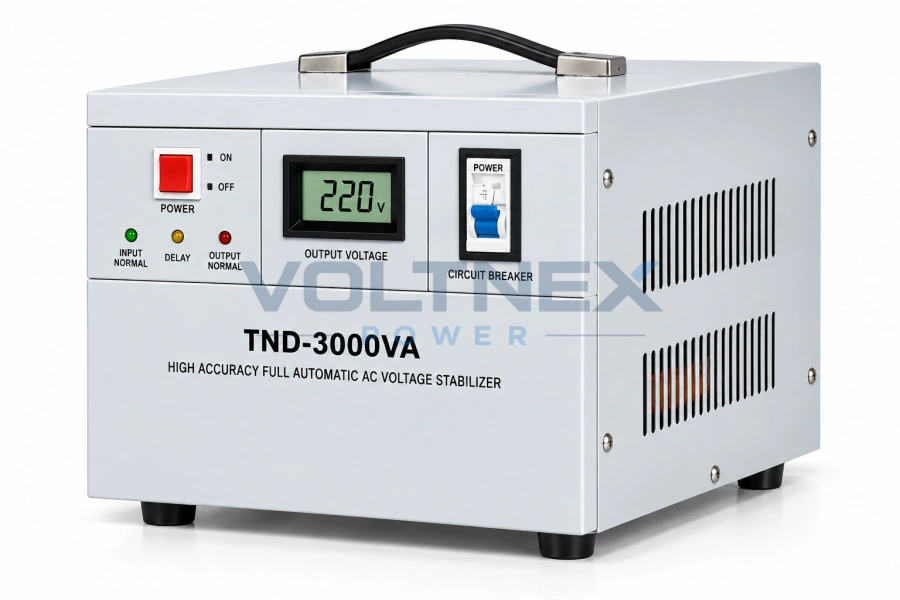
Whole House Voltage Stabilizer Sizing
Correct sizing is one of the most important factors when selecting a whole house voltage stabilizer.
First, calculate the approximate total load that the stabilizer needs to support. Consider both the normal running power and the starting current of motor-driven appliances.
Common residential loads include:
It is recommended to leave additional capacity above the calculated operating load, especially when the home contains air conditioners, pumps, refrigerators or other inductive loads.
For example, a 15 kVA whole house voltage stabilizer may be appropriate for a residential electrical system when the calculated demand and starting requirements remain within the stabilizer’s rated capacity.
The actual size should always be selected according to the home’s voltage, phase, total load and local electrical requirements.
Typical Specifications
Whole house voltage stabilizers can be customized for different residential power systems.
Typical configurations may include:
- Capacity: 1 kVA–15 kVA and customized ratings
- Phase: Single phase
- Input Voltage: AC 90–260 V or customized
- Output Voltage: 220 V or region-specific voltage
- Regulation Accuracy: ±3%, ±8% or customized
- Frequency: 50 Hz / 60 Hz
- Control: Relay or servo
- Cooling: Natural air cooling
- Protection: Overvoltage, undervoltage, overload and short circuit
- Display: Digital voltage and current display
- Installation: Wall-mounted or other customized configurations
For North American applications, the voltage configuration can also be customized according to the local electrical system, including 120 V and other required supply configurations.
Whole House Voltage Stabilizer Applications
A residential automatic voltage stabilizer can be used for a wide range of household electrical equipment.
Home Appliances
Suitable for refrigerators, washing machines, microwave ovens, televisions and other common household appliances.
Air Conditioning
Air conditioners and other motor-driven equipment can experience high starting current and may require additional capacity when selecting a stabilizer.
Home Office
Computers, routers, monitors, printers, network equipment and other electronic devices can benefit from a more stable power supply.
Smart Home Systems
Security cameras, smart home controllers, lighting systems and communication equipment can also be protected by centralized voltage regulation.
Whole House Voltage Stabilizer vs. Surge Protector
A voltage stabilizer and a surge protector perform different functions.
A surge protector primarily limits short-duration voltage spikes, while a voltage stabilizer continuously regulates voltage fluctuations.
If a home experiences both unstable voltage and occasional surges, a properly designed electrical protection system may use voltage regulation together with suitable surge protection.
How to Choose a Whole House Voltage Stabilizer
Before purchasing a whole house voltage stabilizer, consider these factors:
1. Input voltage range
Choose a stabilizer capable of handling the actual voltage fluctuations at the property.
2. Output voltage
Confirm that the regulated output matches the home’s electrical system and appliances.
3. Capacity
Calculate the total connected load and allow additional capacity for motor starting currents.
4. Regulation accuracy
Relay control is suitable for many standard residential applications, while servo control provides tighter voltage regulation.
5. Protection functions
Look for overload, short-circuit, overvoltage and undervoltage protection.
6. Installation
Select a suitable wall-mounted or enclosure configuration according to the available electrical installation space.
Read More:What Is an Automatic Voltage Regulator (AVR)? Working Principle, Benefits and Applications
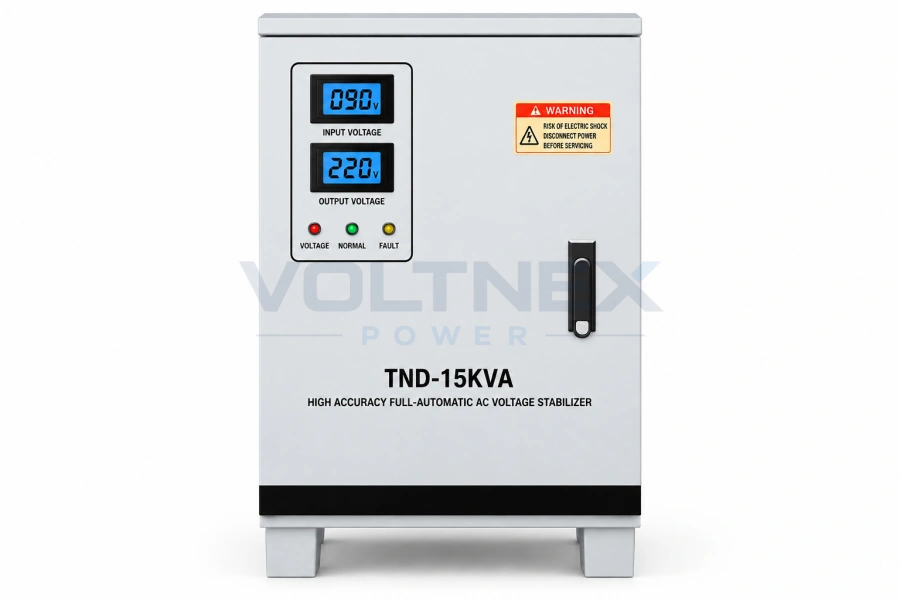
Voltnex Power Whole House Voltage Stabilizer
Voltnex Power manufactures automatic voltage stabilizers and AC voltage regulators for residential and commercial power applications.
Our single-phase stabilizers can be configured for different input and output voltages, capacities, regulation accuracy and control methods. Relay and servo options are available for different voltage regulation requirements.
With customizable electrical specifications, protection functions and enclosure configurations, Voltnex Power provides factory-direct, OEM and wholesale voltage stabilizer solutions for customers in North America, South America, Europe, Asia, Africa and other international markets.
Frequently Asked Questions
What is a whole house voltage stabilizer?
A whole house voltage stabilizer is an automatic voltage regulation device installed at the main power supply to stabilize electricity supplied to multiple household circuits and appliances.
Is a whole house voltage stabilizer the same as a surge protector?
No. A surge protector mainly limits short-duration voltage spikes, while a voltage stabilizer continuously regulates fluctuations in the incoming AC voltage.
What size whole house voltage stabilizer do I need?
The required size depends on the home’s total electrical load, supply voltage, phase and the starting current of motor-driven appliances. Additional capacity should be considered for inductive loads.
Can a voltage stabilizer protect the whole house?
Yes. When correctly sized and properly installed at the main electrical supply, a whole-house stabilizer can regulate voltage for the connected residential electrical system.
Is a servo stabilizer better than a relay stabilizer?
Servo stabilizers generally provide higher regulation precision, while relay stabilizers offer a simpler and economical solution for standard residential loads. The best choice depends on the required voltage accuracy and application.
Conclusion
A whole house voltage stabilizer provides centralized automatic voltage regulation for residential electrical systems. It can help maintain a more stable power supply when utility voltage fluctuates and provide additional protection for household appliances and sensitive electronics.
When selecting a stabilizer, pay particular attention to the input voltage range, output voltage, kVA capacity, regulation accuracy, control method and protection functions.
For custom residential voltage stabilization requirements, contact Voltnex Power for a suitable automatic voltage stabilizer / AC voltage regulator solution.