

A step down power transformer is an electrical transformer designed to reduce a higher input voltage to a lower output voltage required by industrial equipment, machinery, electrical systems, and power distribution networks.
In modern industrial facilities, the available utility voltage does not always match the voltage required by production equipment. A step down transformer provides a reliable way to convert the primary voltage to a suitable secondary voltage while maintaining the required power capacity, insulation level, phase configuration, and electrical safety.
For example, a transformer may convert 480V to 240V, 480V to 208V, 600V to 480V, 400V to 230V, or medium-voltage distribution such as 10kV/10.5kV to 400V/415V, depending on the application.
Voltnex Power manufactures custom dry type step down power transformers and isolation transformers for industrial automation, CNC machinery, manufacturing plants, data centers, renewable energy systems, and commercial power applications, with custom voltage ratios and capacities available.
What Is a Step Down Power Transformer?
A step down power transformer reduces the voltage on its primary winding to a lower voltage on its secondary winding.
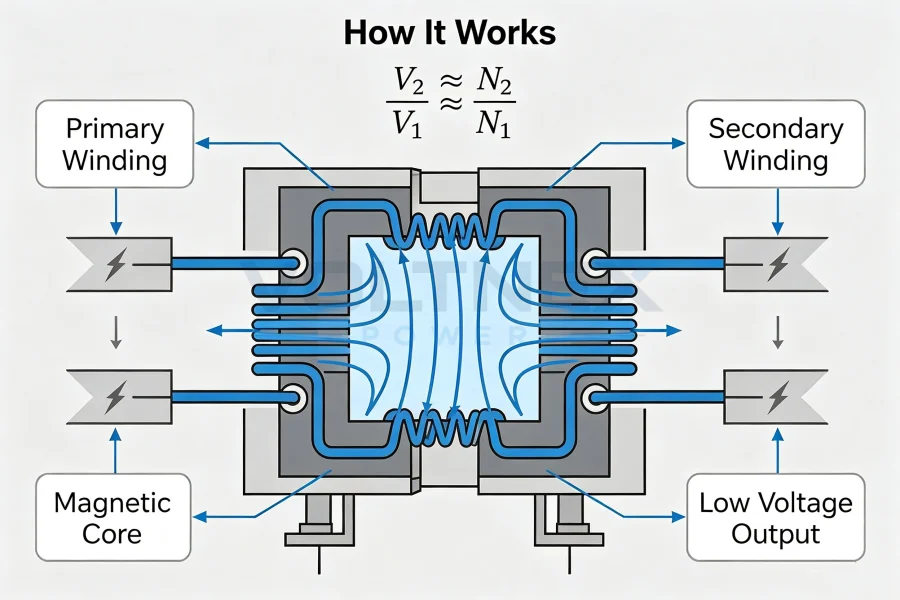
The transformer operates according to electromagnetic induction. When AC voltage is applied to the primary winding, it creates a changing magnetic flux in the transformer core. This magnetic field induces voltage in the secondary winding.
The voltage relationship is primarily determined by the turns ratio:
V₂ / V₁ ≈ N₂ / N₁
Where:
- V₁ = primary input voltage
- V₂ = secondary output voltage
- N₁ = primary winding turns
- N₂ = secondary winding turns
When the secondary winding has fewer turns than the primary winding, the transformer reduces the voltage, creating a step-down voltage transformer.
The transformer does not create additional electrical power. When voltage is reduced, the available current capacity increases correspondingly, subject to transformer efficiency and rated kVA.
How Does a Step Down Transformer Work?
A typical step down power transformer consists of several key components:
- Magnetic core
- Primary winding
- Secondary winding
- Insulation system
- Transformer enclosure
- Cooling system
- Terminals and connection system
- Optional tap changer
- Temperature monitoring and protection devices
The incoming voltage is connected to the primary winding. The magnetic core transfers energy magnetically to the secondary winding, where the required lower voltage is obtained.
For industrial applications, transformer design is not simply about changing voltage. Engineers must also consider:
- Rated power in kVA
- Primary and secondary voltage
- Single-phase or three-phase operation
- 50 Hz or 60 Hz frequency
- Load characteristics
- Motor starting current
- Voltage regulation
- Short-circuit impedance
- Insulation class
- Cooling requirements
- Enclosure protection
- Installation environment
- Applicable electrical standards
This is why selecting a transformer based only on the input and output voltage can result in an incorrectly sized system.
Common Step Down Transformer Voltage Ratios
One of the most common requirements is converting industrial utility voltage to a lower voltage suitable for machinery or electrical equipment.
Typical configurations include:
The actual voltage ratio should always be selected according to the utility supply, equipment requirements, load characteristics, and applicable local standards.
Voltnex Power provides customized primary and secondary voltage configurations ranging from low-voltage equipment applications to high-capacity industrial transformer projects.
Step Down Power Transformer vs Step Up Transformer
The fundamental difference is the direction of voltage conversion.
Step Down Transformer
A step down transformer converts higher voltage to lower voltage.
For example:
480V → 240V
or
10.5kV → 0.4kV
It is commonly used for industrial power distribution and equipment power supplies.
Step Up Transformer
A step up transformer increases voltage.
For example:
208V → 480V
Step-up transformers are commonly used when equipment or power transmission systems require a higher voltage than the available source.
Some transformer designs can be engineered with different primary and secondary voltage configurations according to the project requirements.

Dry Type Step Down Power Transformer
A dry type step down transformer uses air and solid insulation rather than transformer oil as the primary insulating medium.
Dry-type construction is widely used in:
- Industrial plants
- Manufacturing facilities
- CNC workshops
- Automation systems
- Data centers
- Hospitals
- Laboratories
- Commercial buildings
- Renewable energy installations
- Electrical control rooms
Dry-type transformers are particularly attractive for installations where reduced maintenance, fire safety, environmental considerations, and indoor installation are important.
Industrial dry-type transformers are available in different construction methods, including VPI and cast-resin designs, depending on the required insulation system and environmental conditions. Medium-voltage dry-type transformers are also available for higher-power industrial distribution applications.
Step Down Isolation Transformer vs Standard Step Down Transformer
Not every step down transformer is an isolation transformer.
A standard voltage-reduction transformer is primarily selected to obtain the required secondary voltage.
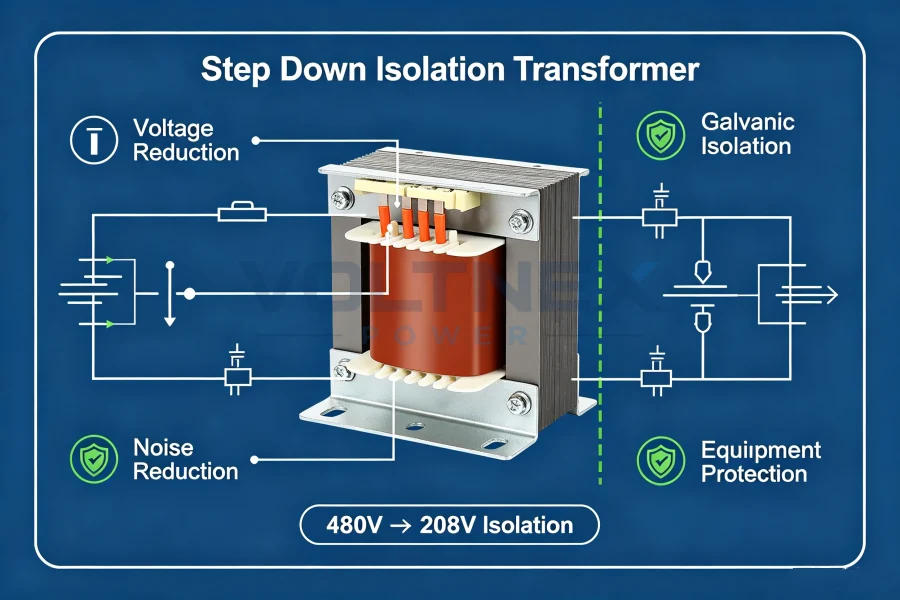
A step down isolation transformer, however, combines voltage conversion with electrical isolation between the primary and secondary circuits.
For example:
480V → 208V isolation transformer
can provide both:
- Voltage reduction
- Galvanic isolation between input and output circuits
This makes isolation transformers particularly useful for sensitive industrial equipment, CNC machines, automation systems, control equipment, laboratory equipment, and other applications where electrical isolation and power quality are important.
Voltnex Power’s dry-type isolation transformer range covers customized input and output voltage configurations and capacities from small industrial applications through high-capacity transformer systems.
Three Phase Step Down Power Transformer
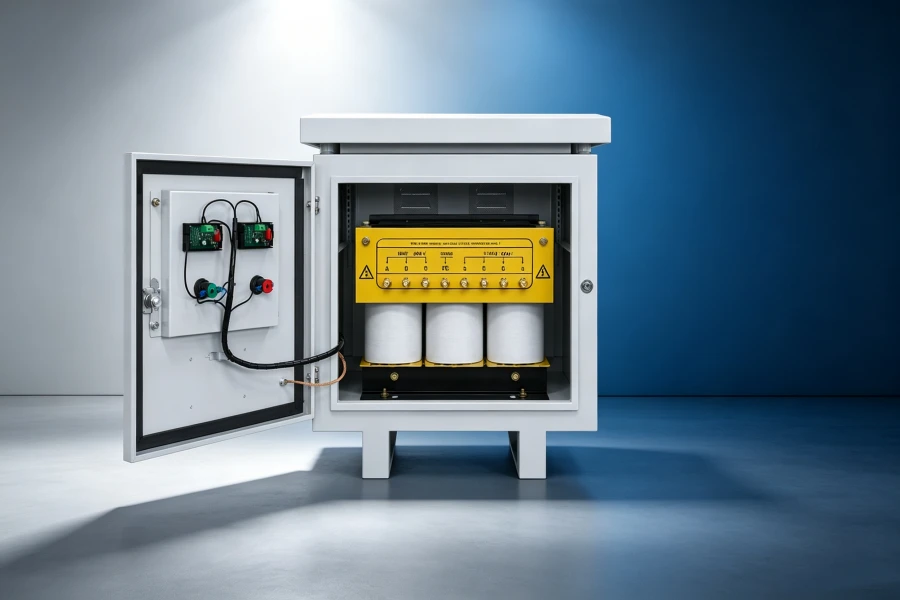
A three phase step down transformer is commonly used for industrial power distribution because most factories and heavy machinery operate on three-phase electrical systems.
Typical applications include:
- CNC machines
- Motors
- VFD systems
- Industrial automation
- Production lines
- Compressors
- Pumps
- Manufacturing equipment
- Factory distribution systems
- Data center electrical systems
Three-phase transformer configurations can be customized according to the required voltage, frequency, vector group, impedance, winding material, cooling method, and enclosure.
For example, a high-capacity industrial transformer may be designed for:
10.5kV primary → 400V secondary
with a three-phase configuration for factory power distribution.
Industrial Applications of Step Down Power Transformers
1. Manufacturing Plants
Manufacturing facilities often operate with different voltage levels between the incoming utility supply and production equipment.
A step down transformer can provide the appropriate voltage for motors, machinery, production lines, and auxiliary systems.
2. CNC Machines
Imported CNC equipment may require a different voltage from the local factory supply.
A transformer can convert the facility’s available voltage to the voltage required by the machine.
Examples include:
400V → 230V
480V → 240V
480V → 208V
3. Industrial Automation
PLC systems, control panels, sensors, contactors, motors, and automation equipment may require different voltage levels.
A properly designed transformer helps create the required electrical supply for industrial control and auxiliary power systems.
4. Data Centers
Data centers require reliable and carefully engineered electrical distribution.
Step down transformers can be integrated into power distribution systems to provide appropriate voltage levels for downstream equipment.
5. Renewable Energy Systems
Solar, battery storage, and other renewable energy projects often require transformers to match voltage levels between generation equipment and the facility or distribution network.
6. Commercial Buildings
Commercial facilities may require voltage conversion for lighting, HVAC, building equipment, elevators, and other electrical loads.
7. Medical and Laboratory Equipment
Where electrical isolation and power quality are important, a step down isolation transformer can provide both voltage conversion and separation between the source and load circuits.
How to Select the Right Step Down Power Transformer
Selecting the correct transformer requires more than choosing the desired voltage ratio.
1. Determine the Transformer kVA Rating
Transformer capacity is normally specified in kVA, rather than simply kW.
The transformer should be selected according to:
- Connected load
- Maximum demand
- Motor starting current
- Inrush current
- Future expansion
- Continuous operating conditions
For industrial applications, additional capacity may be required to prevent excessive heating and voltage drop.
Voltnex Power provides dry-type transformer solutions from approximately 1 kVA to 3500 kVA+, with high-capacity designs available for customized industrial applications.
2. Confirm Primary Voltage
The primary voltage must match the actual available power supply.
Common industrial voltages include:
208V, 220V, 230V, 240V, 380V, 400V, 415V, 440V, 480V, 575V and 600V.
Medium-voltage applications may use primary voltages such as 6kV, 10kV, 10.5kV or 11kV.
3. Select the Secondary Voltage
The secondary voltage must match the equipment or downstream distribution system.
Common secondary voltages include:
110V, 120V, 208V, 220V, 230V, 240V, 380V, 400V and 415V.
Custom voltage ratios can also be engineered.
4. Choose Single Phase or Three Phase
Single-phase transformers are commonly used for smaller loads, control circuits and specialized equipment.
Three-phase transformers are preferred for industrial distribution, motors, CNC equipment and high-power production systems.
5. Select Copper or Aluminum Windings
Copper windings provide high electrical conductivity and are commonly selected for demanding industrial applications.
Aluminum windings can provide a more economical alternative when project requirements and installation conditions permit.
6. Consider the Enclosure and IP Rating
Indoor installations may use ventilated enclosures such as IP20 or similar configurations.
Outdoor or dusty industrial environments may require higher protection such as IP23, IP54 or customized enclosure designs.
The enclosure should be selected according to dust, moisture, ventilation, ambient temperature and installation conditions.
What Is the Difference Between a Step Down Transformer and a Voltage Stabilizer?
A step down transformer and an automatic voltage regulator (AVR) solve different electrical problems.
A step down transformer primarily changes the voltage ratio.
For example:
480V → 240V
An AVR or automatic voltage stabilizer is designed to automatically correct fluctuations in the input voltage and maintain a more stable output voltage.
Therefore:
Transformer = voltage conversion
AVR = voltage regulation
For applications where both voltage conversion and voltage stabilization are required, a customized transformer and AVR solution—or an integrated stabilizer/isolation transformer system—may be considered.
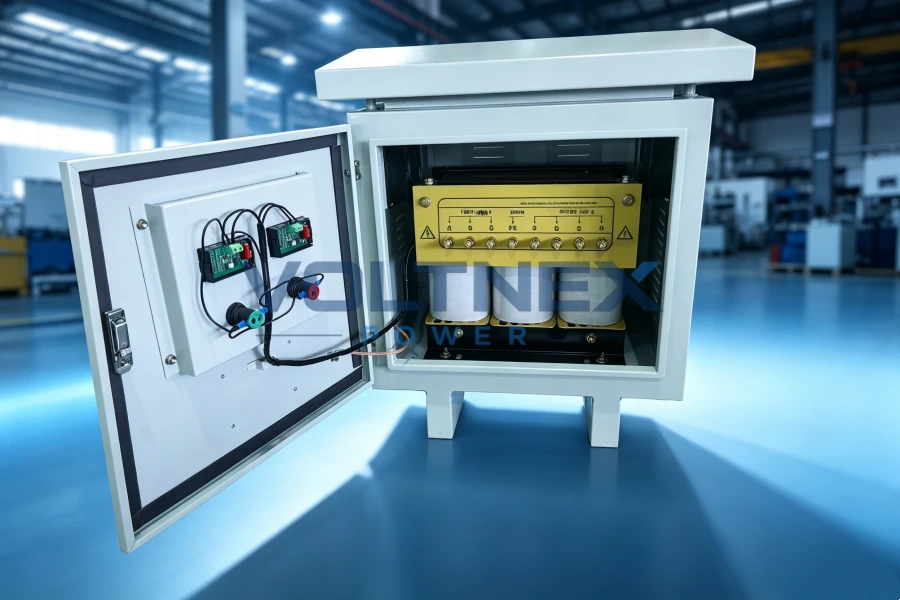
Step Down Transformer Manufacturer for Custom Industrial Applications
Industrial projects rarely have exactly the same voltage, capacity, installation environment, and load characteristics.
A professional step down transformer manufacturer should therefore be able to customize the transformer according to the actual electrical system.
Important customization options include:
- Primary voltage
- Secondary voltage
- kVA capacity
- Single-phase / three-phase
- 50Hz / 60Hz
- Copper / aluminum winding
- Insulation class
- Vector group
- Impedance
- Tap range
- Cooling method
- IP enclosure rating
- Indoor / outdoor construction
- Temperature monitoring
- Forced-air cooling
- Custom terminals
- Special mechanical dimensions
Voltnex Power manufactures customized dry-type isolation and industrial transformers for global OEM, engineering, wholesale, and industrial power applications. Its published transformer range includes custom voltage configurations such as 480V→208V, 480V→240V, 600V→480V, 400V→230V and 380V→220V, as well as higher-capacity industrial designs.
Step Down Power Transformer Testing and Quality Control
For industrial transformer projects, electrical testing is an important part of quality assurance.
Depending on the transformer design and applicable standards, testing may include:
- Winding resistance test
- Insulation resistance test
- Turns ratio test
- No-load loss test
- Load loss test
- Dielectric withstand test
- Short-circuit impedance test
- Temperature-rise evaluation
- Functional inspection
- Visual and mechanical inspection
For medium-voltage and industrial dry-type transformers, applicable IEC, IEEE, ANSI, UL, NEMA or regional requirements should be confirmed during the engineering stage.
Why Custom Transformer Engineering Matters
A standard catalog transformer may be sufficient for simple voltage conversion, but industrial projects often require a more precise design.
For example, a customer may require:
1000 kVA
10.5kV / 0.4kV
Three Phase
Copper Windings
50Hz
Y/Yn-0
AN/AF Cooling
IP54 Outdoor Enclosure
Such a transformer requires coordination between electrical design, thermal performance, enclosure dimensions, cooling, protection, transportation, installation, and local project requirements.
This is why working directly with an experienced step down power transformer manufacturer and factory can be advantageous for OEM projects, industrial plants, EPC contractors, distributors, and international power equipment buyers.
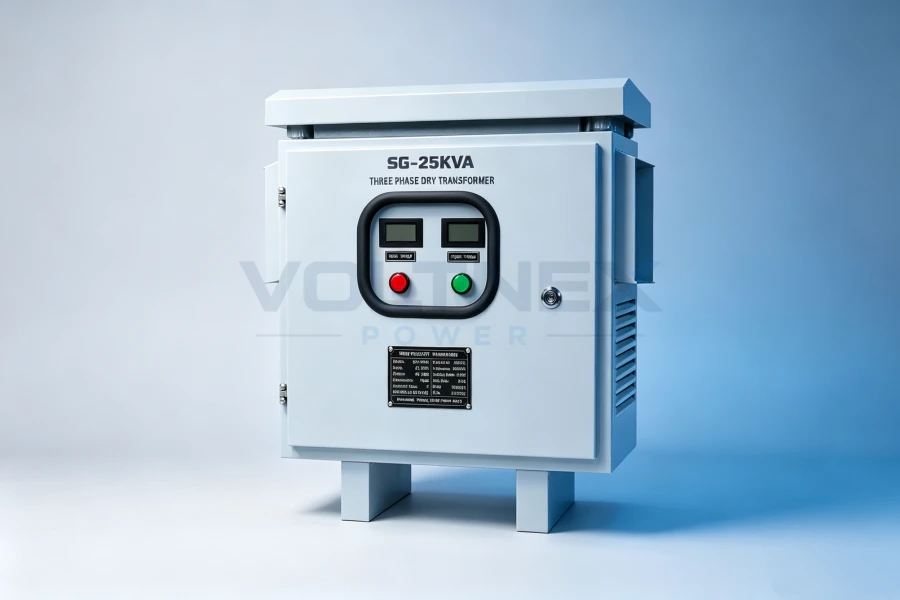
Step Down Power Transformer FAQs
What is a step down power transformer?
A step down power transformer is a transformer that reduces a higher primary voltage to a lower secondary voltage for industrial equipment, electrical distribution, machinery, or other loads.
What is an example of a step down transformer?
A transformer converting 480V to 240V or 10.5kV to 400V is a typical example of a step down transformer.
What is the difference between a step down transformer and an isolation transformer?
A step down transformer reduces voltage. An isolation transformer separates the primary and secondary circuits electrically. A transformer can perform both functions when specifically designed as a step down isolation transformer.
Can a dry type transformer be used as a step down transformer?
Yes. Dry-type transformers are widely designed for step-down applications, including industrial machinery, commercial buildings, automation systems, and power distribution.
Can you manufacture a custom step down transformer?
Yes. Primary voltage, secondary voltage, kVA rating, phase, frequency, winding material, cooling, insulation, enclosure, impedance and other specifications can be customized according to the project requirements.
What voltage can a step down transformer convert?
The available voltage ratio depends on the transformer design. Common industrial configurations include 480V to 240V, 480V to 208V, 600V to 480V, 400V to 230V, 415V to 230V and medium-voltage to low-voltage distribution.
How do I size a step down transformer?
First determine the required secondary voltage and total load. Then calculate the required kVA while considering motor starting current, inrush current, continuous loading and future expansion. The final transformer rating should be confirmed by an electrical engineer.

Conclusion
A step down power transformer is a fundamental component of industrial electrical systems, providing reliable voltage conversion between utility power, plant distribution networks, machinery, and sensitive electrical equipment.
For industrial applications, the best transformer is not necessarily the largest or most economical unit. The correct design should match the voltage ratio, kVA capacity, phase, frequency, load characteristics, insulation, cooling, enclosure, impedance and installation environment.
For projects requiring voltage conversion together with electrical isolation, a dry type step down isolation transformer can provide an effective solution for CNC machines, industrial automation, manufacturing plants, data centers, laboratories, renewable energy systems and other critical loads.
Voltnex Power provides customized dry type step down transformers, isolation transformers and industrial power transformers for international OEM, wholesale and project applications, with customized voltage configurations and high-capacity transformer engineering available.
Need a custom step down power transformer? Provide your required primary voltage, secondary voltage, kVA rating, phase, frequency and application, and the transformer design can be engineered around your actual power system requirements.