


























Residential solar power systems are becoming increasingly common as homeowners use photovoltaic panels to generate electricity for lighting, appliances, heating, air conditioning, electric vehicles and other household loads. While many small rooftop PV systems can connect directly to an existing residential electrical system, some applications require a transformer for voltage conversion, electrical isolation or compatibility between the solar inverter and the local power network.
A residential solar transformer, also called a home solar transformer or residential PV transformer, is designed to match the electrical requirements of a household photovoltaic system. Depending on the system architecture, it can be used between the solar inverter, home distribution panel, battery energy storage system and utility grid.
Voltnex Power provides customized dry type transformers for residential and small commercial solar applications, supporting different capacities, voltages, frequencies, winding configurations and installation requirements.
What Is a Residential Solar Transformer?
A residential solar transformer is an electrical transformer used in a home photovoltaic power system when voltage conversion or electrical isolation is required. Solar panels generate DC electricity, which is converted into AC electricity by the solar inverter. The inverter output must then match the voltage and electrical configuration of the home’s distribution system or utility grid.
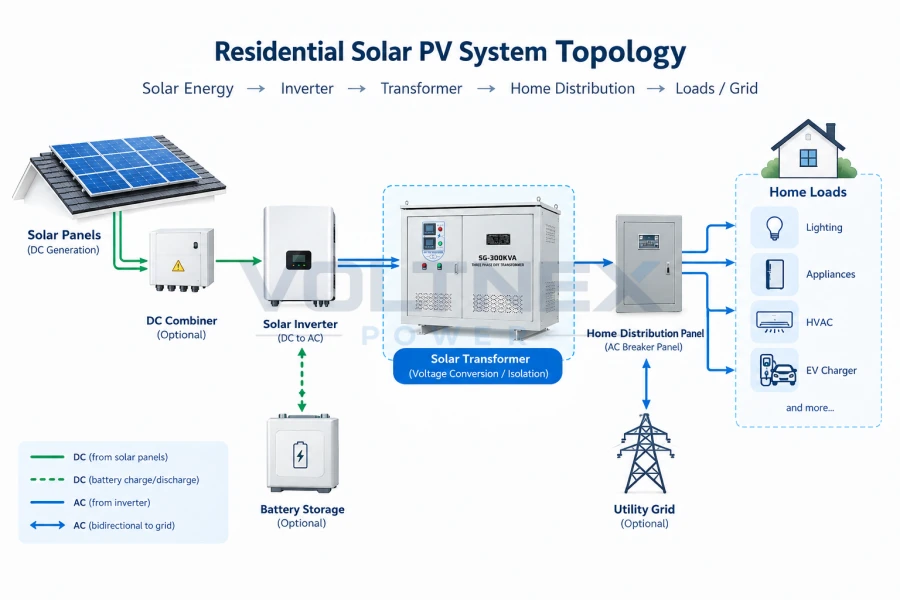
A typical residential solar system may follow this configuration:
Solar Panels → Solar Inverter → Solar Transformer → Home Electrical Panel → Household Loads / Grid
In systems with battery storage, the configuration may also include:
Solar Panels → Inverter → AC Distribution → Home Loads / Battery → Grid
Not every residential PV installation requires a separate transformer. The need depends on the inverter output voltage, household electrical system, utility requirements and overall system design.
For example, a residential inverter may provide 120V, 208V, 220V, 230V, 240V or 480V AC, depending on the market and system architecture. A transformer may be required when the inverter voltage does not directly match the required load or grid voltage.
Why Use a Dry Type Transformer for Home Solar?
A dry type solar transformer is often considered for residential and small commercial applications because it uses air rather than liquid insulation and cooling. This construction can be suitable for installations where low maintenance, clean operation and flexible placement are important.
For example, a dry type transformer may be installed in a utility room, electrical room, solar equipment room, garage, inverter station or other protected location, depending on the project design.
A home solar transformer can provide several functions:
- Voltage step-up or step-down
- Electrical isolation
- Inverter voltage matching
- Connection between different AC voltage systems
- Power distribution
- Compatibility with specific household electrical systems
A residential PV transformer can also be configured with an enclosure suitable for the installation environment. Indoor applications may use compact open or enclosed designs, while outdoor installations may require additional protection against rain, dust, humidity and other environmental conditions.
Residential PV Transformer Voltage and Capacity
Transformer capacity is normally expressed in VA or kVA. Residential solar systems are generally smaller than commercial or utility-scale installations, but the required transformer capacity still depends on inverter output and the expected continuous load.
Common residential transformer ratings may include:
1kVA, 2kVA, 3kVA, 5kVA, 7.5kVA, 10kVA, 15kVA, 20kVA, 25kVA, 30kVA and 50kVA
Larger residential or small commercial systems can require higher capacities.
For a three-phase transformer, apparent power can be estimated using:
kVA = √3 × V × A ÷ 1000
For single-phase systems:
kVA = V × A ÷ 1000
For example, a 10kVA residential solar transformer connected to a 240V single-phase system can support approximately 41.7A at full-load current, before considering design margins and operating conditions.
The transformer should not simply be selected according to the solar panel’s total DC capacity. The solar inverter’s maximum AC output is particularly important because the transformer normally operates on the AC side of the system.
Temperature, power factor, duty cycle, harmonics and future system expansion should also be considered.
Single Phase Solar Transformer for Residential Applications
Many residential photovoltaic systems use single-phase electrical service, making a single phase solar transformer suitable for certain home solar applications.
A single-phase transformer can be configured for common residential voltage combinations such as:
120V → 240V
240V → 120V
208V → 120V
220V → 240V
240V → 480V
The actual voltage ratio should be selected according to the solar inverter and utility requirements.
For example, if a solar inverter produces 240V AC but a specific auxiliary system requires 120V, a step-down transformer can provide the required voltage. Conversely, a solar step-up transformer can increase voltage when required by the downstream electrical network.
For homes with three-phase service, a three phase residential solar transformer may be selected for larger PV installations, workshops, agricultural properties, small commercial buildings or properties with three-phase electrical equipment.
Solar Inverter Transformer and Electrical Isolation
The solar inverter is one of the most important components when selecting a transformer for a residential PV system.
The transformer should be compatible with the inverter’s rated voltage, output current, frequency and operating characteristics. If the inverter produces a voltage different from the household distribution system, the transformer can provide the required voltage conversion.
Some projects may also require a solar inverter transformer with electrical isolation. A PV isolation transformer can provide galvanic separation between electrical circuits while also performing voltage conversion.
This can be useful for applications where isolation between the inverter and downstream system is part of the electrical design. The required insulation system, grounding arrangement, winding configuration and impedance should be confirmed during engineering.
Inverter-based solar systems can also produce harmonic currents. Therefore, transformer selection should consider the inverter’s waveform characteristics and loading conditions rather than treating the transformer as a simple voltage converter.
Home Solar Transformer for Solar + Battery Systems
Modern residential solar systems are increasingly combined with battery energy storage. A typical home energy system may include solar panels, a hybrid inverter, battery modules, a home distribution panel and the utility grid.
In this configuration, the transformer may be installed according to the architecture of the inverter and battery system.
For example:
PV Panels → Hybrid Inverter → Transformer → Home / Grid
or:
PV + Battery → PCS / Hybrid Inverter → Transformer → Home / Grid
The transformer capacity should consider the maximum AC power that may flow through it, including charging and discharging conditions where applicable.
For larger homes, farms or properties with high electrical demand, the transformer may need to support multiple operating modes and future expansion.
Custom Residential Solar Transformer Manufacturer
Residential solar projects can have different voltage standards and electrical configurations depending on the country and utility network. A transformer designed for a North American 120/240V system, for example, may be different from one used in a 220/230V residential system.
Voltnex Power provides custom residential solar transformers for different international markets and electrical applications. Transformer specifications can be customized according to project requirements, including:
- Capacity from small VA ratings to larger kVA ratings
- Single-phase or three-phase
- 120V, 208V, 220V, 230V, 240V, 380V, 400V, 415V and other voltages
- 50赫茲或 60赫茲
- Step-up or step-down configuration
- Copper or aluminum windings
- Dry type construction
- Electrical isolation
- Customized impedance
- Insulation class
- Cooling method
- Indoor or outdoor enclosure
As a China solar transformer manufacturer and factory, Voltnex Power supports OEM/ODM production, custom transformer design, factory-direct supply and wholesale orders for solar installers, distributors, system integrators, EPC companies and electrical equipment buyers.
Our customized transformers can support residential PV, small commercial solar, agricultural solar, microgrids and solar + battery applications in North America, South America, Europe, Asia, Africa and other international markets.
Read More:How to Select a Transformer for a Battery Energy Storage System
How to Select a Home Solar Transformer
Before purchasing a residential solar transformer, the installer or system designer should confirm the solar inverter’s AC output voltage and maximum power, household service voltage, single-phase or three-phase configuration, frequency and required transformer capacity.
Installation conditions should also be reviewed, including indoor or outdoor location, ambient temperature, humidity, ventilation, altitude and enclosure requirements.
For projects requiring isolation, the grounding and neutral configuration should be confirmed as well. If the transformer will operate together with a battery system, the maximum charging and discharging power should also be considered.
A properly selected transformer allows the solar inverter and household electrical system to operate with compatible voltage, capacity and protection characteristics.
Conclusion
A residential solar transformer can provide voltage conversion, electrical isolation and system compatibility for home photovoltaic installations where a transformer is required. Dry type solar transformers are suitable for many residential and small commercial applications because of their low-maintenance construction and flexible installation options.
Voltnex Power is a China solar transformer manufacturer and factory supplying customized home solar transformers, residential PV transformers, single-phase solar transformers, solar inverter transformers and PV isolation transformers for international solar projects.
With custom engineering, OEM/ODM manufacturing and factory-direct wholesale supply, Voltnex Power can develop transformer solutions according to the inverter voltage, household electrical system, capacity and installation requirements.
Looking for a custom residential solar transformer? Contact Voltnex Power for technical specifications, transformer selection support and a project quotation.
Email: inquiry@voltnexpower.com