


























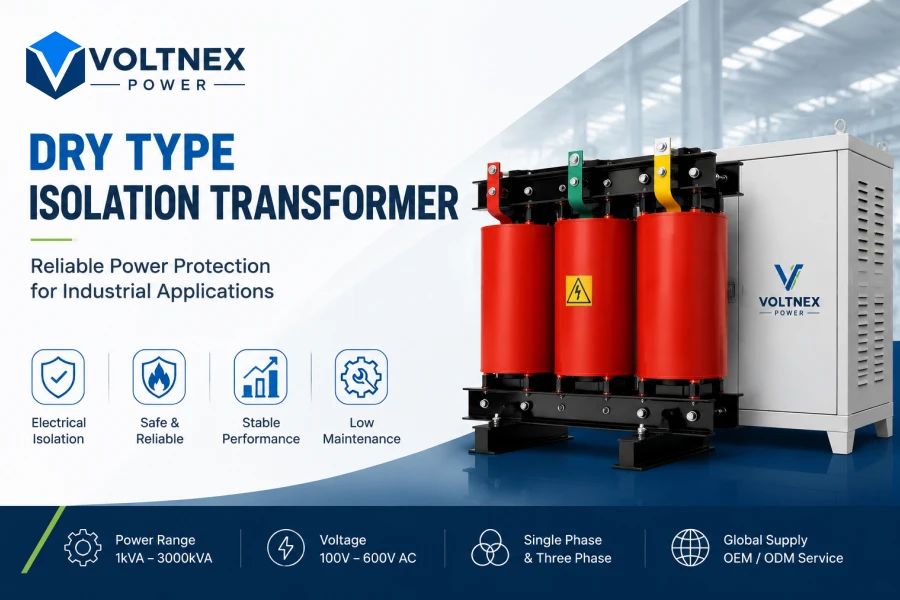
Introduction: Choosing the Right Transformer Technology for Industrial Power Systems
Transformers are one of the most important components in modern electrical infrastructure. From manufacturing plants and automation factories to renewable energy systems, medical facilities and data centers, transformers provide reliable voltage conversion, electrical protection and power distribution.
However, not all transformers are designed for the same purpose.
When selecting a transformer for industrial applications, engineers and project managers often compare two major technologies:
- Dry Type Isolation Transformers
- Oil Filled Transformers
Although both transformer types use electromagnetic induction to transfer electrical energy, their design concepts, safety characteristics, cooling methods and application environments are significantly different.
A standard oil filled transformer is mainly designed for large-scale voltage distribution, while a dry type isolation transformer is designed for electrical isolation, equipment protection and power quality improvement.
For modern factories using:
- CNC machining equipment
- Industrial robots
- PLC control systems
- Semiconductor equipment
- Medical devices
- Laboratory instruments
- Data centers
- Renewable energy systems
power quality has become increasingly important. Voltage fluctuations, electrical noise, electromagnetic interference (EMI), harmonic distortion and ground loop problems can directly affect equipment performance and production efficiency.
This is why many industrial customers choose dry type isolation transformers as a reliable power protection solution.
Voltnex Power is a professional China dry type isolation transformer manufacturer and factory supplier, specializing in:
- Dry Type Isolation Transformers
- Three Phase Isolation Transformers
- 工業用變壓器
- 變頻驅動器變壓器
- 電壓穩壓器
- Power Quality Equipment
With customized voltage solutions, OEM/ODM manufacturing capability and global export experience, Voltnex Power provides industrial electrical solutions for customers worldwide.
1. Understanding Transformer Technology
What Does a Transformer Do?
A transformer is an electrical device that transfers electrical energy between circuits through electromagnetic induction.
The main functions include:
1. Voltage Conversion
Transformers can increase or decrease AC voltage levels.
Examples:
- 480V to 400V
- 400V to 220V
- 380V to 415V
- 600V to 480V
2. Electrical Isolation
Some transformers provide electrical separation between input and output circuits.
This is called:
Galvanic Isolation
The primary and secondary circuits are physically separated and energy is transferred only through magnetic flux.
Benefits:
- Improved electrical safety
- Reduced electrical interference
- Better equipment protection
3. Power Distribution
Large transformers distribute electricity from utility networks to industrial facilities and commercial buildings.
2. What Is a Dry Type Isolation Transformer?
A 乾式隔離變壓器 is a transformer that uses air cooling and solid insulation instead of liquid insulation oil.
Unlike traditional oil transformers, dry type transformers do not require:
- Transformer oil
- Oil tanks
- Oil leakage protection systems
The transformer windings are insulated using high-performance materials such as:
- Epoxy resin
- Nomex insulation
- Polyester insulation materials
Dry type isolation transformers are designed for applications where:
- Safety is critical
- Indoor installation is required
- Equipment protection is important
- Low maintenance is preferred
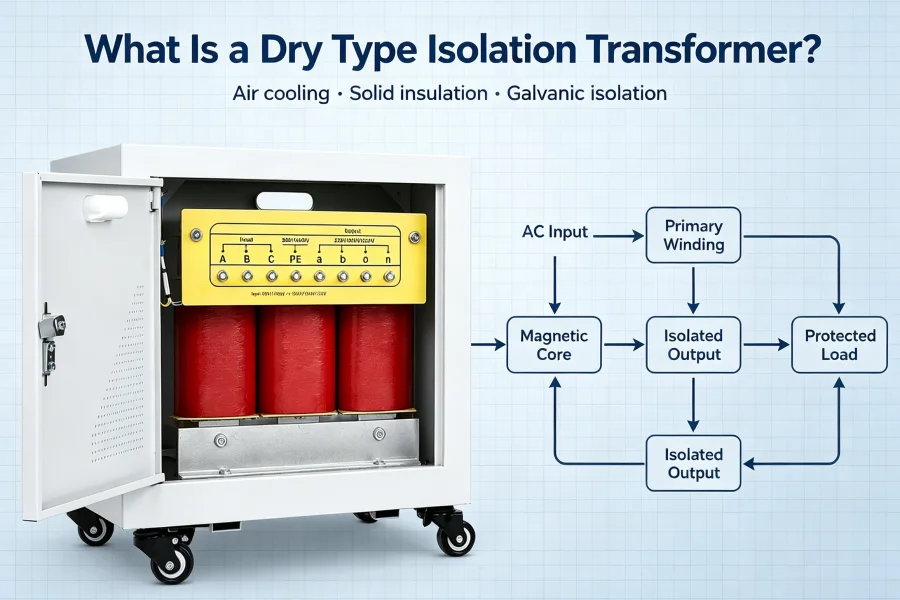
Dry Type Isolation Transformer Working Principle
A dry type isolation transformer operates through electromagnetic induction.
The process includes:
Step 1: AC Input Supply
The incoming AC power enters the primary winding.
Example:
- 380V AC
- 400V AC
- 480V AC
Step 2: Magnetic Field Generation
The current flowing through the primary winding creates a magnetic field inside the transformer core.
The core guides the magnetic flux efficiently between windings.
Step 3: Energy Transfer
The changing magnetic flux induces voltage in the secondary winding.
The energy is transferred without direct electrical connection.
Step 4: Isolated Output Power
The secondary side provides isolated power for connected equipment.
This helps protect:
- Controllers
- Motors
- Sensors
- Electronic systems
Main Components of Dry Type Isolation Transformer
A typical industrial dry type isolation transformer includes:
3. What Is an Oil Filled Transformer?
一個 oil filled transformer is a transformer that uses insulating oil for:
- Cooling
- Electrical insulation
- Heat dissipation
The transformer windings are placed inside a sealed tank filled with transformer oil.
During operation:
- Windings generate heat
- Oil absorbs heat
- Heat transfers to radiators
- Cooling system releases heat
Oil filled transformers are widely used in:
- Utility substations
- Power transmission systems
- Outdoor distribution networks
- Renewable energy plants
Oil Filled Transformer Working Principle
The electrical working principle is similar:
Primary Side
AC power creates magnetic flux.
↓
Transformer Core
Magnetic flux travels through the core.
↓
Secondary Side
Voltage is induced.
↓
Output Power
Electrical energy is delivered to the load.
The main difference is not the electromagnetic principle, but the:
- Cooling method
- Insulation method
- Installation requirements
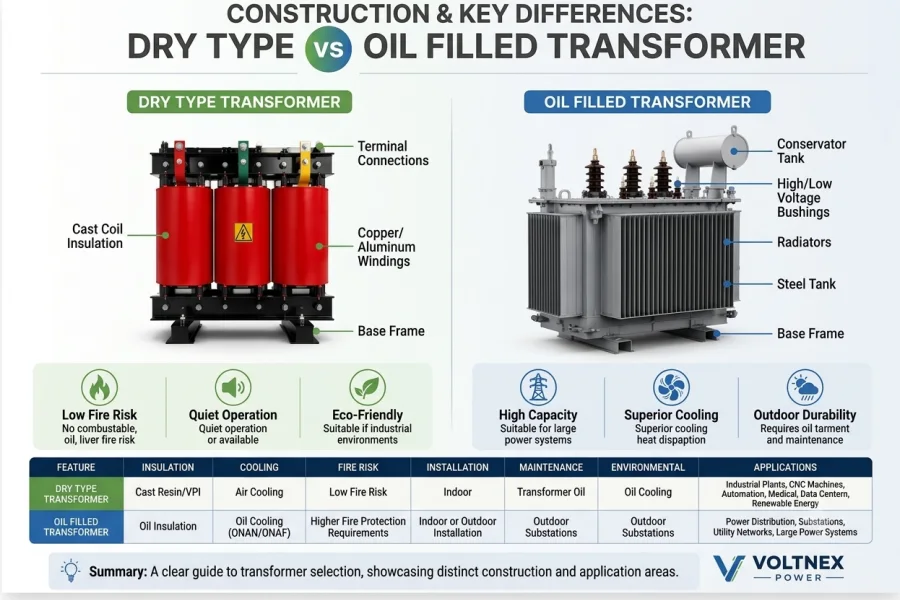
4. Dry Type Isolation Transformer vs Oil Filled Transformer: Core Differences
Technical Comparison Table
5. Construction Difference: Dry Type vs Oil Filled Transformer
Dry Type Transformer Structure
A dry type transformer mainly consists of:
Copper or Aluminum Windings
Windings determine:
- Current capacity
- Efficiency
- Temperature performance
Common options:
- Copper winding
- Aluminum winding
Copper winding advantages:
✔ Lower resistance
✔ Higher efficiency
✔ Better conductivity
✔ Suitable for demanding industrial loads
High Efficiency Magnetic Core
The transformer core uses:
- Silicon steel sheets
- Low-loss electrical steel
Benefits:
- Reduced energy loss
- Lower temperature rise
- Improved efficiency
Solid Insulation System
Dry type transformers use:
- Class F insulation
- Class H insulation
Typical temperature ratings:
Oil Filled Transformer Structure
Oil transformers include:
- Steel tank
- Transformer oil
- Radiators
- Oil conservator
- Cooling accessories
Advantages:
- Excellent heat dissipation
- Suitable for high power applications
Limitations:
- Larger installation space
- Oil maintenance required
- Environmental requirements
6. Power Rating and Voltage Range Comparison
Dry Type Isolation Transformer Typical Specifications
Voltnex Power industrial dry type isolation transformers support:
Common Industrial Voltage Applications
North America:
- 120V
- 208V
- 240V
- 480V
- 600V
Europe:
- 220V
- 380V
- 400V
- 415V
South America:
- 220V
- 380V
- 440V
Asia:
- 220V
- 380V
- 415V
Custom voltage configurations are available according to project requirements.
7. Safety Performance Comparison: Why Many Industries Prefer Dry Type Isolation Transformers
Electrical safety is one of the most important factors when selecting transformer technology.
In industrial environments, transformers are often installed near:
- Production equipment
- Automation systems
- Control rooms
- Electrical panels
- Operators and maintenance personnel
Therefore, transformer safety directly affects:
- Equipment reliability
- Workplace safety
- Maintenance cost
- Long-term operating stability
Dry Type Isolation Transformer Safety Advantages
1. Lower Fire Risk
The biggest advantage of dry type transformers is that they do not use transformer oil.
Traditional oil filled transformers contain combustible insulating oil, which requires additional safety considerations.
Dry type transformers use:
- Epoxy resin insulation
- Solid insulation materials
- Air cooling
Advantages:
✔ No oil fire risk
✔ No oil leakage
✔ Suitable for indoor installation
✔ Better environmental performance
This makes dry type isolation transformers ideal for:
- Hospitals
- Data centers
- Laboratories
- Commercial buildings
- Manufacturing facilities
2. Electrical Isolation Protection
A major feature of isolation transformers is:
Galvanic Isolation
The primary and secondary windings are electrically separated.
This provides protection against:
- Ground faults
- Leakage current
- Electrical noise
- Voltage disturbances
For sensitive equipment, electrical isolation can significantly improve system reliability.
Common protected equipment:
- CNC controllers
- PLC systems
- Industrial computers
- Medical devices
- Testing instruments
3. Improved Operator Safety
In industrial factories, electrical accidents can occur due to:
- Poor grounding
- Leakage current
- Power disturbances
Isolation transformers help create a safer electrical environment by separating equipment circuits from upstream power systems.
8. Power Quality Comparison: Dry Type Isolation Transformer Advantages
Modern industrial equipment has become increasingly sensitive to power quality.
Problems caused by unstable power include:
- Machine errors
- Production interruption
- Control system failure
- Communication problems
- Equipment damage
Common power quality issues:
Voltage Fluctuation
Caused by:
- Heavy motor starting
- Large industrial loads
- Grid instability
Impact:
- Motor overheating
- Controller malfunction
- Reduced equipment lifetime
Electrical Noise
Industrial environments contain noise sources:
- Variable Frequency Drives (VFD)
- Servo motors
- Switching power supplies
- Welding machines
Electrical noise may affect:
- PLC communication
- Sensor signals
- Control accuracy
Harmonic Distortion
Modern factories often use:
- Frequency converters
- Rectifiers
- UPS systems
- Power electronics
These devices generate harmonic currents that can affect electrical systems.
Isolation transformers help reduce the impact of electrical disturbances and improve power system stability.
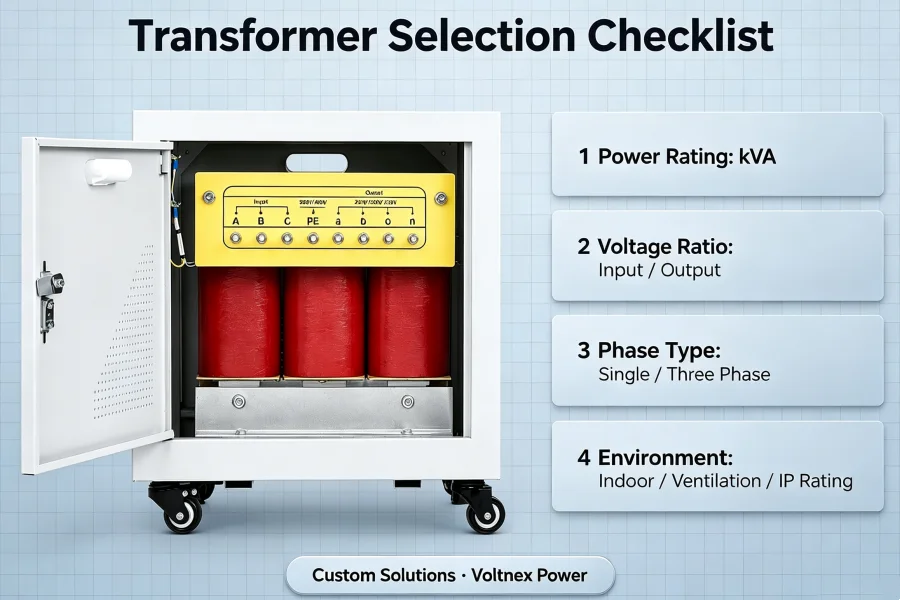
9. EMI Reduction and Sensitive Equipment Protection
Electromagnetic interference (EMI) is a common challenge in industrial applications.
Sources include:
- Motors
- Inverters
- Switching equipment
- Industrial controllers
A dry type isolation transformer provides:
Common Mode Noise Reduction
Helps reduce unwanted electrical signals between:
- Power source
- Equipment ground
Better Signal Stability
Important for:
- Automation systems
- Precision machines
- Laboratory equipment
設備保護
Helps protect expensive equipment from:
- Voltage spikes
- Electrical interference
- Abnormal power conditions
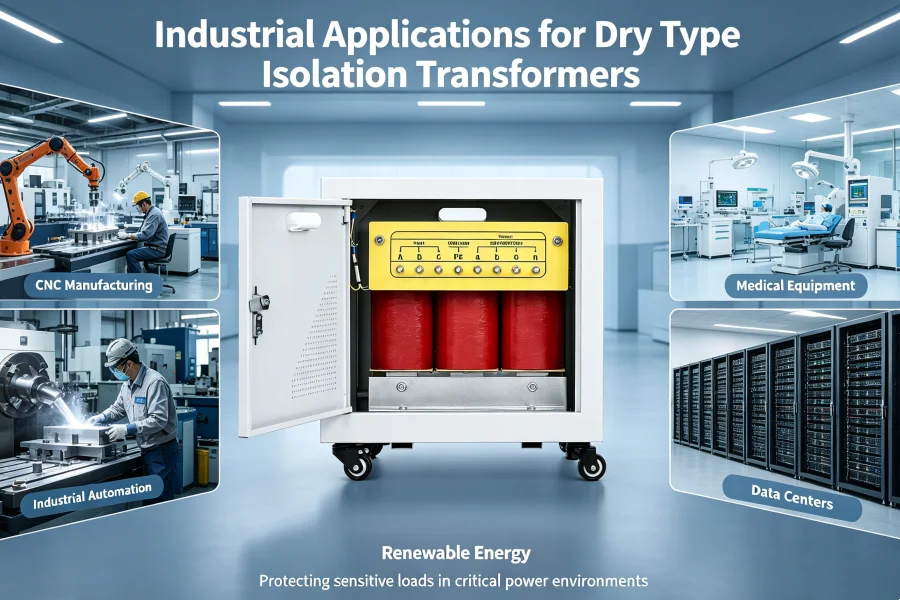
10. Industrial Applications of Dry Type Isolation Transformers
Dry type isolation transformers are widely used across multiple industries.
CNC Machine Tool Applications
CNC equipment requires extremely stable electrical power.
Typical equipment:
- CNC machining centers
- Milling machines
- Laser cutting machines
- Grinding machines
Power problems may cause:
- Servo errors
- Program interruption
- Accuracy problems
Isolation transformer benefits:
✔ Stable voltage supply
✔ Reduced electrical noise
✔ Better control system protection
✔ Improved machining reliability
Industrial Automation Systems
Automation factories rely on:
- PLC controllers
- Robots
- Sensors
- Servo drives
Applications:
- Automotive production lines
- Electronics manufacturing
- Packaging systems
Isolation transformers provide:
- Clean power
- Electrical separation
- Better automation reliability
Medical Equipment Applications
Medical systems require extremely reliable power.
Applications:
- MRI systems
- CT scanners
- Laboratory equipment
- Patient monitoring systems
Advantages:
✔ Reduced electrical interference
✔ Improved safety
✔ Stable operation
Data Center Applications
Data centers require:
- Continuous operation
- Stable voltage
- Clean power
Isolation transformers are used with:
- UPS systems
- Server power systems
- Network equipment
Benefits:
- Power protection
- Noise reduction
- Improved system reliability
Renewable Energy Applications
Modern renewable energy systems include:
- Solar inverters
- Battery storage systems
- Energy management systems
Dry type isolation transformers are used for:
- Voltage matching
- Electrical isolation
- Grid connection protection
Applications:
- Solar farms
- Commercial photovoltaic systems
- Industrial energy storage
11. Dry Type Isolation Transformer Selection Guide
Selecting the correct transformer requires evaluating several technical factors.
Step 1: Determine Required Power Capacity (kVA)
Transformer capacity should match the connected load.
Common ratings:
- 5kVA
- 10kVA
- 15kVA
- 25kVA
- 50kVA
- 75kVA
- 100kVA
- 250kVA
- 500kVA
- 1000kVA
For motor applications, consider:
- Starting current
- Load fluctuation
- Future expansion
A safety margin is usually recommended.
Example:
Equipment Load:
80kW
Recommended transformer:
100kVA
Step 2: Confirm Input and Output Voltage
Important questions:
What is your incoming voltage?
Examples:
- 208V
- 220V
- 380V
- 400V
- 415V
- 480V
What voltage does your equipment require?
Examples:
- 220V
- 380V
- 400V
- 480V
Transformer example:
Input:
480V
Output:
400V
Step 3: Select Single Phase or Three Phase
單相隔離變壓器
Suitable for:
- Small equipment
- Laboratory devices
- Control systems
Typical range:
1kVA-20kVA
Three Phase Isolation Transformer
Suitable for:
- Industrial machinery
- Motors
- Automation systems
- Factory power systems
Typical range:
15kVA-3000kVA
Step 4: Select Cooling Method
AN Cooling
Natural air cooling.
Suitable for:
- Normal industrial loads
AF Cooling
Forced air cooling.
Suitable for:
- High capacity transformers
- Continuous heavy loads
Step 5: Select Protection Level
Common enclosure options:
IP20
Indoor electrical rooms.
IP21
Improved protection against vertical water drops.
IP54
Suitable for:
- Dusty environments
- Industrial workshops
12. Installation Environment Guide
Before installation, consider:
安裝位置
Recommended locations:
- Electrical rooms
- Control rooms
- Factory power rooms
Avoid:
- Direct rain exposure
- Excessive dust
- Corrosive environments
Ambient Temperature
Typical:
-10℃ to +50℃
Higher temperature environments may require:
- Additional ventilation
- Forced cooling
Humidity
Recommended:
≤95% RH
Ventilation Requirements
Dry type transformers require sufficient airflow.
Installation should maintain:
- Air circulation space
- Cooling clearance
- Heat dissipation area
13. Dry Type Transformer vs Oil Transformer: Maintenance Comparison
14. Total Cost of Ownership Comparison
When purchasing transformers, initial price is not the only factor.
Consider:
- Installation cost
- Maintenance cost
- Safety cost
- Downtime risk
Dry Type Transformer Advantages
Although initial investment may be slightly higher:
Long-term benefits:
✔ Lower maintenance cost
✔ Reduced safety risk
✔ Longer service life
✔ Easier indoor installation
For industrial customers, total ownership cost is often lower.
15. Why Industrial Customers Choose Dry Type Isolation Transformers
Modern factories require:
- Reliable power
- High equipment availability
- Safe operation
- Low maintenance
Dry type isolation transformers provide:
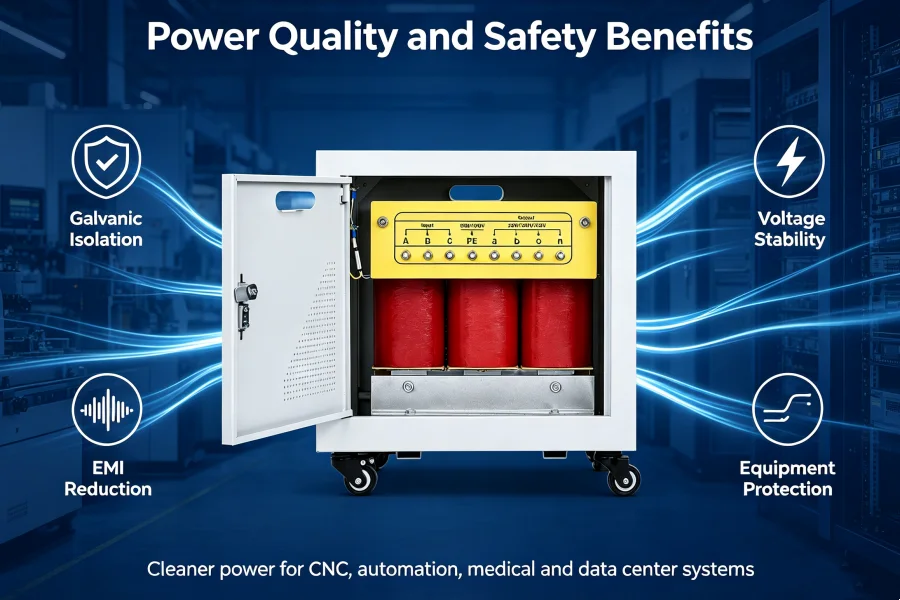
✔ Electrical isolation
✔ Voltage conversion
✔ EMI reduction
✔ Power quality improvement
✔ Equipment protection
✔ Flexible installation
Read More:What Is an Isolation Transformer? Working Principle, Benefits and Industrial Applications
16. Industrial Case Study 1: CNC Manufacturing Factory Power Protection Solution
Customer Background
A precision machining manufacturer located in South America operates multiple CNC machining centers for automotive component production.
The factory uses:
- CNC milling machines
- CNC turning centers
- Laser cutting systems
- Automated production equipment
- Industrial control systems
During operation, the customer experienced several electrical problems:
- Unexpected machine alarms
- PLC communication interruptions
- Servo drive errors
- Voltage fluctuation during peak production hours
- Increased equipment downtime
Because CNC equipment contains sensitive electronic control components, even small electrical disturbances could affect:
- Machining accuracy
- Production efficiency
- Equipment lifetime
Customer Electrical Requirements
The customer required a transformer solution with:
Voltnex Power Solution
Voltnex Power supplied a customized:
100kVA Three Phase Dry Type Isolation Transformer
Main features:
- Separate primary and secondary windings
- Copper winding design
- High efficiency silicon steel core
- Low-loss operation
- Class F insulation system
- Forced air cooling
- Industrial protection enclosure
Installation Process
The transformer was installed between:
Utility Power Supply
↓
Circuit Protection
↓
乾式隔離變壓器
↓
CNC Equipment
↓
Production System
The isolation transformer created a cleaner and more stable power environment for the factory.
Project Results
After installation:
Improved Machine Stability
CNC systems operated with fewer electrical interruptions.
Reduced Electrical Noise
Control communication became more reliable.
Improved Production Efficiency
Less downtime resulted in improved production continuity.
設備保護
Sensitive electronic components received cleaner isolated power.
17. Industrial Case Study 2: Medical Equipment Power Isolation Solution
Customer Background
A medical technology company required a reliable transformer solution for advanced diagnostic equipment.
The facility included:
- Medical imaging equipment
- Laboratory instruments
- Monitoring systems
- Precision electronic devices
Medical equipment requires extremely stable electrical conditions because power disturbances may affect:
- Measurement accuracy
- Equipment calibration
- Patient safety
Customer Challenges
The facility experienced:
- Electrical interference
- Ground loop issues
- Voltage instability
- Signal disturbance
The customer needed:
- Electrical isolation
- Noise reduction
- Stable output voltage
- High safety performance
Voltnex Power Solution
Provided:
Technical specifications:
Benefits Achieved
The installation provided:
✔ Improved electrical safety
✔ Reduced EMI interference
✔ More stable equipment operation
✔ Better power quality
The isolation transformer became an important part of the medical facility power protection system.
18. Industrial Case Study 3: Solar Energy System Isolation Transformer Solution
Customer Background
A renewable energy developer was building a commercial solar power project.
The system included:
- Solar inverter equipment
- Monitoring systems
- Industrial control cabinets
- Energy management systems
The customer required a transformer capable of:
- Voltage matching
- Electrical isolation
- Long-term continuous operation
- Outdoor industrial reliability
Project Requirements
Voltnex Power Solution
The supplied transformer included:
- Customized voltage ratio
- High-efficiency copper winding
- Advanced insulation system
- Industrial enclosure
- Reliable cooling structure
Project Results
After installation:
Stable Power Conversion
The transformer improved the stability between inverter output and connected loads.
Improved Equipment Protection
Sensitive control systems received isolated power.
Reduced Maintenance Requirements
Compared with oil filled transformer solutions:
- No oil inspection
- No leakage concerns
- Easier maintenance
Read More:Three Phase Isolation Transformer: Applications, Benefits and Industrial Guide
19. Why Choose Voltnex Power as Your Dry Type Isolation Transformer Manufacturer?
Voltnex Power is a professional China dry type isolation transformer factory and global supplier.
We provide complete industrial electrical solutions for:
- Manufacturing plants
- Automation factories
- Renewable energy projects
- Medical systems
- Data centers
- Commercial facilities
Factory Direct Manufacturing Advantages
1. Professional Transformer Production Capability
Voltnex Power focuses on:
- Transformer design
- Electrical engineering
- Manufacturing
- Quality control
- Global export
Our product range includes:
2. OEM & ODM Customization Services
Every industrial project has different electrical requirements.
Voltnex Power provides customization for:
Voltage Configuration
Examples:
- 110V
- 120V
- 208V
- 220V
- 240V
- 380V
- 400V
- 415V
- 440V
- 480V
- 575V
- 600V
Power Capacity
Available:
Mechanical Design
Options:
- Cabinet type
- Open type
- Indoor enclosure
- Industrial protection enclosure
3. Quality Manufacturing Process
Voltnex Power follows strict production procedures:
Core Manufacturing
Using:
- Premium electrical steel
- Low-loss core technology
Winding Process
Options:
- Copper winding
- Aluminum winding
Insulation System
Testing:
- Insulation resistance
- Voltage withstand
- Temperature rise
Final Inspection
Before shipment:
- Electrical testing
- Appearance inspection
- Performance verification
4. Global Export Capability
Voltnex Power supplies customers worldwide.
Main markets:
North America
- USA
- Canada
- Mexico
South America
- Brazil
- Chile
- Colombia
- Argentina
Europe
- UK
- Germany
- France
- Spain
Middle East & Africa
- UAE
- Saudi Arabia
- South Africa
Asia Pacific
- Australia
- Southeast Asia
20. Frequently Asked Questions (FAQ)
1. What is the main difference between dry type and oil filled transformers?
Dry type transformers use air cooling and solid insulation, while oil filled transformers use transformer oil for cooling and insulation.
2. Why are dry type isolation transformers safer?
Because they do not contain flammable transformer oil, reducing fire and leakage risks.
3. Are dry type transformers suitable for factories?
Yes. They are widely used in:
- CNC factories
- Automation systems
- Production lines
- Industrial equipment
4. Can isolation transformers reduce electrical noise?
Yes. They help reduce:
- EMI interference
- Common mode noise
- Ground loop problems
5. What capacity dry type isolation transformer do I need?
It depends on:
- Equipment power
- Starting current
- Load characteristics
Professional engineering calculation is recommended.
6. Can Voltnex Power customize transformer voltage?
Yes.
Customized solutions are available for:
- Input voltage
- Output voltage
- Frequency
- 相位
- Protection level
7. Do dry type transformers require transformer oil?
No.
Dry type transformers use solid insulation and air cooling.
8. How long does a dry type isolation transformer last?
With proper installation and maintenance, service life can reach 20-30 years.
9. Are dry type transformers suitable for VFD applications?
Yes.
They are commonly used with:
- 變頻驅動器
- Motor control systems
- Industrial automation equipment
10. Does Voltnex Power provide wholesale transformer supply?
Yes.
We provide:
- Factory direct pricing
- Bulk orders
- Distributor cooperation
- OEM manufacturing
11. What standards do Voltnex transformers follow?
Typical standards include:
- IEC 60076
- International electrical requirements
12. Can dry type transformers work in 50Hz and 60Hz systems?
Yes.
Customized frequency designs are available.
13. What is the difference between isolation transformer and distribution transformer?
Isolation transformers focus on:
- Electrical separation
- Equipment protection
- Power quality
Distribution transformers focus on:
- Voltage distribution
14. Do dry type transformers need special installation rooms?
They require:
- Proper ventilation
- Heat dissipation space
- Suitable electrical environment
15. Why choose Voltnex Power?
Because Voltnex Power provides:
✔ Factory direct manufacturing
✔ OEM/ODM solutions
✔ Customized transformer design
✔ Competitive wholesale pricing
✔ Global technical support
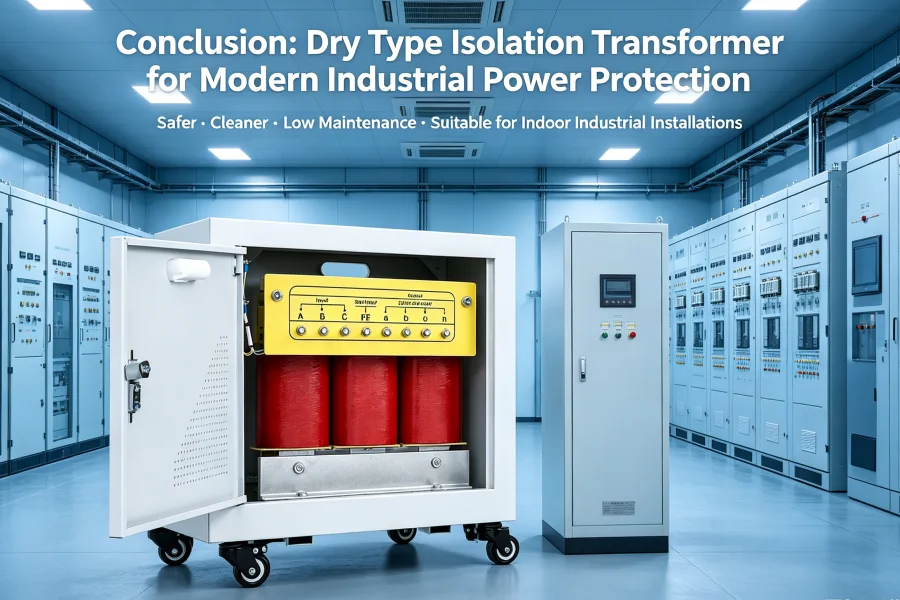
Conclusion: Dry Type Isolation Transformer Is the Preferred Solution for Modern Industrial Power Protection
Dry type isolation transformers and oil filled transformers both have important roles in electrical systems.
Oil filled transformers remain widely used for:
- Utility distribution
- Outdoor substations
- Large power networks
However, for modern industrial applications requiring:
- High electrical safety
- Low maintenance
- Reliable operation
- Sensitive equipment protection
- Improved power quality
Dry type isolation transformers provide a more suitable solution.
With advanced manufacturing capability, customized engineering services and global supply experience, Voltnex Power delivers reliable industrial transformer solutions for factories, automation systems, renewable energy projects, medical facilities and commercial applications worldwide.