


























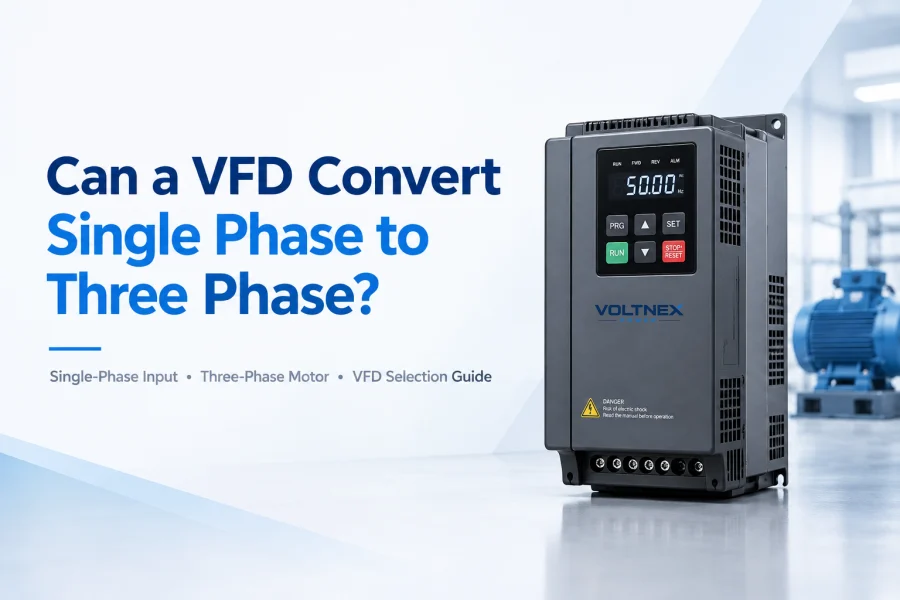
If your facility only has single-phase power but you need to operate a three-phase AC motor, you may wonder: Can a VFD convert single phase to three phase?
Yes. A properly selected single phase to three phase VFD can accept single-phase AC input and provide a controlled three-phase output for a compatible three-phase motor. This makes a VFD a practical solution for many machine tools, pumps, fans, conveyors, compressors and other industrial equipment.
However, a VFD is primarily a motor control device, not a general-purpose three-phase power supply. Understanding this difference is important when selecting equipment for an industrial application.
How Does a Single Phase to Three Phase VFD Work?
A VFD, or variable frequency drive, normally converts incoming AC power into DC power and then uses an inverter section to generate a controlled AC output.
For a single-phase input application, the process can be simplified as:
Single-Phase AC Input → DC Bus → Inverter → Three-Phase AC Output → Three-Phase Motor
The inverter continuously controls the output frequency and voltage according to the motor requirements. This allows the motor to start smoothly, adjust speed and operate according to the required load.
For example, if a facility has a 220V single-phase power supply but uses a compatible 220V three-phase motor, a suitable single-phase input VFD can provide the required three-phase motor output.
This is particularly useful when installing a three-phase utility service would be expensive or impractical.
Can a VFD Run a Three-Phase Motor from Single-Phase Power?
Yes, but the VFD must be specifically designed or approved for single-phase input and three-phase output operation.
Not every three-phase VFD can simply be connected to single-phase power. Some VFDs are designed specifically for three-phase input, while other models or configurations support single-phase input with a three-phase motor output.
Another important consideration is current capacity.
When a VFD operates from single-phase input, the input current and DC bus ripple can be different from a conventional three-phase input application. Depending on the VFD design and manufacturer specifications, input derating or a larger VFD frame size may be required.
For this reason, VFD selection should be based on the motor’s rated current and the manufacturer’s single-phase input requirements rather than choosing a VFD only from the motor’s kW or HP rating.
VFD vs. Traditional Phase Converter
A single phase to three phase VFD and a traditional phase converter can both be used when three-phase equipment must operate from single-phase power, but they serve different purposes.
A phase converter is mainly intended to create a usable three-phase supply for equipment. A VFD, on the other hand, creates three-phase motor power while also providing variable frequency and speed control.
If the application requires motor speed adjustment, soft starting, acceleration/deceleration control or process automation, a VFD provides functions that a conventional phase converter does not normally provide.
Where Are Single Phase to Three Phase VFDs Used?
This type of VFD is commonly considered for industrial and commercial equipment where only single-phase power is available but a three-phase motor is preferred.
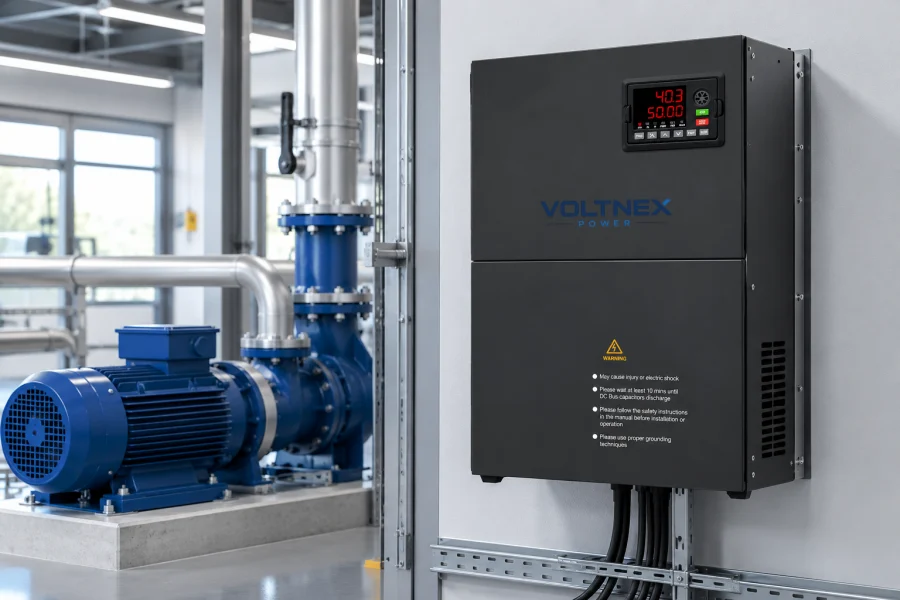
Typical applications include CNC machines, machine tools, pumps, fans, conveyors, compressors, mixers and small production equipment.
For example, a workshop may have single-phase utility power but need to operate a three-phase motor on a machine tool. Instead of replacing the motor with a single-phase motor, a suitable VFD can allow the existing three-phase motor to operate while providing additional speed control.
For pumps and fans, the variable-speed function can also help match motor output to actual process demand. In applications where the motor does not need to operate continuously at full speed, reducing motor speed can significantly reduce power consumption.
How to Select the Right VFD
Choosing a VFD should start with the motor nameplate, rather than simply selecting a model based on horsepower.
The most important information includes:
- Motor power: kW or HP
- Motor rated voltage
- Motor rated current
- Motor frequency
- Motor phase
- Required operating speed
- Load type
- Starting torque
- Input power supply
Motor current is particularly important because two motors with the same horsepower can have different rated currents depending on voltage, efficiency and power factor.
For example, a pump or fan may have relatively predictable torque characteristics, while a conveyor, compressor or machine tool may require higher starting or overload torque.
The VFD should therefore be selected according to the actual application duty. Heavy-duty applications may require a higher overload capacity than normal-duty applications.
Motor Voltage Must Also Match
Another important point is the relationship between the VFD output voltage and the motor winding configuration.
A common example is a motor designed for 220V/380V or 230V/400V operation. Depending on the motor nameplate and connection configuration, the motor may need to be wired differently for low-voltage or high-voltage operation.
Always check the motor nameplate before connecting the VFD.
The VFD output voltage should match the motor’s required operating voltage, while the VFD input configuration must match the available facility power.
Can You Use a VFD as a General Three-Phase Power Supply?
This is one of the most important limitations to understand.
A VFD is designed primarily to control a motor, and its output waveform and control method are optimized for motor operation.
Therefore, a VFD should not normally be treated as a general-purpose three-phase power source for unrelated loads such as:
- Multiple independent machines
- Transformers
- Heaters
- General building distribution
- Sensitive electronic equipment
- Other loads not approved by the VFD manufacturer
If you need to convert single-phase utility power into a stable three-phase electrical supply for several different types of equipment, a phase converter, transformer-based system, power converter or engineered three-phase power solution may be more appropriate.
The correct solution depends on whether the requirement is simply to operate one motor or to create a three-phase power system for an entire installation.
VFD vs. Transformer: What Is the Difference?
A VFD and a transformer solve completely different electrical problems.
A transformador changes AC voltage from one level to another while maintaining the power frequency. For example, a transformer can convert 480V to 208Y/120V for industrial and commercial electrical systems.
A VFD controls an AC motor by changing output frequency and voltage while controlling motor speed and torque.
Therefore:
Transformer = Voltage Conversion
VFD = Motor Speed and Torque Control
In some industrial systems, both may be used together. For example, a transformer can provide the appropriate voltage for the equipment, while a VFD controls the speed of the connected three-phase motor.
What About VFD Efficiency and Motor Energy Savings?
One of the major advantages of a VFD is the ability to adjust motor speed according to actual operating requirements.
For applications such as centrifugal pumps and fans, reducing motor speed can significantly reduce the required mechanical power. Instead of operating the motor continuously at full speed and controlling the process through throttling or other mechanical methods, a VFD can adjust motor speed directly.
However, actual energy savings depend on the motor, load profile, operating hours, control strategy and system efficiency. A VFD does not automatically reduce energy consumption in every application.
Proper motor and VFD sizing is therefore important for achieving the expected operating benefits.
Common Mistakes When Using a Single Phase to Three Phase VFD
Several problems occur when a VFD is selected only according to motor horsepower.
The first is using a three-phase-input-only VFD with single-phase power. Always confirm that the specific VFD model supports the required input configuration.
The second is ignoring input-current requirements or derating. Single-phase input operation can require different sizing from a standard three-phase input installation.
The third is selecting the VFD based only on kW or HP without checking the motor’s rated current.
Another common mistake is using the VFD output to supply equipment that is not designed to operate from a VFD output.
Finally, incorrect motor wiring can cause problems. Motor voltage, winding configuration, grounding, acceleration time and overload settings should all be checked before commissioning.
Voltnex Power Single Phase to Three Phase VFD Solutions
Voltnex Power supplies industrial variable frequency drives and AC motor drives for industrial automation, machinery and motor-control applications.
Our VFD solutions cover approximately 0,75 kW a 1.000 kW, with configurations for different voltage, motor power, control and enclosure requirements. Depending on the selected configuration, functions can include V/F control, sensorless vector control, RS485/Modbus communication, overload protection and IP20 or IP54 enclosure options.
For applications requiring single-phase input and three-phase motor operation, the VFD should be selected according to the actual motor nameplate and available power supply.
As a manufacturer and factory supplier, Voltnex Power can provide custom VFD, OEM and ODM solutions for machine builders, distributors, electrical contractors and industrial projects.
For a quotation, provide the following information:
Motor power + motor voltage + rated current + input power supply + frequency + application + required speed range + quantity
Our engineering team can then recommend a suitable VFD configuration based on the actual operating requirements.
Frequently Asked Questions
Can a VFD convert single phase to three phase?
Yes. A compatible VFD designed for single-phase input can convert the incoming power into a controlled three-phase output for a suitable three-phase AC motor.
Can I run a 3-phase motor on single-phase power?
Yes, using an appropriate single-phase input to three-phase output VFD or another suitable phase-conversion solution. The VFD must be correctly sized for the motor and application.
Can any VFD accept single-phase input?
No. Many VFDs are designed for three-phase input only. Always check the specific manufacturer’s input configuration before installation.
Does a single-phase VFD need to be oversized?
It may. Some VFD manufacturers require derating or a larger capacity when a three-phase-input model is operated from single-phase power. The actual requirement depends on the VFD design and manufacturer specifications.
Is a VFD better than a phase converter?
They perform different functions. A VFD provides three-phase motor power while also controlling motor speed and torque. A phase converter is primarily intended to provide three-phase power from a single-phase source. The appropriate choice depends on the equipment and application.
Can a VFD power multiple three-phase motors?
A standard VFD is generally intended to control a motor or a specifically engineered motor group. Multiple-motor applications require careful engineering, including motor protection, current calculation and control requirements.
Can a VFD replace a transformer?
No. A VFD and transformer perform different functions. A transformer changes AC voltage, while a VFD controls motor frequency, voltage and speed.
Need a Single Phase to Three Phase VFD?
If your facility has single-phase power but your equipment requires a three-phase motor, Voltnex Power can help you evaluate the appropriate VFD configuration.
Send us your motor kW/HP, voltage, rated current, available input power, application and required quantity for a customized recommendation and quotation.
Voltnex Power — Industrial VFD Manufacturer, Factory & Custom OEM/ODM Supplier.