


























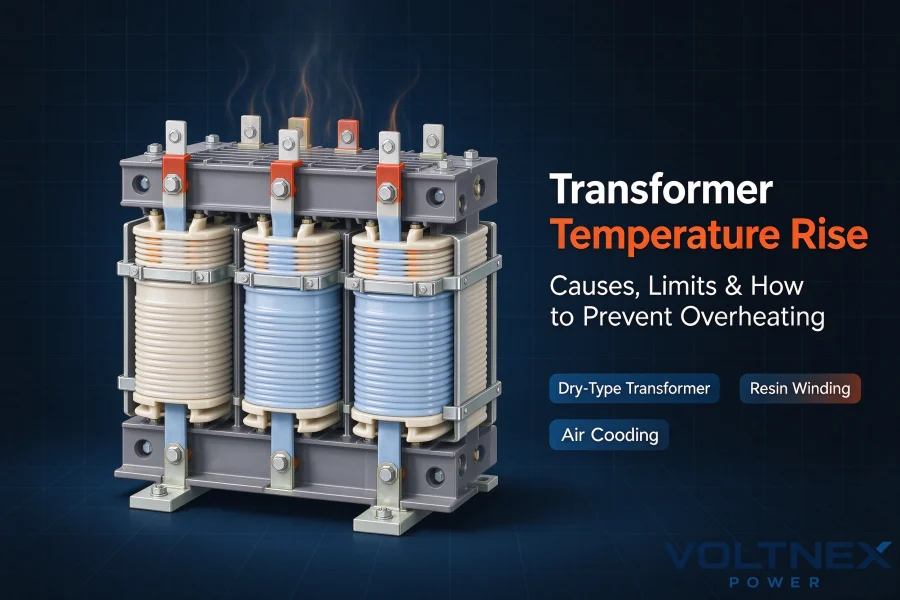
Transformer temperature rise is an important factor when selecting and operating an industrial transformer. Excessive temperature can accelerate insulation aging, reduce service life, increase losses, and eventually cause transformer failure.
For transformadores de tipo seco, temperature management is especially important because heat must be dissipated through air rather than insulating oil. Understanding temperature rise helps engineers select the correct transformer rating, insulation class, cooling method, and installation environment.
This guide explains what transformer temperature rise means, why transformers overheat, how insulation class affects operating temperature, and what practical measures can be used to prevent overheating.
What Is Transformer Temperature Rise?
Transformer temperature rise is the difference between the temperature of the transformer’s winding or other relevant components and the surrounding ambient temperature.
For example, if the ambient temperature is 30°C and the winding temperature rise is 100°C, the approximate winding temperature is:
30°C + 100°C = 130°C
Temperature rise is not the same as the actual operating temperature. The surrounding ambient temperature must also be considered.
This is particularly important in industrial installations. A transformer designed for a specific temperature rise may operate normally in a cool electrical room but experience higher temperatures when installed in a hot factory, poorly ventilated enclosure, or high-temperature environment.
Why Does a Transformer Heat Up?
A transformer inevitably generates heat while operating. The main sources are electrical losses inside the transformer.
1. Copper Loss
Copper loss occurs because current flowing through the windings encounters electrical resistance.
As transformer load increases, winding current increases and copper losses increase approximately with the square of current:
Copper Loss ∝ I²R
This means that operating a transformer significantly above its rated load can cause a rapid increase in heat generation.
2. Core Loss
Transformer cores experience losses caused by alternating magnetic flux. These include hysteresis and eddy-current losses.
Core losses occur whenever the transformer is energized, even when the transformer is lightly loaded.
3. Harmonic Currents
Nonlinear loads such as VFDs, UPS systems, rectifiers, switching power supplies, and other electronic equipment can introduce harmonic currents.
Harmonics can increase additional losses in transformer windings and magnetic components, resulting in higher operating temperatures.
For installations with significant nonlinear loads, transformer selection should consider harmonic conditions rather than relying only on the nominal kVA rating.
Transformer Temperature Rise vs Ambient Temperature
Ambient temperature has a direct effect on transformer operating temperature.
Consider a dry type transformer with a rated temperature rise of 100°C:
| Ambient Temperature | Approximate Winding Temperature |
|---|---|
| 20°C | 120°C |
| 25°C | 125°C |
| 30°C | 130°C |
| 40°C | 140°C |
| 50°C | 150°C |
These values are simplified examples for understanding the relationship. Actual transformer temperature depends on the design, insulation system, loading, cooling conditions, and applicable standard.
This is why engineers should provide the manufacturer with the expected installation environment when requesting a custom transformer.
What Causes Transformer Overheating?
A transformer operating at a high temperature does not always mean the transformer itself is defective. Several external and operating conditions can contribute to overheating.
Overloading
Continuous operation above the rated capacity increases winding losses and temperature.
If a transformer is consistently operating close to or above its rated kVA, selecting a larger transformer may be more appropriate than simply increasing cooling.
Poor Ventilation
Dry type transformers depend on air circulation to remove heat.
Blocked ventilation openings, insufficient clearance, or installation inside a poorly designed enclosure can significantly reduce heat dissipation.
High Ambient Temperature
Transformers installed in hot production areas, electrical rooms, outdoor enclosures, or poorly ventilated spaces may operate at higher temperatures than expected.
Harmonic Loads
VFDs, UPS systems, rectifiers, data equipment, and other nonlinear loads can increase transformer heating.
If the transformer supplies a high percentage of nonlinear loads, harmonic conditions should be considered during design.
Unbalanced Loads
For three-phase transformers, significant phase imbalance can result in uneven loading and additional heating.
Checking phase currents can help identify whether one phase is carrying substantially more load than the others.
Incorrect Transformer Selection
A transformer may experience excessive heating when its voltage, frequency, kVA rating, load characteristics, cooling configuration, or environmental conditions do not match the actual application.
How Does Insulation Class Affect Transformer Temperature?
Insulation class is an important consideration for dry type transformer design.
Common insulation classes include Class F y Class H.
Class F insulation systems are designed for higher thermal capability than lower-temperature insulation systems, while Class H provides an even higher thermal rating.
However, a higher insulation class does not mean that a transformer should simply be operated at an excessively high temperature.
Temperature rise, insulation system, ambient temperature, loading, and thermal design must be considered together.
For industrial applications with demanding operating conditions, selecting an appropriate insulation system provides additional thermal margin and can support long-term reliability.
How Can Transformer Overheating Be Prevented?
Several practical measures can reduce transformer operating temperature.
1. Select the Correct kVA Rating
Avoid selecting a transformer based only on today’s measured load.
Consider expected load growth, motor starting conditions, duty cycle, harmonic loads, and future expansion.
A properly sized transformer can operate more efficiently and maintain a reasonable thermal margin.
2. Provide Adequate Ventilation
Maintain sufficient clearance around the transformer and ensure that ventilation openings are not blocked.
For enclosed installations, the enclosure design must provide an appropriate method of removing heat.
3. Control the Ambient Temperature
Where possible, install transformers in a properly ventilated electrical room.
For high-temperature environments, discuss the expected ambient temperature with the transformer manufacturer before finalizing the design.
4. Monitor Transformer Temperature
Temperature monitoring can help identify abnormal operating conditions before they develop into serious failures.
Depending on the application, monitoring may include temperature sensors, winding temperature indicators, alarms, or other protection devices.
5. Check Load and Phase Balance
Measure actual current on all phases and compare the load with the transformer’s rated capacity.
If one phase is significantly more heavily loaded than the others, investigate the downstream electrical distribution.
6. Consider Harmonic Conditions
If the transformer supplies a large number of VFDs, UPS systems, rectifiers, or electronic loads, evaluate the harmonic environment.
In some applications, a transformer specifically designed for nonlinear or harmonic-rich loads may be more appropriate.
How Do Manufacturers Test Transformer Temperature Rise?
Transformer manufacturers evaluate temperature rise as part of the design and testing process.
Testing may involve operating the transformer under controlled conditions and measuring temperature at appropriate locations, including windings and other relevant components.
For industrial projects, customers should confirm the applicable transformer standard, rated capacity, voltage, frequency, insulation system, cooling method, and required testing before production.
The exact test requirements depend on the transformer type, applicable standards, and project specifications.
When Should High Transformer Temperature Be Investigated?
Some temperature increase is normal during transformer operation. The key question is whether the temperature is consistent with the transformer’s design and operating conditions.
Investigation is recommended when you notice:
- Temperature significantly higher than expected
- Rapid temperature increases
- Repeated thermal alarms
- Transformer operating near or above rated capacity
- Abnormal noise or smell
- Discoloration or visible insulation deterioration
- Poor ventilation or blocked airflow
- Significant phase-load imbalance
- Increasing temperature after connecting new nonlinear loads
If the transformer has suddenly become hotter under the same load conditions, the cause should be investigated rather than simply assuming that higher temperature is normal.
Choosing the Right Transformer for Your Application
Transformer temperature performance depends on more than the nameplate kVA rating.
When specifying an industrial dry type transformer, consider:
- Rated power and expected load
- Primary and secondary voltage
- Single-phase or three-phase configuration
- 50 or 60 Hz frequency
- Ambient temperature
- Installation altitude and environment
- Cooling method
- Insulation class
- Harmonic load conditions
- Enclosure and ventilation requirements
- Required protection and monitoring
- Applicable standards and testing requirements
For applications with unusual voltage requirements, high ambient temperatures, nonlinear loads, or limited installation space, a custom transformer design may provide a better solution than selecting a standard model.
Custom Dry Type Transformers from Voltnex Power
Voltnex Power manufactures dry type transformers and isolation transformers for industrial, commercial, automation, machinery, and power distribution applications.
Our transformer solutions can be customized according to voltage, capacity, frequency, insulation requirements, enclosure configuration, cooling requirements, and application conditions.
Typical industrial applications include CNC machinery, production lines, control panels, commercial buildings, automation systems, renewable energy projects, and voltage conversion systems.
When requesting a transformer quotation, provide the kVA rating, primary voltage, secondary voltage, phase, frequency, installation environment, and load type. For applications involving VFDs, UPS systems, rectifiers, or other nonlinear loads, include the load information so the transformer can be properly evaluated.
A correctly specified transformer with appropriate thermal design can provide stable operation, longer service life, and better reliability in demanding industrial environments.