


























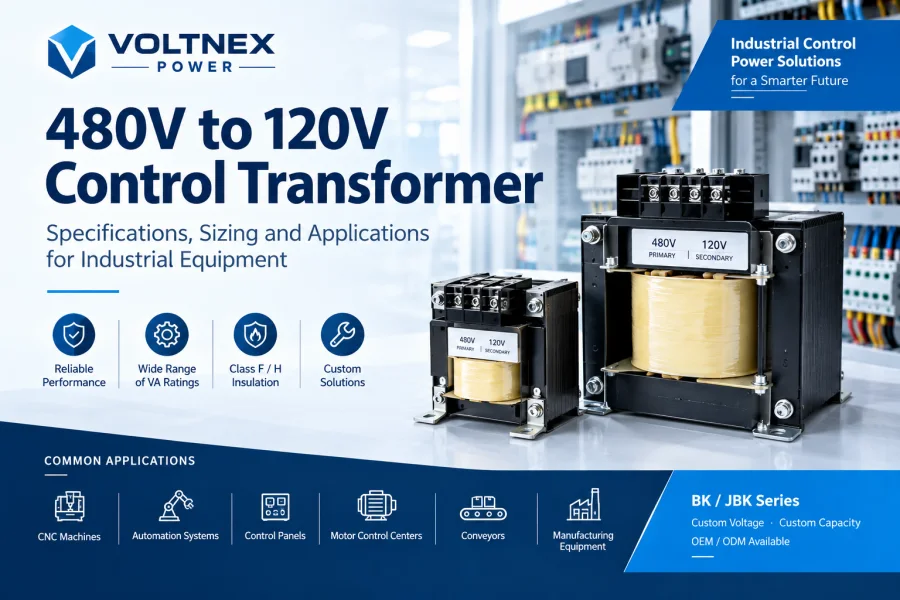
A 480V to 120V control transformer is widely used in industrial control panels, machine tools, CNC equipment, motor control centers, automation systems and manufacturing machinery where the main power supply is 480V AC but control components require a lower 120V AC voltage.
The transformer steps down the incoming 480V supply to 120V for control circuits while providing a dedicated power source for devices such as contactors, relays, PLC-related equipment, solenoid valves, pilot lights, timers and operator controls.
For industrial equipment manufacturers and electrical contractors, selecting a 480V to 120V control transformer involves more than matching the input and output voltage. VA capacity, inrush current, frequency, phase, insulation, terminals, mounting, enclosure and operating environment all affect transformer performance.
This guide explains the main specifications, sizing considerations and applications of 480V to 120V control transformers and provides practical guidance for selecting a customized industrial control transformer.
What Is a 480V to 120V Control Transformer?
A 480V to 120V control transformer is a step-down transformer with a 480V primary winding and a 120V secondary winding.
The primary side connects to the industrial power supply, while the secondary side supplies the control circuit.
For example:
Primary: 480V AC
Secondary: 120V AC
Frequency: 50/60Hz
Phase: Commonly single phase for control circuits
The transformation ratio is approximately:
480V ÷ 120V = 4:1
This means the transformer reduces the voltage to one quarter of the primary voltage while maintaining the required apparent power according to its VA or kVA rating.
A 500VA transformer, for example, can provide up to approximately 500VA of apparent power on the secondary under its specified operating conditions.
Industrial control transformers are designed specifically for control circuits, where voltage stability during the starting or energizing of inductive loads can be critical.
Why Use 480V to 120V for Industrial Control Circuits?
Many industrial facilities use 480V three-phase power for motors, pumps, compressors, conveyors and other high-power equipment.
However, control devices often operate at much lower voltages.
A typical machine may therefore have:
480V main power → 480V/120V control transformer → 120V control circuit
The 120V control circuit can then supply:
- Magnetic contactors
- Motor starters
- Control relays
- Solenoid valves
- Pilot lights
- Push buttons
- Timers
- Control switches
- PLC-related components
- Machine-control devices
- Alarm indicators
This arrangement separates the high-power circuit from the lower-voltage control circuit and allows the machine designer to select an appropriate control voltage for the equipment.
Key Specifications of a 480V to 120V Control Transformer
When requesting a quotation, buyers should provide the following specifications.
Primary Voltage
The standard requirement is:
480V AC
However, industrial equipment may require multiple primary taps to accommodate variations in the available supply.
For example:
440V / 460V / 480V
or other customized input configurations.
Secondary Voltage
The main configuration discussed in this guide is:
120V AC
Other applications may require:
24V, 36V, 110V, 220V or customized secondary voltages.
A manufacturer can configure the secondary winding according to the control-system requirements.
VA or kVA Rating
Control transformers are normally specified by VA for smaller control circuits and kVA for larger systems.
Common industrial ratings may include:
100VA, 150VA, 250VA, 300VA, 500VA, 750VA, 1kVA, 1.5kVA, 2kVA, 3kVA and 5kVA.
The correct rating should be calculated from the actual control load rather than selected only from the physical size of the machine.
Frecuencia
Typical requirements are:
50 Hz / 60 Hz
The transformer should be designed for the actual frequency of the electrical system.
Fase
Many industrial control transformers are single-phase because the control circuit only requires power between two phases of a three-phase 480V system.
However, three-phase control transformer configurations are also available when required by the system design.
How to Size a 480V to 120V Control Transformer
Correct sizing is one of the most important parts of control transformer selection.
A common mistake is to calculate only the continuous or sealed VA of the control components.
That can be insufficient when the circuit contains contactors, relays or solenoids because these devices can draw significantly higher VA during energization.
Industrial control transformer selection therefore considers both:
Sealed VA
y
Inrush VA
Manufacturer selection guidance commonly evaluates the combination of steady-state and inrush requirements to prevent excessive secondary voltage drop during startup.
Step 1: Calculate the Continuous VA Load
List all control components that may operate simultaneously.
For example:
Total continuous load:
40 + 40 + 20 + 20 = 120 VA
This does not necessarily mean a 120VA transformer is sufficient.
Step 2: Consider Inrush VA
Electromagnetic contactors, relays and solenoid devices can draw substantially more power for a short period when their coils are energized.
If several devices start simultaneously, the transformer must support the resulting temporary demand without excessive voltage drop.
This is particularly important in:
- Motor starter panels
- CNC machinery
- Máquinas herramienta
- Conveyor systems
- Automated production lines
- Industrial control cabinets
A transformer that is sized only according to continuous VA may experience excessive secondary voltage drop when several contactors energize simultaneously. This can cause contactor chatter or unreliable control operation.
Step 3: Select the Appropriate Standard VA Rating
After determining the continuous and inrush requirements, select a transformer with an appropriate VA rating and sufficient regulation performance.
For example, if the calculated requirement is approximately 250VA, a 300VA or higher transformer may be considered depending on the actual inrush characteristics, manufacturer’s selection chart and required voltage regulation.
Do not simply apply one universal percentage to every control transformer. The appropriate selection depends on the actual component VA data, simultaneous operation, transformer characteristics and required secondary voltage during inrush.
480V to 120V Control Transformer Applications
These transformers are widely used in industrial electrical equipment.
CNC Machines
CNC machines often use 480V or other industrial supply voltages for the main machine power system while control components operate at lower voltage.
A 480V to 120V control transformer can supply:
- Contactors
- Relays
- Operator controls
- Pilot lights
- Auxiliary control circuits
Machine Tools
Machine tools may contain multiple motors and electrically operated control devices.
A dedicated control transformer helps separate the control circuit from the main motor power circuit.
Automatización industrial
Automation panels can contain PLCs, relays, contactors, sensors, solenoids and other control devices.
The transformer can provide a dedicated 120V AC control supply for equipment designed around this voltage.
Motor Control Centers
Industrial motor control systems commonly use high-voltage motor power circuits together with lower-voltage control circuits.
A 480V to 120V transformer can supply the control side of motor starters and associated components.
Conveyor Systems
Manufacturing and material-handling systems often use multiple motors, contactors and control devices.
Correct transformer sizing becomes particularly important when several contactors may energize during the same sequence.
480V to 120V Control Transformer vs Isolation Transformer
A 480V to 120V control transformer can also provide electrical isolation between its primary and secondary windings when designed as an isolated transformer.
However, buyers should not assume that every step-down transformer has the same isolation characteristics.
When isolation is important, specify it clearly in the technical requirement.
For example:
480V primary / 120V secondary / 60Hz / single phase / isolated secondary
The manufacturer should then confirm the winding configuration, insulation system, dielectric withstand requirements and grounding arrangement.
This distinction is important for industrial machinery and control panels where the transformer is part of the overall electrical protection and control design.
Copper vs Aluminum Winding
Control transformers can be manufactured with copper or aluminum windings.
Copper Winding
Copper generally provides:
- High electrical conductivity
- Compact winding design
- Good thermal performance
- Strong mechanical properties
Aluminum Winding
Aluminum can provide:
- Lower material cost
- Lower equipment weight
- Competitive electrical performance when properly designed
The appropriate winding material depends on the required transformer performance, available space, budget and project specification.
For OEM machinery manufacturers, specifying the winding material during quotation helps avoid differences between quotations from different suppliers.
Insulation and Construction
Industrial control transformers may be supplied with different insulation systems according to the required application.
Common considerations include:
- Class F insulation
- Class H insulation
- Open-type construction
- Enclosed construction
- Indoor installation
- Special environmental conditions
- Customized terminals
- DIN rail or panel mounting requirements
For industrial equipment, the physical dimensions and mounting method can be just as important as the electrical specifications.
A transformer may need to fit into a specific control cabinet, machine enclosure or electrical panel.
What Information Should You Send to a Transformer Manufacturer?
To receive an accurate quotation quickly, provide:
Primary Voltage: 480V
Secondary Voltage: 120V
Capacidad: ___ VA / kVA
Phase: Single Phase / Three Phase
Frequency: 50 Hz / 60 Hz
Winding: Cobre / Aluminio
Insulation: F / H
Application: CNC / machine tool / control panel / automation / motor control
Installation: Indoor / Outdoor
Quantity: ___ units
Required Standard: IEC / UL / NEMA / other project requirements
Destination: Country and delivery location
If you have an existing transformer, providing a nameplate photograph is also useful.
For OEM projects, drawings and control-panel schematics can help the manufacturer confirm terminal configuration, mounting dimensions and control-circuit requirements.
Custom 480V to 120V Control Transformers from China
Standard 480V to 120V control transformers are widely available, but industrial machinery manufacturers may require customized specifications.
A China-based transformer factory can provide customized combinations such as:
480V → 120V
480V → 24V
480V → 120V + 24V
600V → 120V
400V → 120V
or other primary and secondary voltage combinations.
Customization may also include VA rating, winding material, insulation class, enclosure, terminal arrangement, mounting dimensions, nameplate information and OEM requirements.
For wholesalers, distributors and machine manufacturers, factory-direct sourcing can also provide a practical option when the project requires multiple units or repeated production.
Voltnex Power 480V to 120V Control Transformer Solutions
Voltnex Power manufactures customized industrial control transformers for machinery, automation systems, CNC equipment, electrical control panels and industrial power applications.
El Serie BK is designed for low-voltage industrial control applications, while related JBK series products are used for machine-tool and electrical control applications.
Typical customization options include:
- 480V primary
- 120V secondary
- 24V secondary
- 220V / 230V secondary
- Custom voltage combinations
- 50 Hz / 60 Hz
- Single-phase / three-phase options
- Copper or aluminum winding
- Class F / Class H insulation
- Custom terminals
- OEM nameplate
- Custom dimensions
- Factory-direct production
For larger control-power requirements, customized VA/kVA ratings can be discussed according to the connected control load and inrush requirements.
Final Checklist for Selecting a 480V to 120V Control Transformer
Before purchasing, confirm these parameters:
1. Is the input actually 480V AC?
2. Is the required secondary voltage 120V AC?
3. Is the system 50Hz or 60Hz?
4. Is the transformer single phase or three phase?
5. What is the total continuous VA load?
6. What is the maximum simultaneous inrush VA?
7. Are contactors, relays or solenoids included?
8. What insulation class is required?
9. Is copper or aluminum winding specified?
10. Does the transformer need a specific enclosure or mounting configuration?
11. Are IEC, UL, NEMA or other standards required?
12. Is OEM/ODM customization required?
Getting these details right before production can significantly reduce the risk of transformer undersizing, excessive voltage drop, installation problems and control-system instability.
Request a Custom 480V to 120V Control Transformer
For industrial machinery, CNC equipment, automation panels and motor-control systems, Voltnex Power can provide customized 480V to 120V control transformer solutions according to your required VA/kVA rating, voltage, frequency, insulation, winding material and installation requirements.
Send your primary voltage, secondary voltage, VA/kVA, phase, frequency, application and quantity for technical review and a factory-direct quotation.
Voltnex Power – China Manufacturer of Industrial Control Transformers, Transformadores de tipo seco, AVR Voltage Stabilizers y VFD Solutions.