


A 3 phase to single phase transformer is used when a facility has three-phase electrical power but a machine, control system, or other electrical load requires single-phase power.
This type of transformer is widely used for CNC machines, machine tools, industrial automation, manufacturing equipment, control cabinets, laboratory systems, telecom equipment, and commercial power systems.
Common searches include 3 phase to single phase transformer, 3 phase to 1 phase transformer, 3 phase to single phase 220V, 3 phase to single phase step-down transformer, and 3 phase to single phase isolation transformer.
Some buyers also search for 3 phase to single phase converter or phase converter 3 phase to single. However, a transformer and a phase converter normally serve different purposes.
This guide explains what a three-phase to single-phase transformer does, how to convert 3 phase to single phase 220V, when to use a transformer or phase converter, how to size the transformer, and how to select a custom industrial solution.
What Is a 3 Phase to Single Phase Transformer?
A 3 phase to single phase transformer is an electrical transformer designed to receive a three-phase input and provide a single-phase output.
It is particularly useful when the available industrial power supply is three-phase but the connected equipment requires a dedicated single-phase voltage.
Typical configurations include:
- 380V 3 Phase → 220V 1 Phase
- 400V 3 Phase → 220V / 230V 1 Phase
- 415V 3 Phase → 230V 1 Phase
- 440V 3 Phase → 220V 1 Phase
- 480V 3 Phase → 220V / 240V 1 Phase
- 600V 3 Phase → 220V / 240V 1 Phase
The transformer can be designed for step-down, step-up, or isolation applications, depending on the project requirements.
For industrial applications, dry type construction is commonly selected for factories, workshops, control rooms, electrical rooms, and manufacturing facilities.
How To Convert 3 Phase To Single Phase 220V
One of the most common questions from industrial equipment buyers is:
How do you convert 3 phase to single phase 220V?
There are several possible methods, and the correct solution depends on the existing electrical system.
1. Use a 3 Phase to Single Phase Transformer
A dedicated 3 phase to single phase transformer is a practical solution when three-phase power needs to be converted into a specific single-phase voltage.
For example:
380V 3 Phase → 220V 1 Phase
400V 3 Phase → 220V 1 Phase
480V 3 Phase → 220V 1 Phase
A transformer can reduce the incoming voltage and provide the required single-phase output.
This method is especially useful when:
- The available three-phase voltage is higher than 220V.
- A dedicated single-phase supply is required.
- Voltage transformation is necessary.
- Electrical isolation is required.
- The equipment has specific voltage requirements.
For applications requiring both voltage conversion and electrical separation, the transformer can be designed as a 3 phase to single phase isolation transformer.
2. Use One Phase and Neutral
Some three-phase distribution systems already provide 220V between a phase and neutral.
For example:
L1 + N = 220V
L2 + N = 220V
L3 + N = 220V
A 380/220V three-phase system may therefore provide 220V single-phase power without a separate transformer.
However, this is not the same as converting three-phase power through a transformer.
This method depends on:
- The existing distribution system
- Neutral availability
- Available circuit capacity
- Equipment requirements
- Grounding arrangement
- Local electrical regulations
If the existing system already provides the correct phase-to-neutral voltage, this may be a simpler solution.
3. Do Not Confuse It With a Phase Converter
A phase converter is generally used for the opposite direction.
For example:
240V Single Phase → 240V Three Phase
This is common when a workshop has single-phase utility power but needs to operate three-phase machinery.
Therefore, if the requirement is:
Three Phase → Single Phase 220V
the first products to evaluate are generally a three-phase to single-phase transformer or an appropriate phase-to-neutral supply.
If the requirement is:
Single Phase → Three Phase
then a phase converter, VFD, or another three-phase conversion system may be appropriate.
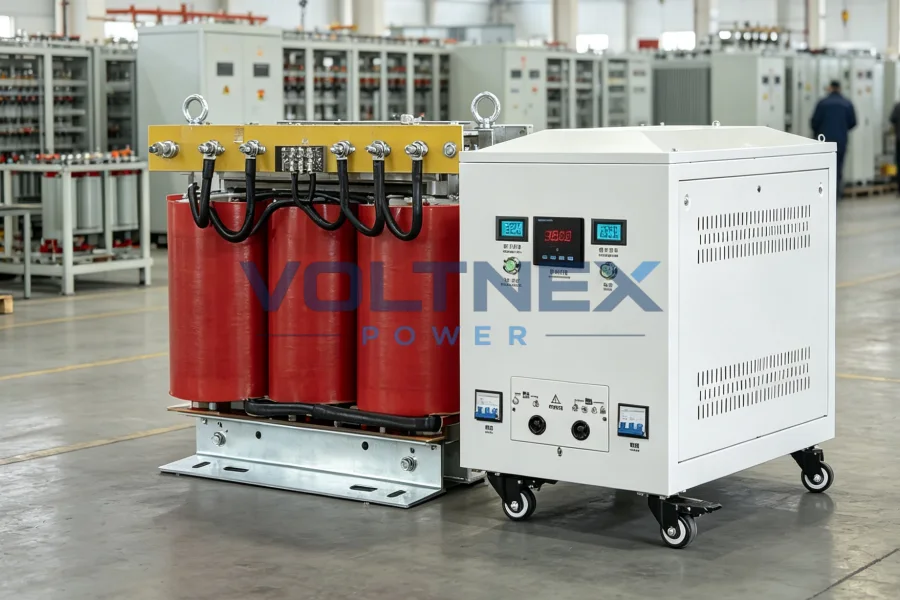
3 Phase to Single Phase Transformer vs Phase Converter
Understanding the difference is important because the two terms are often mixed together in online searches.
A simple example makes the difference clear.
Requirement A
480V 3 Phase → 220V 1 Phase
A 3 phase to single phase step-down transformer may be appropriate.
Requirement B
240V 1 Phase → 240V 3 Phase
A phase converter or VFD may be more appropriate.
The correct product should therefore be selected according to the actual input and output requirements rather than the word “converter” alone.
How Does a 3 Phase to Single Phase Transformer Work?
A transformer transfers electrical energy between windings through electromagnetic induction.
The primary side receives the three-phase electrical supply, while the transformer winding and core configuration are designed to provide the required single-phase secondary output.
For example:
Primary: 480V 3 Phase
Transformer: Step-Down
Secondary: 220V 1 Phase
The transformer therefore performs two important functions:
- Converts the voltage from the primary level to the required secondary level.
- Provides the required single-phase output configuration.
When designed as an isolation transformer, it can also provide galvanic isolation between primary and secondary circuits.
The exact winding configuration, insulation system, grounding arrangement, and connection method depend on the transformer design and project requirements.
Common 3 Phase to Single Phase 220V Configurations
Common industrial voltage combinations include:
- Medical equipment
- Communication equipment
- Electrical testing systems
Isolation can help separate the primary and secondary electrical circuits, but the actual protection and grounding performance depends on the complete electrical system design.

Dry Type 3 Phase to Single Phase Transformer
A dry type transformer uses air and solid insulation rather than liquid transformer oil.
For many indoor industrial applications, dry type construction offers a practical solution for factories, workshops, electrical rooms, control rooms, and manufacturing facilities.
Typical options include:
The choice between dry type and oil-immersed construction should be based on transformer rating, installation environment, cooling requirements, maintenance considerations, and project standards.
3 Phase to Single Phase Transformer Specifications
For industrial projects, a transformer can be customized according to the required electrical and mechanical specifications.
For large industrial projects, additional specifications such as impedance, temperature rise, connection configuration, insulation level, noise level, altitude, and special protection requirements may also need to be defined.
How to Choose a 3 Phase to Single Phase Transformer
Before selecting a transformer, confirm the following:
Input Voltage
Examples:
380V / 400V / 415V / 440V / 480V / 600V
Output Voltage
Examples:
220V / 230V / 240V / 120V
Phase
3 Phase Input → 1 Phase Output
Capacity
Examples:
25kVA / 50kVA / 75kVA / 100kVA
Frequency
50Hz or 60Hz
Transformer Type
- Dry Type
- Step-Down
- Step-Up
- Isolation
- Control Transformer
Winding
- Copper
- Aluminum
Cooling
- AN
- AF
Enclosure
- IP20
- IP23
- IP54
Installation
- Indoor
- Outdoor
Providing these specifications allows the manufacturer to determine the appropriate transformer construction.
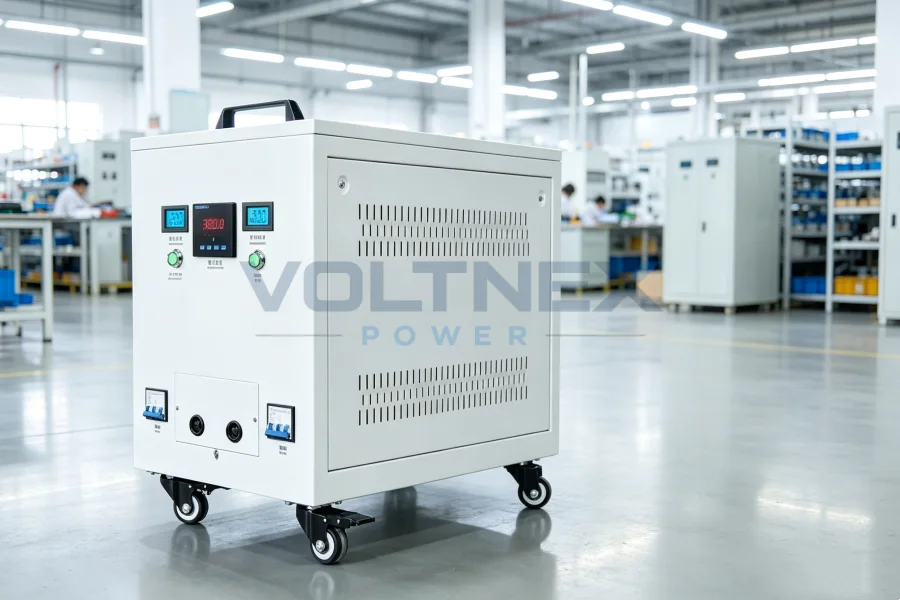
3 Phase to Single Phase Transformer Manufacturer
Voltnex Power manufactures custom industrial transformers for voltage conversion, electrical isolation and power distribution.
Our transformer solutions can be customized for:
- 3 phase to single phase conversion
- 3 phase to single phase 220V
- Step-down transformers
- Isolation transformers
- Dry type transformers
- Industrial control transformers
- Custom voltage transformers
- OEM transformer projects
- ODM transformer projects
- Wholesale and bulk orders
Typical applications include:
CNC Machines | Machine Tools | Industrial Automation | Manufacturing Equipment | Control Cabinets | Laboratory Systems | Telecom Equipment | Industrial Power Systems
As a China transformer manufacturer and factory, Voltnex Power supports customized electrical specifications and international B2B projects.
Custom 3 Phase to Single Phase Transformer
Voltnex Power supports customized transformer designs according to the customer’s electrical requirements.
Typical customization includes:
Capacity: 1kVA–3500kVA+
Input: 110V–690V / Custom
Output: 220V 1 Phase / Custom
Frequency: 50Hz / 60Hz
Winding: Copper / Aluminum
Insulation: Class F / Class H
Cooling: AN / AF
Protection: IP20 / IP23 / IP54
Type: Step-Up / Step-Down / Isolation
Installation: Indoor / Outdoor
This makes the transformer suitable for project-specific applications where standard off-the-shelf electrical equipment does not match the required voltage, capacity, or installation conditions.
How to Order a 3 Phase to Single Phase Transformer
For an accurate quotation, provide the following information:
- Required capacity in kVA
- Three-phase input voltage
- Single-phase output voltage
- Frequency
- Load type
- Starting current requirements
- Continuous or intermittent operation
- Indoor or outdoor installation
- Enclosure requirement
- Copper or aluminum winding
- Applicable standards
- Required quantity
For example:
75kVA, 480V 3 Phase to 220V 1 Phase, 60Hz, Dry Type, Copper Winding, IP23, Indoor Installation
With this information, a transformer manufacturer can evaluate the appropriate winding configuration, insulation system, cooling method, enclosure, and other design requirements.
Read More:UPS Transformer: Types, Working Principle, Sizing, K-Factor and Selection Guide

Frequently Asked Questions
1. Can 3 phase be converted to single phase?
Yes. Depending on the electrical system, single-phase power can be obtained from a three-phase supply using a suitable phase-to-neutral connection or a specifically designed three-phase to single-phase transformer.
2. How do I convert 3 phase to single phase 220V?
If the electrical system already provides 220V between phase and neutral, one phase and neutral may provide the required supply. If the available three-phase voltage is higher, such as 380V, 400V, 415V, or 480V, a 3 phase to single phase 220V step-down transformer can be used.
3. Can 380V 3 phase be converted to 220V single phase?
Yes. A 380V 3 phase to 220V 1 phase transformer can be designed for this application. A 380/220V three-phase distribution system may also provide 220V phase-to-neutral power.
4. Can 400V 3 phase be converted to 220V single phase?
Yes. A custom 400V 3 phase to 220V single phase transformer can be manufactured according to the required capacity and load.
5. Can 415V 3 phase be converted to 220V single phase?
Yes. A transformer can be designed for 415V 3 Phase → 220V 1 Phase conversion.
6. Can 480V 3 phase be converted to 220V single phase?
Yes. A 480V 3 phase to 220V single phase step-down transformer can provide the required output when correctly sized for the load.
7. Is a phase converter the same as a transformer?
No. A transformer primarily performs voltage transformation and can provide electrical isolation. A phase converter is generally used to obtain three-phase power from a single-phase source.
8. What size 3 phase to single phase transformer do I need?
The required kVA depends on the connected load, starting current, power factor, harmonics, duty cycle, ambient temperature, and installation conditions.
9. Can a 3 phase to single phase transformer provide isolation?
Yes. It can be specifically designed as a 3 phase to single phase isolation transformer, providing both voltage conversion and galvanic isolation.
10. Is a dry type transformer suitable for 3 phase to single phase conversion?
Yes. Dry type transformers are commonly used for indoor industrial applications including factories, workshops, CNC equipment, automation systems, and control cabinets.
11. What voltages can be used with a 3 phase to single phase transformer?
Common industrial input voltages include 380V, 400V, 415V, 440V, 480V, and 600V. Output voltage can be customized according to the equipment requirements.
12. Can a transformer be customized for CNC equipment?
Yes. The transformer can be designed according to the CNC machine’s input voltage, required single-phase voltage, kVA rating, frequency, load characteristics, and isolation requirements.
13. Can Voltnex manufacture a 3 phase to single phase 220V transformer?
Yes. Voltnex Power provides custom 3 phase to single phase 220V transformers, including dry type, step-down, and isolation configurations.
14. What information is needed for a transformer quotation?
The most important information includes kVA capacity, input voltage, output voltage, frequency, load type, starting requirements, installation environment, enclosure, winding material, standards, and quantity.
15. Does Voltnex supply transformers for wholesale and OEM projects?
Yes. Voltnex Power supports custom manufacturing, OEM/ODM projects, wholesale orders, and international B2B transformer supply.
Conclusion
A 3 phase to single phase transformer is a practical solution when a three-phase electrical system needs to supply a specific single-phase voltage.
For example:
380V 3 Phase → 220V 1 Phase
400V 3 Phase → 220V 1 Phase
415V 3 Phase → 220V 1 Phase
480V 3 Phase → 220V 1 Phase
If the existing three-phase system already provides the required 220V phase-to-neutral voltage, a separate transformer may not be necessary. However, when voltage conversion, dedicated single-phase power, or electrical isolation is required, a properly designed transformer can provide the appropriate solution.
A phase converter is generally used for a different requirement—converting single-phase power into three-phase power for three-phase machinery.
The key factors when selecting a transformer are input voltage, output voltage, phase configuration, kVA capacity, frequency, load characteristics, starting current, winding material, cooling, enclosure, and installation environment.
Voltnex Power provides custom dry type 3 phase to single phase transformers from 1kVA to 3500kVA+ for CNC machines, industrial automation, manufacturing equipment, control cabinets, and industrial power systems.