


























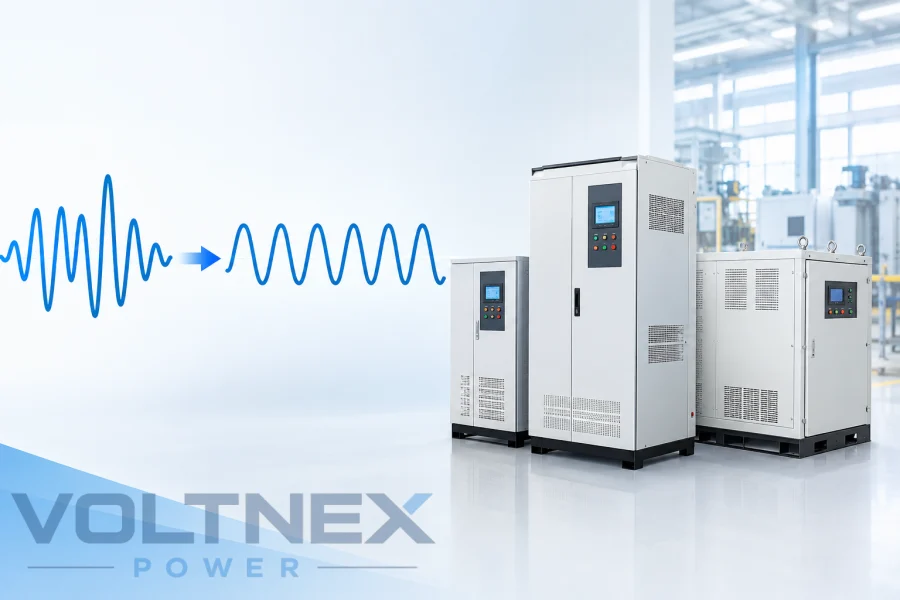
A power regulator is an important part of many industrial and commercial electrical systems where stable and reliable power is required. In AC power applications, power regulators are commonly associated with voltage regulators, reguladores automáticos de voltaje (AVR), AC voltage stabilizers, and servo voltage stabilizers used to control and stabilize fluctuating input voltage.
Unstable voltage can affect motors, CNC machines, PLC systems, automation equipment, VFDs, lighting systems, control panels, and other sensitive electrical loads. Common symptoms include excessive output voltage fluctuation, overheating, abnormal noise, overload trips, low output voltage, and unstable three-phase voltage.
As a China manufacturer and supplier of industrial electrical equipment, Voltnex Power provides customized power regulation and voltage stabilization solutions for industrial facilities, commercial buildings, automation systems, machinery, and power quality applications.
This guide explains common power regulator problems and solutions, how to select the appropriate regulator, and when an AVR, voltage stabilizer, SVG, or AHF may be more suitable for an application.
What Is a Power Regulator?
The term power regulator can describe different types of equipment depending on the electrical parameter being controlled.
For AC industrial applications, a power regulator may refer to equipment designed to maintain stable voltage, improve power quality, or regulate electrical conditions supplied to downstream equipment.
Common equipment includes:
- Regulador automático de voltaje (AVR)
- Estabilizador de voltaje de CA
- Servo Voltage Stabilizer
- Three Phase Voltage Regulator
- Static Var Generator (SVG)
- Active Harmonic Filter (AHF)
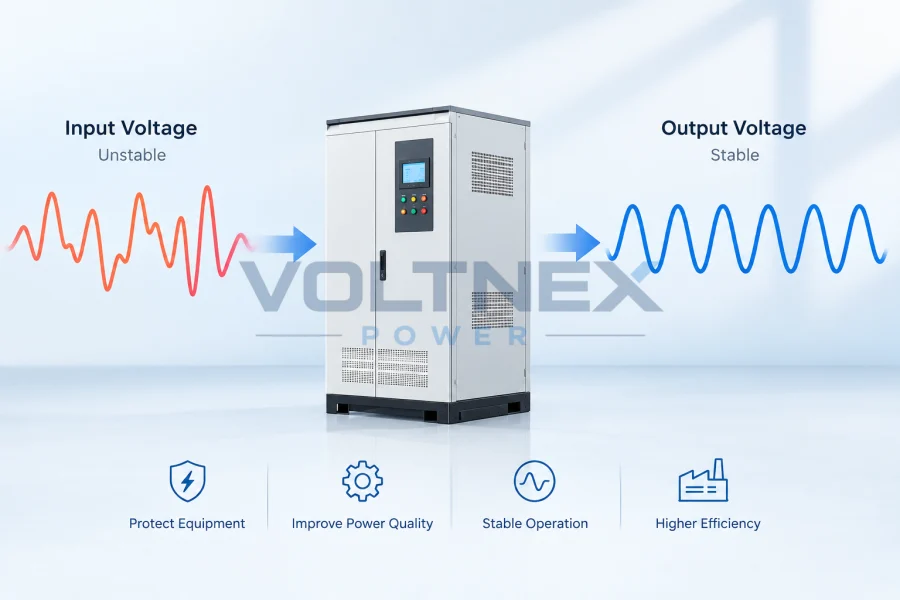
Un AVR or AC voltage stabilizer primarily regulates and stabilizes AC voltage. It can compensate for input voltage fluctuations and provide a more stable output voltage for connected loads.
For example, industrial AVR systems can be designed for approximately De 1 kVA a 3500 kVA, with single-phase or three-phase configurations and customized voltage requirements such as 110V, 120V, 208V, 220V, 380V, 400V, 415V, 440V, 480V, 575V, and 600V.
The correct configuration depends on the incoming voltage, required output voltage, load capacity, frequency, voltage fluctuation range, installation environment, and type of electrical load.
Common Power Regulator Problems and Solutions
Power regulators normally operate continuously under changing electrical loads. Incorrect sizing, excessive input fluctuation, poor installation, overloaded operation, or component problems can cause abnormal performance.
1. Output Voltage Is Too High or Too Low
One of the most common problems is that the regulator does not maintain the required output voltage.
For example, a system designed to provide 400V may produce an output outside the required operating range.
Possible causes include:
- Excessive input voltage fluctuation
- Incorrect regulator configuration
- Incorrect sensing settings
- Overload
- Internal control or adjustment problems
- Loose electrical connections
- Incorrect input or output wiring
The first step is to measure the actual input and output voltage with a properly rated electrical measuring instrument.
If the input voltage is already outside the regulator’s specified operating range, the regulator may not be able to maintain the required output.
For industrial applications, the regulator should therefore be selected according to the actual input voltage range, rather than only the nominal voltage.
2. Output Voltage Fluctuates Continuously
Another common problem is unstable output voltage.
The output may repeatedly increase and decrease instead of remaining within the required voltage range.
Possible causes include:
- Rapid changes in input voltage
- Large motor starting currents
- Oversized or undersized control settings
- Excessive load variation
- Loose connections
- Faulty sensing components
- Regulator capacity that is too small for the application
This problem is particularly important in facilities with motors, compressors, pumps, welding equipment, CNC machines, VFDs, and automated production lines.
A regulator should be sized according to the real operating conditions rather than simply using the nominal kW rating of the equipment.
Where the load changes significantly during operation, the voltage fluctuation range and transient load characteristics should be considered during system design.
3. Power Regulator Overheating
Excessive temperature is another important warning sign.
A regulator may operate at a higher temperature when it is continuously loaded near or above its rated capacity.
Common causes include:
- Continuous overload
- Insufficient ventilation
- High ambient temperature
- Blocked ventilation openings
- Poor installation
- Excessive harmonic current
- Undersized regulator
- Loose electrical connections
For indoor installations, adequate ventilation and heat dissipation should be provided.
The rated capacity should also provide sufficient margin for the actual application.
For example, a regulator supplying a motor-driven production line may experience higher current during motor starting than during normal steady-state operation. Selecting the equipment only according to the motor’s running power may therefore result in insufficient capacity.
4. The Regulator Trips Under Load
If the power regulator operates normally without a load but trips when the load is connected, the problem may be related to overload or starting current.
Possible causes include:
- Regulator capacity is insufficient
- Motor starting current is high
- Short circuit or wiring fault
- Load imbalance
- Excessive inrush current
- Incorrect protection settings
- Poor cable or terminal connections
This is common in industrial facilities using pumps, fans, compressors, conveyors, machine tools, and other motor-driven equipment.
For three-phase systems, measuring the current on each phase can help identify whether the problem is caused by phase imbalance or excessive load.
5. Three-Phase Output Voltage Is Unbalanced
For three-phase industrial equipment, voltage balance is particularly important.
If one phase has a significantly different voltage from the other phases, possible causes include:
- Uneven phase loading
- Loose terminals
- Incorrect wiring
- Input voltage imbalance
- Internal regulator problems
- Uneven distribution of single-phase loads
Three-phase voltage imbalance can affect motors and other equipment and may result in increased heating and abnormal operation.
The incoming voltage and outgoing voltage should therefore be measured phase-to-phase and, where applicable, phase-to-neutral.
For a customized three-phase AVR or voltage stabilizer, the customer’s actual voltage system should be confirmed before manufacturing.
6. Power Regulator Makes Abnormal Noise
A small amount of operating noise may be normal depending on the regulator design.
However, a sudden increase in noise, vibration, buzzing, or mechanical sound should be investigated.
Possible causes include:
- Loose components
- Transformer vibration
- Cooling fan problems
- Mechanical wear
- Loose electrical connections
- Abnormal load conditions
If abnormal noise appears together with overheating, unstable voltage, or protection trips, the equipment should be inspected before continuing normal operation.
7. The Regulator Cannot Start
If the equipment cannot start, check the basic electrical conditions first.
Possible causes include:
- No input power
- Incorrect wiring
- Input protection device is open
- Emergency stop activated
- Control circuit problem
- Incorrect phase sequence
- Control fuse failure
- Internal component failure
For industrial installations, commissioning should verify input voltage, output voltage, phase configuration, frequency, protection settings, grounding, and load connections.
Electrical troubleshooting should be performed by qualified personnel using appropriate safety procedures.
How to Choose the Right Power Regulator
Selecting a power regulator only by kVA capacity is not enough.
The following parameters should be considered before purchasing an industrial AVR, voltage stabilizer, or power regulation system.
Input Voltage
Determine the actual incoming voltage and its fluctuation range.
Typical industrial requirements may include:
220V / 380V / 400V / 415V / 440V / 480V / 575V / 600V
The actual input range is particularly important in regions where utility voltage fluctuates significantly.
Output Voltage
Specify the required regulated output voltage.
For example:
- 220V
- 380V
- 400V
- 415V
- 440V
- 480V
- 208V
- 208Y/120V
- Custom voltage
Capacity
The regulator should have sufficient capacity for the connected load.
Industrial equipment can have high starting current, nonlinear loads, or rapidly changing power demand. Therefore, the required kVA should be determined from the complete electrical load profile rather than simply the nameplate kW.
Voltnex Power can provide customized AVR and voltage stabilization solutions for applications from De 1 kVA a 3500 kVA, depending on the required configuration.
Single Phase or Three Phase
The regulator should match the electrical distribution system.
Single-phase regulators are commonly used for smaller equipment and individual loads, while three-phase systems are widely used in factories, commercial buildings, production lines, machinery, and industrial facilities.
Accuracy
The required output voltage accuracy should also be defined.
Depending on the application, customers may require approximately ±1%, ±2%, or ±3% voltage regulation.
Sensitive equipment may require tighter control than general industrial loads.
Frequency
The regulator should match the local electrical frequency, typically:
50 Hz o 60 Hz
This is particularly important for international projects and customized export orders.
Installation Environment
The installation environment should also be considered.
Typical enclosure options may include:
- IP20
- IP23
- IP54
For dusty, humid, or outdoor environments, the enclosure and cooling system should be selected according to the actual conditions.
Power Regulator vs AVR vs AC Voltage Stabilizer
The terminology can sometimes be confusing.
In many industrial applications, power regulator, voltage regulator, regulador automático de voltaje, y AC voltage stabilizer may be used to describe equipment intended to maintain stable AC voltage.
However, the exact technical configuration can be different.
Therefore, customers should define what electrical problem needs to be solved before selecting the equipment.
Can an SVG Replace a Power Regulator?
Not in every application.
Un SVG (Static Var Generator) and an AVR perform different primary functions.
An AVR is designed to regulate voltage by compensating for changes in the input voltage and maintaining the required output voltage.
An SVG dynamically controls reactive power and can help improve:
- Power factor
- Reactive power
- Voltage stability in certain conditions
- Electrical system power quality
An SVG is therefore more appropriate when the main problem involves reactive power, poor power factor, or dynamic load compensation rather than simply unstable incoming voltage.
Similarly, an AHF (Active Harmonic Filter) is designed primarily to reduce harmonic distortion caused by nonlinear loads such as VFDs, rectifiers, UPS systems, and power electronic equipment.
For complex industrial power-quality problems, an application assessment may require a combination of voltage regulation, reactive power compensation, and harmonic filtering.
How to Prevent Power Regulator Problems
Proper selection and installation can prevent many common problems.
Before purchasing a power regulator, confirm:
- Input voltage and fluctuation range
- Required output voltage
- Single-phase or three-phase system
- Total load kVA
- Motor starting current
- Frequency
- Required voltage accuracy
- Load type
- Installation environment
- Required enclosure protection
- Future load expansion
- Local electrical standards
Regular inspection should also include checking terminal connections, ventilation, temperature, current balance, output voltage, protection devices, and abnormal noise.
For critical industrial applications, periodic electrical testing can help identify problems before they cause equipment downtime.
Custom Power Regulator Solutions from Voltnex Power
Different factories and electrical systems have different voltage, capacity, frequency, and installation requirements. A standard model is therefore not always the most suitable solution.
Voltnex Power is a China-based manufacturer and supplier of industrial electrical equipment, providing customized solutions for AVR voltage regulators, AC voltage stabilizers, industrial transformers, VFDs, SVGs, and AHF systems.
Our voltage regulation solutions can be configured according to:
- 1kVA–3500kVA capacity
- Single-phase or three-phase
- 110V–600V input/output systems
- 50 Hz o 60 Hz
- ±1% to ±3% voltage regulation
- IP20 / IP23 / IP54 enclosure options
- Industrial machinery and automation applications
- CNC and production equipment
- Pumps, fans and compressors
- Commercial buildings
- VFD and motor-driven systems
- OEM and ODM requirements
- Wholesale and project orders
For international projects, customers can provide their input voltage, required output voltage, frequency, capacity, phase, input fluctuation range, load type, and destination country. Voltnex Power can then recommend a suitable configuration and provide a customized quotation.
Final Thoughts
A power regulator is an important solution for applications where unstable voltage or other power-quality problems can affect electrical equipment.
However, the correct solution depends on the actual problem.
If the primary issue is voltage fluctuation, un AVR or AC voltage stabilizer may be appropriate. If the main problem is reactive power and poor power factor, un SVG may be more suitable. If harmonic distortion is the major concern, an AHF can provide a more targeted solution.
Correct sizing, voltage matching, phase configuration, load analysis, installation, and regular inspection are essential for reliable operation.
If you are sourcing a power regulator, automatic voltage regulator, AC voltage stabilizer, or customized industrial power-quality equipment, contact Voltnex Power with your electrical specifications and application requirements for a factory-direct solution.
Voltnex Power — China Manufacturer of Custom Industrial Power Equipment for Global Applications.