

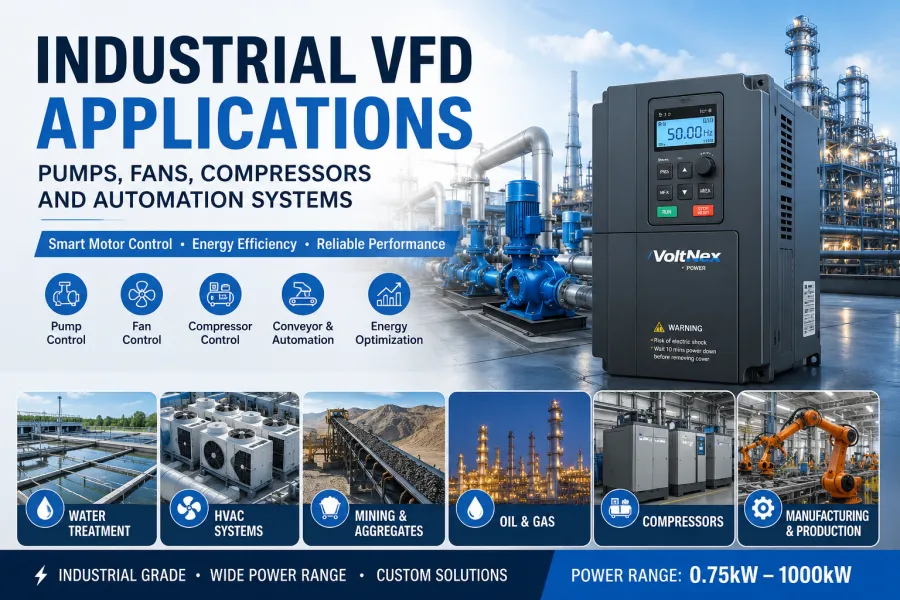
Industrial motors are used throughout modern factories, infrastructure projects, processing plants, HVAC systems, water treatment facilities, mining operations, and production lines. However, many motors do not need to operate at full speed all the time.
When process demand changes, continuously running a motor at full speed and controlling the output with valves, dampers, bypass systems, or mechanical devices can result in unnecessary energy consumption and limited process flexibility.
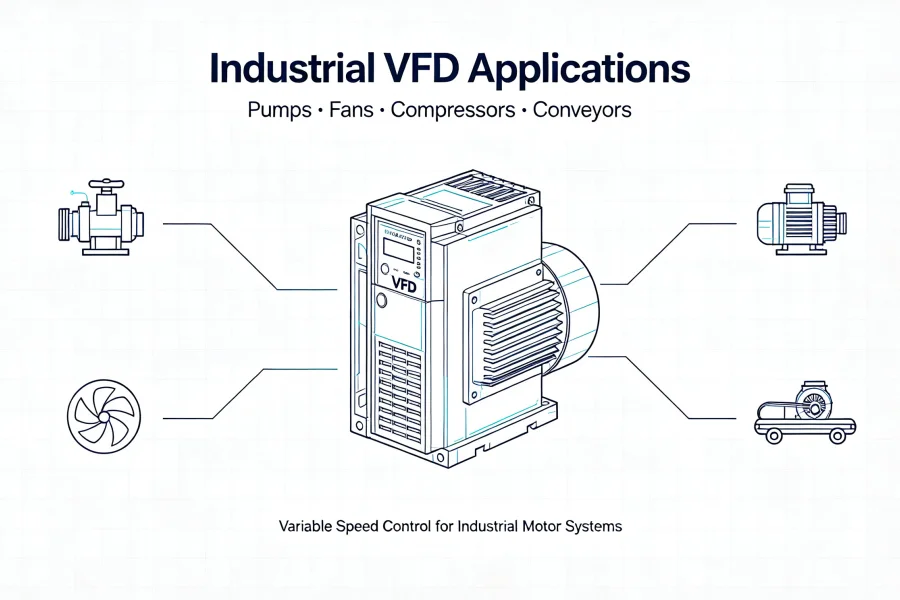
An Industrial Variable Frequency Drive (VFD) provides another approach. By controlling motor frequency and voltage, a VFD allows an AC motor to operate at an adjustable speed according to actual process requirements.
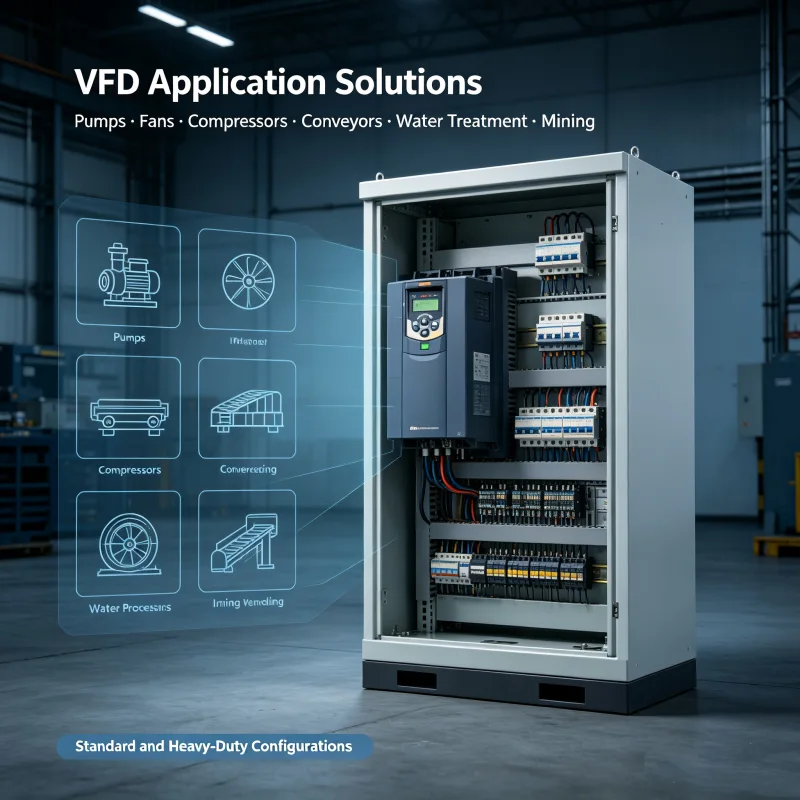
This makes VFDs suitable for a wide range of applications, including industrial pumps, fans, compressors, conveyors, HVAC systems, water treatment equipment, mining machinery, oil and gas equipment, and automated manufacturing lines.
This guide explains the most common industrial VFD applications, how to select a VFD for different loads, and what information engineers should provide when requesting a VFD quotation.
What Are Industrial VFD Applications?
An industrial VFD is an AC motor controller designed to regulate motor speed, torque, acceleration, and deceleration.
A conventional motor starter generally provides basic ON/OFF motor control, while a VFD can continuously adjust the motor operating speed according to the application.
A simplified system is:
AC Power → VFD → AC Motor → Industrial Equipment
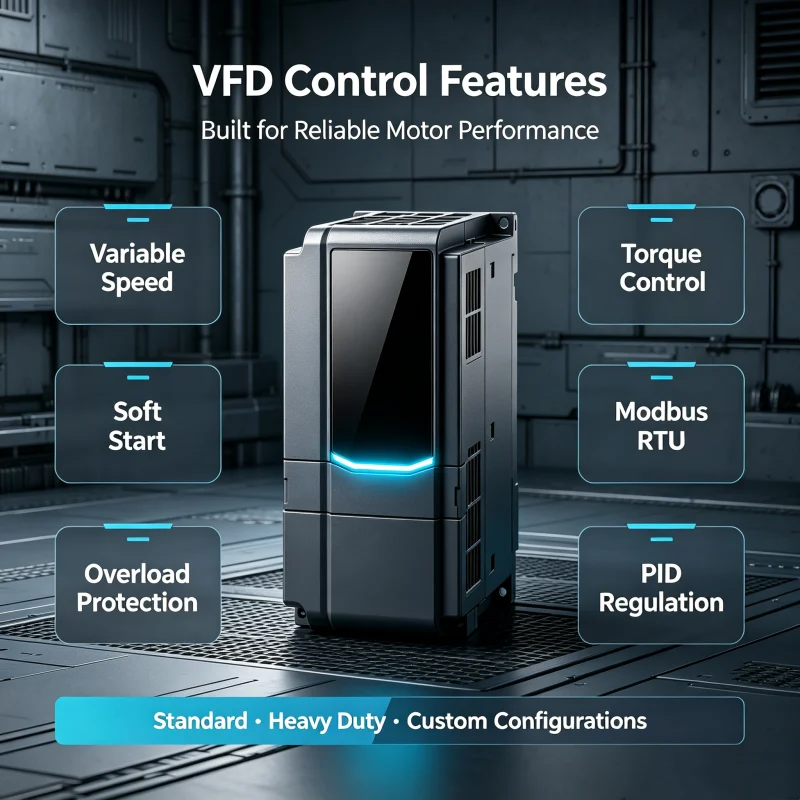
Depending on the application, a VFD can provide:
- Variable motor speed
- Adjustable acceleration and deceleration
- Torque control
- Soft motor starting
- Process speed regulation
- PID control
- Motor overload protection
- Overcurrent and overvoltage protection
- PLC and automation integration
- RS485 / Modbus communication
- Energy optimization for suitable loads
The most appropriate VFD depends on the motor power, rated current, voltage, load characteristics, required speed range, overload requirements, and operating environment.
| Application | Typical Equipment | Main VFD Function | Main Benefit |
|---|---|---|---|
| Water Treatment | Pumps | Flow and pressure control | Energy optimization |
| HVAC | Fans and pumps | Variable speed | Efficient airflow and circulation |
| Chiller Systems | Pumps and compressors | Capacity control | Process optimization |
| Mining | Conveyors, pumps, fans | Speed and torque control | Heavy-duty operation |
| Oil & Gas | Pumps and compressors | Process control | Stable operation |
| Manufacturing | Motors and machinery | Speed control | Production flexibility |
| Production Lines | Conveyors and machines | Synchronization | Process automation |
Industrial VFD Applications in Water Treatment
Water treatment is one of the most important applications for industrial VFD systems.
Water demand can change significantly throughout the day. A pump may need to operate at high speed during peak demand but require much less flow during low-demand periods.
Instead of operating the pump continuously at full speed, a VFD can adjust motor speed according to actual system requirements.
Typical water treatment VFD applications include:
- Raw water pumps
- Booster pumps
- Filtration pumps
- Wastewater pumps
- Sewage pumps
- Sludge pumps
- Cooling water pumps
- Circulation pumps
- Irrigation systems
- Water distribution systems
A VFD can receive feedback from pressure sensors, flow meters, tank-level sensors, or other process instruments and automatically adjust pump speed.
For example:
Low water demand → Lower pump speed
Higher water demand → Higher pump speed
This can improve pressure stability while potentially reducing energy consumption in suitable variable-flow systems.
For water treatment projects, engineers should consider pump rated power, motor current, required flow, pressure, minimum speed, operating hours, and system characteristics before selecting the VFD.
VFD Applications for Industrial Pumps
Pumps are among the most common industrial VFD applications, particularly centrifugal pumps.
Typical industrial pump applications include:
- Process water pumps
- Booster pumps
- Cooling water pumps
- HVAC circulation pumps
- Irrigation pumps
- Chemical process pumps
- Water treatment pumps
- Fire and utility water systems
- Industrial circulation systems
For centrifugal pumps, reducing motor speed can significantly reduce the required pump power under appropriate operating conditions.
This is related to the pump affinity laws:
Flow ∝ Speed
Pressure ∝ Speed²
Power ∝ Speed³
For this reason, VFD pump control can provide significant energy-saving potential when flow requirements vary.
However, the VFD should be selected according to the actual pump and motor characteristics rather than simply choosing a drive based on motor kW.
Important parameters include:
- Motor power
- Motor rated current
- Pump flow
- Pump pressure or head
- Required speed range
- Minimum operating speed
- Operating hours
- Load profile
- Ambient temperature
- Installation environment
For large industrial pump systems, VFD capacities such as 315kW, 400kW and 500kW may be required depending on the motor and project configuration.
VFD Applications in HVAC and Chiller Systems
HVAC systems often operate under changing thermal and airflow requirements.
A building, factory, hospital, commercial facility, or industrial plant may require different airflow and cooling capacity depending on occupancy, outdoor temperature, production activity, and operating schedules.
VFDs can be applied to HVAC fans and pumps to adjust motor speed according to actual demand.
Common HVAC applications include:
- Air handling unit fans
- Supply fans
- Return fans
- Exhaust fans
- Cooling tower fans
- Chilled water pumps
- Condenser water pumps
- Heating water pumps
- Ventilation systems
VFD-controlled fans can adjust airflow without continuously operating at maximum speed.
Similarly, VFD-controlled pumps can adjust water circulation according to pressure or temperature requirements.
VFDs for Chiller Systems
VFDs can also be used in suitable chiller applications for:
- Chilled water pumps
- Condenser water pumps
- Cooling tower fans
- Compressor motors
However, compressor VFD applications depend on the compressor design and manufacturer’s requirements.
Engineers should verify the compressor’s permitted operating speed range, cooling requirements, lubrication conditions, control method, and manufacturer’s specifications before selecting a VFD.
Heavy Duty VFD Applications in Mining
Mining equipment often operates under demanding conditions, including high mechanical loads, long operating hours, dust, vibration, and significant starting torque requirements.
This makes heavy duty VFD solutions particularly important for suitable mining applications.
Common applications include:
- Belt conveyors
- Crushers
- Mining pumps
- Ventilation fans
- Blowers
- Material handling equipment
- Processing machinery
- Dewatering systems
For mining applications, VFD selection should consider more than motor power.
Engineers should evaluate:
- Starting torque
- Continuous torque
- Overload capacity
- Acceleration time
- Deceleration requirements
- Ambient temperature
- Cooling method
- Enclosure protection
- Dust conditions
- Motor cable length
For crushers and heavily loaded conveyors, a VFD may need a higher overload rating and a heavy-duty control configuration.
Therefore:
A VFD for a mining conveyor or crusher should be selected according to motor current, torque requirements and application duty—not motor kW alone.
VFD Applications for Industrial Conveyors
Conveyor systems are widely used in manufacturing, logistics, mining, warehouses, ports, and material handling facilities.
A VFD can provide controlled speed and acceleration for different types of conveyors.
Common conveyor applications include:
- Belt conveyors
- Roller conveyors
- Screw conveyors
- Bucket conveyors
- Mining conveyors
- Packaging conveyors
- Material handling systems
A VFD can provide:
Adjustable Speed
Different production stages may require different conveyor speeds.
Smooth Acceleration
Gradual acceleration can reduce mechanical shock on belts, gears, couplings, and other components.
Controlled Deceleration
Controlled stopping can reduce sudden mechanical stress and improve process safety.
Process Synchronization
VFDs can integrate with PLC and automation systems to coordinate conveyor speed with upstream and downstream equipment.
For heavily loaded conveyors, engineers should pay particular attention to starting torque and overload capacity.
Industrial VFD Applications in Oil & Gas
Oil and gas facilities use motors across many stages of production, processing, transportation, and utility systems.
Suitable VFD applications can include:
- Process pumps
- Transfer pumps
- Cooling systems
- Fans
- Compressors
- Circulation systems
- Auxiliary process equipment
In these applications, process stability and reliability can be just as important as energy efficiency.
Important VFD selection considerations may include:
- Motor power
- Voltage
- Load type
- Speed range
- Overload capacity
- Cooling
- Enclosure
- Environmental conditions
- Communication
- Protection requirements
For projects involving hazardous areas, the complete electrical system must also comply with the applicable project and hazardous-area requirements. The VFD itself should not be assumed to be suitable for a hazardous location simply because it is described as an industrial drive.
Industrial VFD Applications for Compressors
Compressors can have significant electrical power requirements, making motor control an important consideration in industrial plants.
VFDs may be used for suitable:
- Air compressors
- Process compressors
- Gas compressors
- Refrigeration compressors
A VFD can allow motor speed to respond to changing process demand.
Potential advantages include:
- Adjustable compressor capacity
- Improved pressure control
- Reduced unloaded operation
- Controlled acceleration
- Reduced starting stress
- Process optimization
However, compressor applications require careful engineering.
The correct VFD depends on the compressor type, pressure requirements, operating speed, cooling method, lubrication system, motor characteristics, and compressor manufacturer’s specifications.
Therefore, a VFD should be selected in coordination with the compressor equipment requirements.
VFD Applications in Manufacturing and Production Lines
Manufacturing plants use many different motor-driven machines, and each production process can have different speed and torque requirements.
Typical applications include:
- Textile machinery
- CNC equipment
- Extruders
- Mixers
- Packaging machines
- Processing machines
- Blowers
- Material handling systems
- Production conveyors
- Automated machinery
In manufacturing, the primary reason for installing a VFD may not always be energy saving.
Instead, manufacturers may require:
- Precise speed adjustment
- Consistent production speed
- Controlled acceleration
- Controlled deceleration
- Torque regulation
- Process synchronization
- PLC integration
- Automated speed control
For example, a production line may need one motor to operate at a synchronized speed with another machine. A VFD can receive a speed reference from a PLC or other control system and adjust motor speed accordingly.
This makes VFDs an important component of modern industrial automation systems.
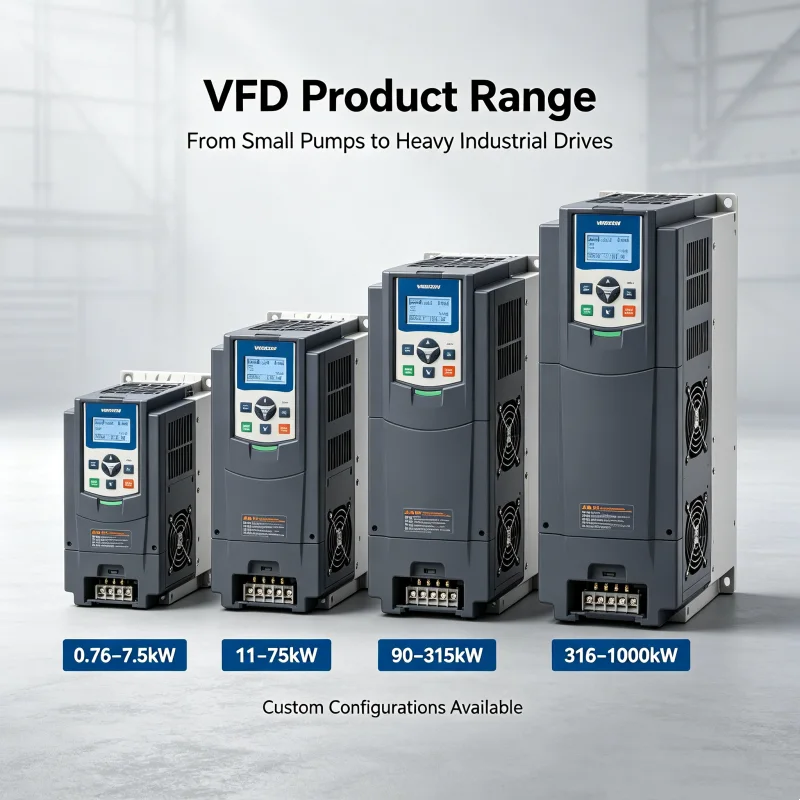
Industrial VFD Power Ratings and Motor Applications
Industrial VFDs are available across a wide range of motor capacities.
The appropriate VFD should always be selected based on the motor nameplate and application requirements.
A general application guide is shown below:
| VFD Power Range | Typical Industrial Applications |
|---|---|
| 0.75–7.5kW | Small pumps, fans and machinery |
| 11–30kW | HVAC, pumps and conveyors |
| 37–75kW | Industrial pumps, fans and compressors |
| 90–160kW | Large pumps, fans and material handling |
| 185–315kW | Water treatment, HVAC and industrial machinery |
| 315–500kW | Large pumps, fans, compressors and conveyors |
| 500–1000kW | Heavy industrial equipment and large motor systems |
These ranges are for general application guidance only. Actual VFD sizing should be based on motor rated current, load type, overload requirements, operating conditions and the required duty.
For example, a 315kW heavy-duty conveyor application may require a different VFD configuration from a 315kW centrifugal pump, even though both motors have the same nominal power rating.
How to Select the Right Industrial VFD
Selecting an industrial motor controller involves more than matching the VFD’s kW rating to the motor.
1. Check Motor Power
Start with the motor nameplate.
Common industrial ratings may include:
15kW, 30kW, 75kW, 110kW, 160kW, 315kW, 400kW and 500kW.
2. Check Motor Rated Current
Motor current is one of the most important VFD selection parameters.
The VFD should have sufficient continuous output current for the motor and application.
Do not select an industrial VFD by motor kW alone.
3. Identify the Load Type
Determine whether the application is:
- Variable torque
- Constant torque
- Heavy duty
- Constant power
A centrifugal pump and a crusher may have the same motor power but very different VFD requirements.
4. Check Voltage
Common industrial motor systems include:
- 220V
- 230V
- 380V
- 400V
- 415V
- 440V
- 460V
- 480V
The VFD must be compatible with the electrical supply and motor configuration.
5. Determine the Required Speed Range
For example:
25–50Hz
or
20–60Hz
The motor and driven equipment must be suitable for the selected operating range.
6. Check Overload Requirements
Heavy-duty applications may require higher overload capacity.
This is particularly important for:
- Crushers
- Conveyors
- Compressors
- Mixers
- Heavy machinery
7. Check Control and Communication
Depending on the automation system, you may require:
- V/F control
- Sensorless vector control
- Vector control
- PID control
- RS485
- Modbus RTU
- PLC integration
- HMI communication
- Digital and analog I/O
Learn More:VFD vs Soft Starter vs DOL Starter: Which Motor Control Method Is Best?
Why Choose a Professional Industrial VFD Manufacturer?
For a simple motor application, purchasing a standard drive may be sufficient.
However, industrial projects often require more than the VFD itself.
A professional industrial VFD supplier should be able to assist with:
- VFD model selection
- Motor matching
- Load analysis
- Overload selection
- Parameter configuration
- Control mode selection
- Communication configuration
- OEM customization
- Technical documentation
- Warranty support
- Project engineering
For large industrial projects, correct VFD selection can help prevent problems such as insufficient starting torque, overload trips, overheating, unstable speed control, and incorrect motor protection.
Custom Industrial VFD Solutions for OEM and Project Applications
Industrial equipment manufacturers and engineering contractors may require VFDs with customized configurations.
Depending on the project, customization may include:
- Input voltage
- Output voltage
- Frequency
- Motor power
- Overload capacity
- Control mode
- Enclosure configuration
- Cooling method
- Keypad and display
- Communication interface
- RS485 / Modbus
- PLC integration
- Braking configuration
- Protection functions
VoltNex Power provides industrial VFD solutions from 0.75kW to 1000kW for applications including pumps, fans, compressors, conveyors, HVAC, water treatment, mining, manufacturing, and other industrial motor control systems.
High-power configurations such as 315kW, 400kW and 500kW VFDs can be specified according to motor current, load characteristics and project requirements.
What Information Do You Need for an Industrial VFD Quote?
If you are purchasing a VFD for an industrial project, providing complete motor information can significantly speed up technical selection.
Ideally, send the following information:
| Parameter | Example |
|---|---|
| Motor Power | 315kW |
| Motor Voltage | 400V |
| Frequency | 50Hz |
| Rated Current | Motor nameplate value |
| Application | Centrifugal Pump |
| Load Type | Variable Torque |
| Required Speed | 25–50Hz |
| Overload Requirement | Standard / Heavy Duty |
| Quantity | 2 Sets |
| Installation | Panel / Cabinet / Wall Mounted |
A motor nameplate photo is often the easiest way to provide the necessary information.
For project applications, it is also useful to provide:
- Application description
- Existing starter/control system
- Operating hours
- Required speed range
- Ambient temperature
- Installation location
- Communication requirements
- Quantity
- Destination country
This allows the manufacturer or engineering supplier to recommend a more appropriate VFD configuration.
Industrial VFD Applications: Quick Selection Guide
The following guide provides a simple starting point:
| Application | Recommended VFD Focus |
|---|---|
| Water Treatment Pump | Variable torque, PID, pressure control |
| HVAC Fan | Variable torque, energy optimization |
| Chilled Water Pump | Variable speed and pressure control |
| Cooling Tower Fan | Variable-speed airflow control |
| Mining Conveyor | Heavy duty, starting torque, overload |
| Crusher | Heavy-duty torque and overload |
| Oil & Gas Pump | Process control and reliability |
| Compressor | Compressor compatibility and pressure control |
| Manufacturing Machine | Speed and torque control |
| Production Conveyor | Speed control and synchronization |