

























Solve Industrial Voltage Mismatch with the Right Transformer
Industrial equipment is not always designed for the same voltage available from the local power supply. Imported machinery, CNC equipment, automation systems, production lines, and commercial electrical equipment often require operating voltages different from the grid.
A properly selected voltage conversion transformer seamlessly matches available utility supply with required load voltage, while optimizing capacity, phase configuration, insulation, and protective performance.
Common Industrial Voltage Conversion Requirements
| Available Supply | Required Voltage | Typical Solution | Solicitud |
|---|---|---|---|
| 480V | 380V | Step-Down Transformer | Industrial Machinery |
| 480V | 400V | Step-Down Transformer | Factory Equipment |
| 480V | 220V | Step-Down / Isolation | Industrial Equipment |
| 480V | 208V | Step-Down / Isolation | Commercial & Industrial Systems |
| 400V | 220V | Step-Down Transformer | Machinery & Control Systems |
| 380V | 220V | Step-Down Transformer | Industrial Equipment |
| 220V | 110V | Step-Down Transformer | Control & Auxiliary Systems |
| 208V | 120V | Step-Down / Isolation | Equipment & Control Circuits |
| 600V | 480V | Step-Down Transformer | Industrial Power Systems |
| 380V | 480V | Step-Up Transformer | Industrial Distribution |
| 400V | 480V | Step-Up Transformer | Industrial Equipment |
| 208V | 480V | Step-Up Transformer | Specialized Equipment |
Tailored Solution
Need a Custom Voltage Ratio?
Voltnex Power manufactures custom industrial transformers tailored to your exact voltage, capacity, and enclosure specs.
100V – 1000V
1-Phase & 3-Phase
NEMA 1 / 3R / IP54
IEC & IEEE Compliant
Engineers reply within 24 hours
Transformer Solutions for Voltage Conversion
Different electrical systems require specialized transformer configurations. Voltnex Power provides high-reliability dry-type and isolation transformer engineered for step-up, step-down, and precise voltage conversion applications.

Reduce a higher supply voltage to the level required by industrial equipment and electrical systems.
- Industrial machinery
- CNC equipment
- Factory distribution
- Production lines
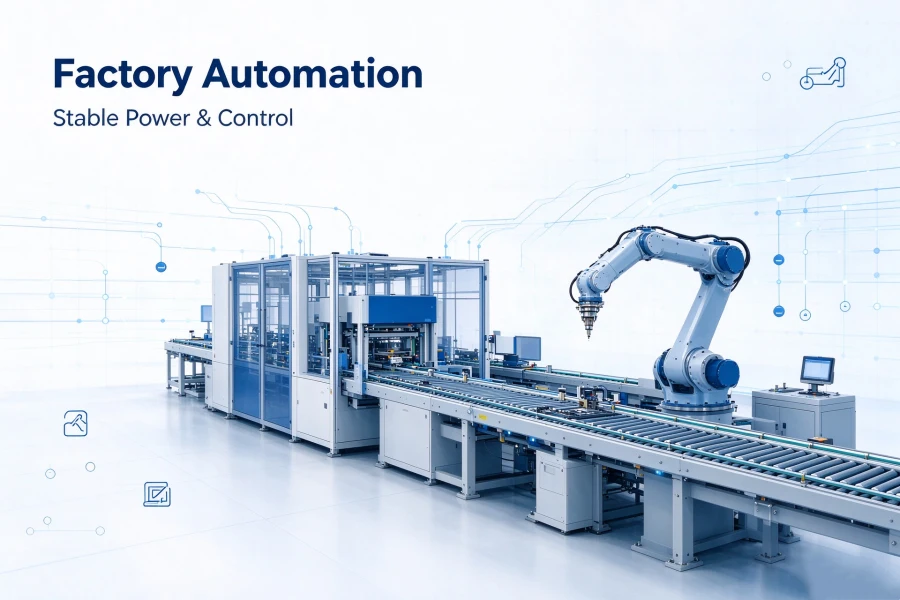
- Automation systems
- Commercial buildings
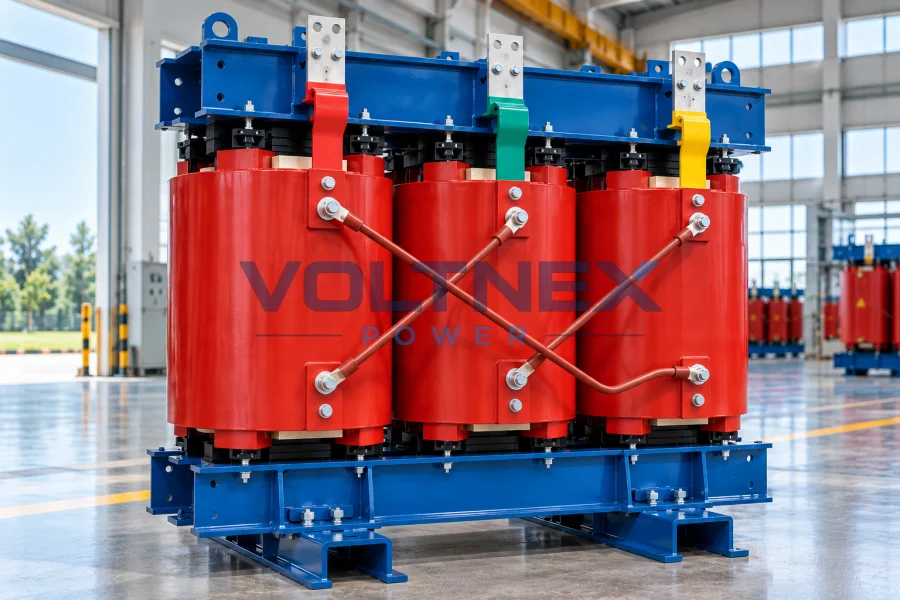
Increase the available supply voltage when equipment or distribution systems require a higher operating voltage.
- Industrial power systems
- Specialized machinery
- Power distribution
- Renewable energy systems
- Equipment voltage matching
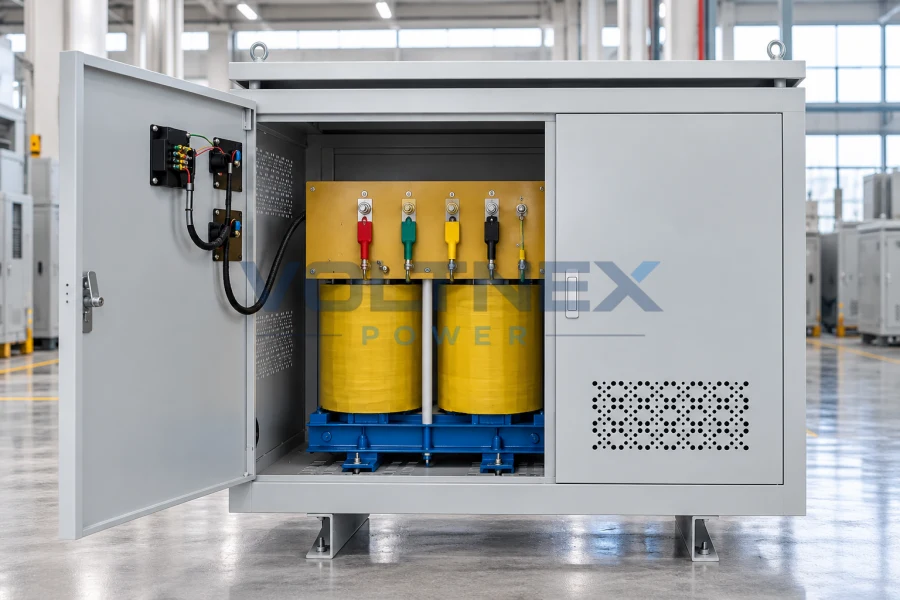
Combine voltage conversion with electrical isolation where required by the application.
- CNC machines
- Industrial automation
- Control systems
- Laboratory equipment
- Sensitive electrical loads
- Industrial power systems
How to Select a Voltage Conversion Transformer
Ensure optimal performance and longevity by evaluating these 7 essential technical parameters before specifying your transformer.
Consider load, inrush current & future expansion
Trifásico
(Required / Optional)
Indoor / Outdoor
|
TECHNICAL PARAMETERS
Custom Voltage Conversion Transformer Specifications
|
|
|
Industrial Applications
|
CNC Machines
|
Automatización industrial
|
Imported Machinery
|
|
Industrial Manufacturing
|
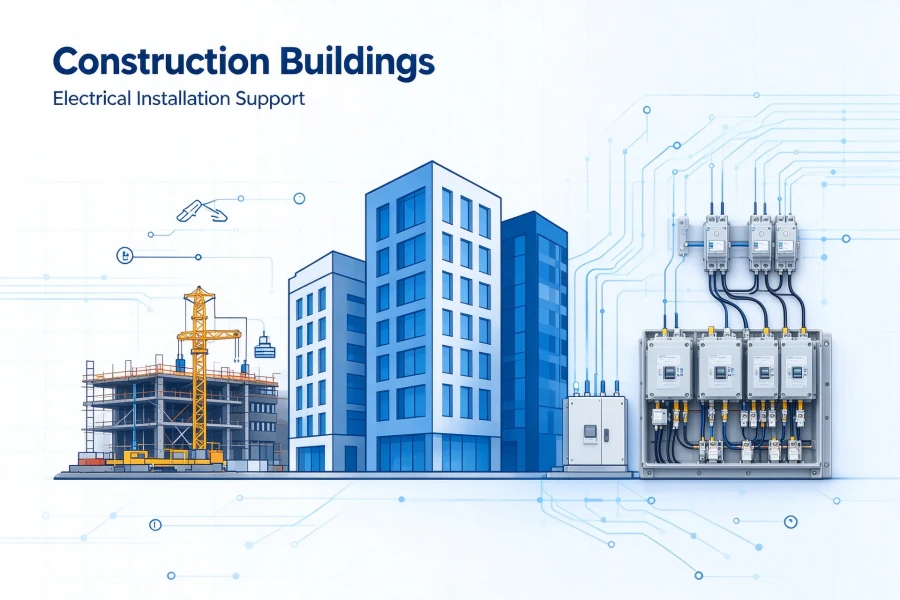
Commercial Buildings
|
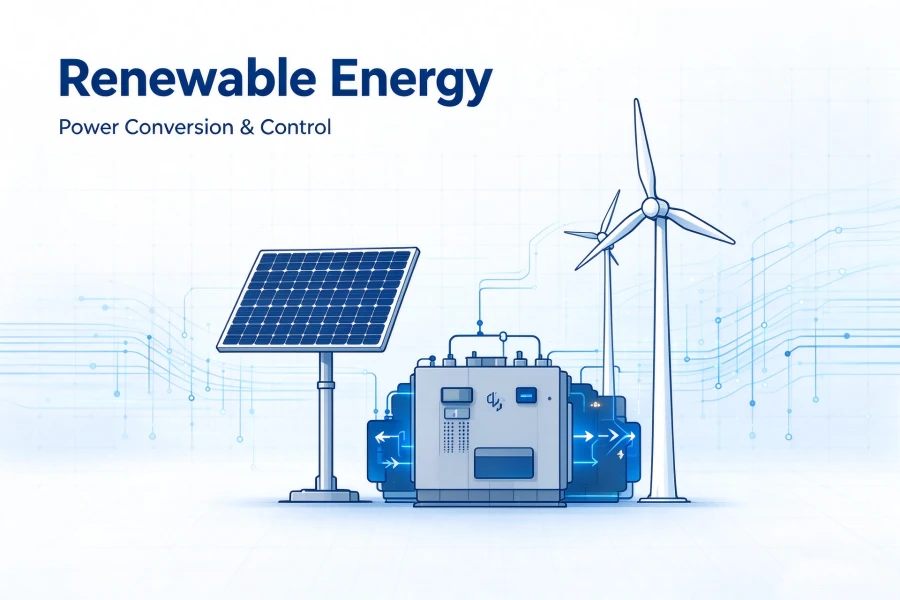
Energía renovable
|



Transformer or AVR: Which Do You Need?
Compare core functions to select the right voltage unit.
Transformer + AVR Combo Solution
Integrated system for unsuited and unstable voltage.
480V Fluctuation
480V → 400V
±1% Precision
400V Stable
Custom Manufacturing Options
Tailored electrical specifications designed for your unique project.
Factory Manufacturing & Engineering Support
Solves voltage mismatch when available power differs from equipment requirements.
• 400V → 220V
• 220V → 110V
Stabilizes grid fluctuations to supply a continuous, steady output voltage.
• Output precision ±1%
• Fast response <15ms
From Engineering Review to Finished Transformer
Voltnex Power supports the complete manufacturing process with rigorous quality control:
Why Choose Voltnex Power?
What Information Do We Need for a Transformer Quote?
Please provide the following details:
Input Voltage
Output Voltage
Capacity
Fase
Frequency
Quantity
Solicitud
Indoor / Outdoor
Required Standard
Enclosure
Special Requirements
Destination Country
Example
- 480V — 380V
- 150kVA
- 3 Phase
- 60Hz
- Dry Type
- Indoor
- Quantity: 2 Units
Don’t Have All Specs?
No problem. Send us your equipment nameplate, existing transformer datasheet, electrical drawing, or basic voltage requirements. Our engineering team can review and recommend a suitable configuration.
We will guide you through the process and help you select the exact transformer for your project.
Voltage Conversion Transformer FAQ
A voltage conversion transformer is a static electrical device designed to transfer electrical energy between two or more circuits through electromagnetic induction, specifically to alter alternating current (AC) voltage levels. It adjusts incoming grid or generator supply voltage (primary voltage) to the specific operating level required by downstream machinery, industrial controls, or electrical equipment (secondary voltage). By stepping up or stepping down voltage without changing frequency, a voltage conversion transformer ensures seamless power compatibility, operational safety, and system stability across different regional grid standards and industrial equipment specifications.
Yes, absolutely. We manufacture custom and standard 480V to 220V step-down transformers specifically engineered for industrial and commercial power distribution. This configuration is widely utilized in facility integration where standard North American 480V 3-phase utility power needs to feed 220V 3-phase or single-phase machinery imported from regions such as Asia or Europe, or for lower-voltage control panels, auxiliary motors, and lighting circuits. Our 480V to 220V transformers can be customized in terms of kVA capacity, winding materials (copper or aluminum), enclosure protection ratings (IP20/IP23 for indoor or IP54/NEMA 3R for outdoor), and isolation requirements.
Yes, we engineer and manufacture a full range of step-up transformers designed to increase primary supply voltage to a higher secondary voltage level. Step-up transformers are essential when local utility grid voltage is lower than the input requirement of high-power machinery, renewable energy setups, long-distance transmission lines, or specialized commercial equipment (for example, stepping up 208V/220V/240V utility power to 380V, 415V, or 480V). Our step-up units are built to handle high inrush currents, heavy continuous loads, and stringent thermal limits to maintain high energy efficiency and low total harmonic distortion (THD).
While both devices manage electrical power, their primary core functions are fundamentally different:
-
Transformer: A static device that alters AC voltage levels at a fixed turn ratio (e.g., converting 480V to 380V). A standard transformer does not actively adjust or regulate utility line fluctuations; if the input line voltage fluctuates by ±10%, the secondary output voltage will also fluctuate by ±10% proportionally.
-
Automatic Voltage Regulator (AVR): An active electrical control system designed to automatically stabilize unstable or fluctuating mains supply voltages, maintaining a precise target output (e.g., keeping voltage stable at 380V ±1%) regardless of incoming voltage sags, surges, or transients.
If your facility experiences clean utility power but needs a different operating voltage level, a transformer is required. If your power source suffers from severe line instability, an AVR—or a combined transformer-AVR unit—is recommended.
No, a standard dry-type or oil-immersed transformer does not actively stabilize dynamic line voltage fluctuations. A passive transformer operates on a fixed winding ratio: any percentage variation in the primary input voltage will result in a corresponding percentage shift in the secondary output voltage. However, transformers do provide essential passive benefits, such as electrical isolation (filtering common-mode noise and electrical spikes in isolation transformer models) and line impedance stabilization. If active voltage regulation is needed to protect sensitive electronic machinery from grid fluctuations, an Automatic Voltage Regulator (AVR) or Voltage Stabilizer should be specified alongside the transformer.
Determining the correct transformer capacity (measured in kVA) involves calculating the total electrical load of your equipment and accounting for operating safety margins:
-
Calculate Total Load: Sum the maximum operating current (Amps) and voltage (Volts) required by all connected machinery, or check the equipment nameplate for power consumption in kW or kVA.
-
Account for Inrush Current: Machinery equipped with electric motors, compressors, CNC spindles, or inductive heating elements draws high starting currents (inrush currents) that can be 3 to 7 times higher than normal operating current.
-
Safety Margin & Future Expansion: We strongly recommend sizing the transformer with a 20% to 30% safety margin above continuous peak operating load to prevent thermal overload, voltage sag during startup, and premature insulation degradation.
If you are unsure of your load profile, our engineering team can review your equipment nameplates or electrical single-line diagrams to recommend the exact kVA rating needed.
Yes, 480V to 380V step-down transformers are among our most frequently requested configurations for industrial cross-border equipment deployment. This ratio is specifically engineered to adapt North American 480V / 60Hz industrial electrical supplies to 380V equipment built for European, Asian, and Latin American industrial standards. We supply these units in both autotransformer (compact and cost-effective) and isolation transformer (galvanic separation for noise suppression and electrical safety) topologies across a wide capacity range, from 5 kVA up to several megavolt-amperes (MVA).
Yes, converting 400V 3-phase utility grid power to 220V (either 3-phase or single-phase) is a standard application for industrial step-down transformers. This is widely used in facilities across Europe, Australia, the Middle East, and parts of Asia where 400V 3-phase supply is standard, but specialized production lines, imported machine tools, or auxiliary control devices demand 220V input. Our transformers ensure smooth voltage step-down while maintaining precise phase balance, thermal dissipation, and short-circuit withstand capabilities.
Yes, we manufacture high-performance dry-type isolation transformers featuring complete galvanic isolation between primary and secondary windings. Unlike standard autotransformers, isolation transformers physically separate input and output circuits, providing key technical advantages:
-
Electrical Noise & Spike Suppression: Eliminates high-frequency electrical noise, transient spikes, and ground loops.
-
Personnel & Equipment Safety: Prevents accidental shock hazards by decoupling the load from the utility ground reference.
-
Harmonic Attenuation: Protects sensitive CNC machines, medical instruments, automation PLCs, and telecom systems from upstream grid harmonics.
Our isolation transformers can also be customized with electrostatic shielding between windings for superior electromagnetic compatibility (EMC).
Yes, our voltage conversion transformers are fully compatible with both 50Hz and 60Hz power frequencies. A passive transformer operates on the frequency supplied to it by the incoming grid or power source (i.e., a 50Hz input yields a 50Hz output, and a 60Hz input yields a 60Hz output).
When designing transformers intended for cross-frequency operation (such as 50Hz equipment deployed in a 60Hz grid region, or vice versa), our engineers optimize the magnetic core flux density, copper wire gauges, and lamination steel grades. This prevents core saturation, minimizes iron losses, and avoids excessive temperature rise when operating under continuous duty.
Yes, custom voltage ratios are a core specialization of our manufacturing facility. Beyond standard commercial voltages (208V, 220V, 380V, 400V, 415V, 440V, 480V, 600V), we engineer custom primary and secondary winding taps to match any non-standard utility supply or specialized machinery requirement. We can also integrate multiple primary or secondary taps (e.g., dual input 480V/240V or multi-tap outputs) into a single transformer enclosure to provide flexible voltage switching for versatile industrial installations.