












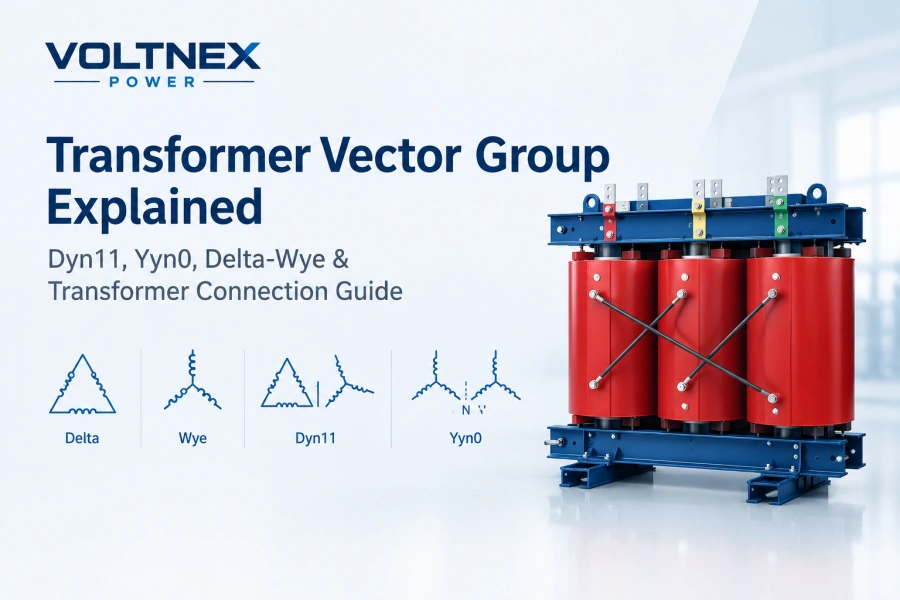
Choosing the correct transformer connection is important for voltage conversion, phase relationships, grounding, system compatibility, and reliable industrial power distribution. For three-phase transformers, terms such as Dyn11, Yyn0, Delta-Wye, Wye-Delta, and transformer vector group describe how the primary and secondary windings are connected and how their phase voltages are displaced.
For industrial equipment, factory automation, commercial buildings, CNC machinery, renewable energy systems, and power distribution projects, understanding transformer vector groups helps engineers select a transformer that is electrically compatible with the existing system.
This guide explains transformer vector groups, Dyn11, Yyn0, Delta-Wye connections, phase displacement, and practical transformer selection considerations.
What Is a Transformer Vector Group?
A transformer vector group identifies the connection configuration of the three-phase transformer windings and the phase displacement between the primary and secondary voltages.
The vector group normally contains:
- A capital letter for the high-voltage winding connection
- A lowercase letter for the low-voltage winding connection
- A clock-hour number representing phase displacement
- N/n when a neutral point is brought out
Common winding connection symbols include:
For example, Dyn11 means the high-voltage winding is connected in Delta, the low-voltage winding is connected in Star/Wye with a neutral point, and the secondary has a specific phase displacement represented by clock position 11.
Understanding these designations is particularly important when connecting transformers to existing three-phase electrical systems.
What Does Dyn11 Mean on a Transformer?
Dyn11 is one of the most common vector groups used for three-phase distribution and industrial transformers.
The designation can be separated into three parts:
D — High-Voltage Delta
The primary or high-voltage winding is connected in a Delta configuration.
y — Low-Voltage Wye
The secondary or low-voltage winding is connected in a Wye (Star) configuration.
n — Neutral
The neutral point of the low-voltage winding is brought out for connection to the system.
11 — Phase Displacement
The number 11 represents the phase displacement using the clock notation system.
Therefore:
Dyn11 = Delta primary + Wye secondary + neutral + clock-hour phase displacement
This configuration is widely used where a three-phase transformer needs to provide a line-to-neutral secondary supply in addition to three-phase power.
For example, a transformer with a 480V primary and 208Y/120V secondary can provide 208V three-phase power together with 120V line-to-neutral power for suitable industrial and commercial loads.
What Does Yyn0 Mean?
Yyn0 represents another common three-phase transformer connection.
It means:
- Y = High-voltage winding connected in Wye
- y = Low-voltage winding connected in Wye
- n = Neutral brought out on the low-voltage side
- 0 = Zero phase displacement
Therefore:
Yyn0 = Wye primary + Wye secondary + neutral + zero phase displacement
Yyn0 can be suitable for applications where the system requires a neutral connection and the primary and secondary voltages maintain the specified phase relationship.
The appropriate vector group depends on the electrical system, grounding arrangement, load characteristics, parallel operation requirements, and project specifications.
Delta-Wye Transformer Connection Explained
A Delta-Wye transformer uses a Delta connection on one winding and a Wye connection on the other.
This configuration provides several advantages for industrial power systems.
A Wye-connected secondary can provide:
- Three-phase line-to-line voltage
- Line-to-neutral voltage
- A defined neutral point
- Flexible distribution for mixed three-phase and single-phase loads
This makes Delta-Wye transformers useful for:
- Industrial factories
- Commercial buildings
- Manufacturing facilities
- CNC machine power systems
- Factory automation
- Equipos accionados por motor
- Control systems
- Electrical distribution panels
- Industrial machinery
For example, an industrial facility may have a 480V three-phase supply but require 208Y/120V for equipment, control systems, receptacles, lighting, and auxiliary electrical loads.
A properly specified three-phase transformer can provide the required voltage conversion while maintaining the required electrical connection configuration.
Dyn11 vs Yyn0: What Is the Difference?
Dyn11 and Yyn0 are not simply different names for the same transformer. They represent different winding configurations and phase relationships.
The correct choice depends on the requirements of the electrical system rather than simply choosing the most common vector group.
When a transformer is being installed as a replacement or integrated into an existing system, engineers should verify the required vector group, voltage ratio, frequency, grounding arrangement, impedance, and phase sequence before ordering.
Why Is Transformer Vector Group Important?
Transformer vector group affects more than the internal winding arrangement.
It can influence:
1. Phase Relationship
The phase displacement between primary and secondary voltages must be compatible with the electrical system.
2. Transformer Parallel Operation
When two transformers are intended to operate in parallel, their vector groups and other important electrical characteristics must be compatible.
3. Grounding and Neutral Availability
A Wye-connected winding with an accessible neutral can provide useful options for three-phase four-wire distribution systems.
4. System Compatibility
Replacing an existing transformer requires more than matching the kVA rating and voltage. The vector group should also match the project requirements.
5. Industrial Equipment Power Supply
CNC machines, automation systems, motors, drives, control panels, and production equipment may have specific voltage and connection requirements.
How to Choose the Right Transformer Vector Group
Before specifying a transformer, consider the complete electrical system rather than selecting the vector group independently.
Important parameters include:
Primary voltage: 208V, 380V, 400V, 415V, 440V, 480V, 575V, 600V, or custom voltage
Secondary voltage: 120V, 208V, 220V, 230V, 240V, 380V, 400V, or other required voltage
Phase: Monofásico o trifásico
Frequency: 50 Hz o 60 Hz
Capacidad: From small control transformers to large industrial transformers
Vector group: Dyn11, Yyn0, or another project-specified configuration
Impedance: According to system and short-circuit requirements
Insulation class: Such as Class F or Class H for suitable dry-type designs
Enclosure: Indoor, IP20, IP23, IP54, or project-specific requirements
Application: Industrial machinery, factory distribution, automation, commercial buildings, solar PV, BESS, or other electrical systems
For custom industrial transformers, providing the complete electrical requirements is more reliable than specifying only the input and output voltage.
Dyn11 and Yyn0 for Industrial Dry Type Transformers
Dry type transformers are widely used where oil-free construction, indoor installation, fire-safety considerations, and convenient maintenance are important.
A custom dry type isolation or distribution transformer can be designed with the required voltage ratio, vector group, insulation system, enclosure, cooling method, and installation configuration.
Typical applications include:
- Factory automation production lines
- CNC machines
- Industrial control systems
- Manufacturing plants
- Commercial buildings
- Renewable energy systems
- Electrical distribution
- Imported machinery
- Power conversion projects
For projects involving imported machinery, the transformer can also be designed to match the local power supply with the equipment’s required operating voltage.
Frequently Asked Questions About Transformer Vector Groups
What is the most common transformer vector group?
Dyn11 is widely used for many three-phase distribution and industrial transformer applications, but the correct vector group depends on the electrical system and project requirements.
What is the difference between Dyn11 and Yyn0?
Dyn11 uses Delta on the high-voltage winding and Wye with neutral on the low-voltage winding, with the specified phase displacement. Yyn0 uses Wye connections on both windings with a neutral and zero phase displacement.
Can Dyn11 and Yyn0 transformers be used interchangeably?
Not necessarily. Vector group, phase displacement, grounding, system configuration, and application requirements must be checked before replacing one transformer with another.
Does vector group affect transformer parallel operation?
Yes. Transformers operating in parallel generally require compatible vector groups and other electrical characteristics.
Can Voltnex manufacture a custom Dyn11 transformer?
Yes. Voltnex Power provides custom three-phase dry type and isolation transformer solutions with specified voltage ratios, capacities, frequencies, vector groups, enclosures, and other electrical requirements for industrial and international projects.
Conclusion
Transformer vector group is an important specification when selecting a three-phase transformer for industrial power distribution. Dyn11, Yyn0, Delta-Wye, and Wye-Wye connections determine the relationship between transformer windings, neutral availability, and phase displacement.
For industrial applications, selecting a transformer should involve more than matching kVA and voltage. Engineers should consider vector group, voltage ratio, frequency, impedance, grounding, phase sequence, insulation, enclosure, and the actual characteristics of the connected equipment.
Voltnex Power manufactures custom dry type transformers, isolation transformers, industrial transformers, and voltage conversion transformers for factory automation, machinery, commercial buildings, renewable energy projects, and industrial power distribution. Customers can provide their required voltage, kVA, frequency, vector group, installation conditions, and application, and Voltnex can develop a transformer configuration according to the project requirements.
Need a custom Dyn11, Yyn0, Delta-Wye, or other three-phase transformer? Contact Voltnex Power for a technical and commercial quotation.