
























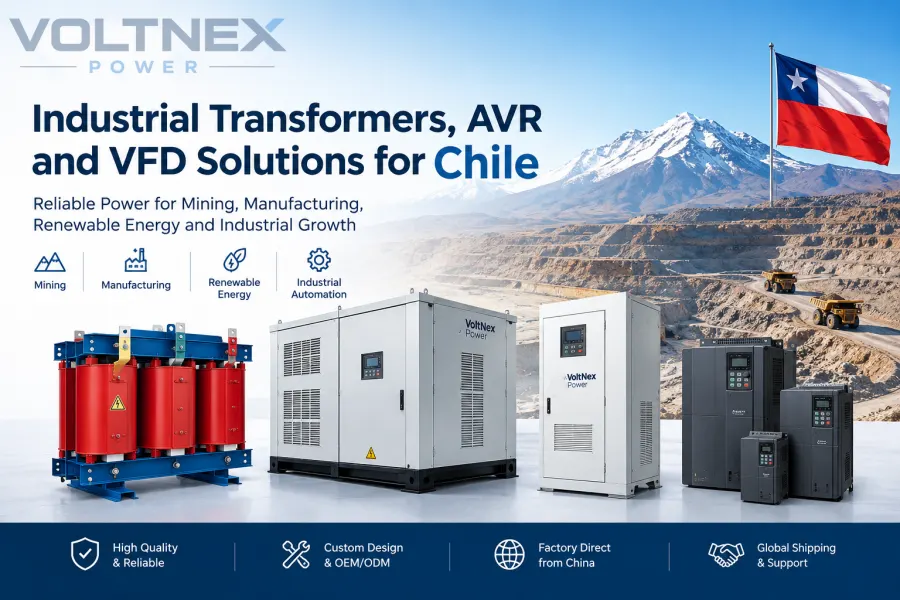
Chile’s industrial, mining, and renewable energy sectors require robust, precision-engineered power equipment. From the high-altitude copper mines in the Atacama region to manufacturing facilities and water treatment plants across Santiago, Antofagasta, and Valparaíso, electrical stability and motor control are critical to preventing catastrophic operational downtime.
When sourcing βιομηχανικοί μετασχηματιστές, Αυτόματοι ρυθμιστές τάσης (AVR), and Variable Frequency Drives (VFD) for projects in Chile, standard off-the-shelf equipment often fails to meet harsh field demands. Electrical engineers and procurement managers must select equipment tailored to local grid standards, high-altitude derating, and specific environmental factors.
In this comprehensive guide, we break down Chilean grid parameters, SEC compliance, engineering design considerations for mining environments, real-world application scenarios, and how to choose the right power solutions for your facility.
1. Chilean Electrical System Specifications & SEC Compliance
Before selecting power equipment, you must verify the primary electrical parameters and regulatory requirements of your installation site in Chile:
System Frequency: Chile operates on a 50 Hz electrical standard.
Low-Voltage Standards: Standard low-voltage industrial systems operate at 380V (3-Phase) and 220V (Single-Phase). However, many imported mining equipment and automated production lines from the US, Europe, or Asia require custom stepping (e.g., 380V → 480V, 440V, 208V, or 600V).
Grid Volatility: In heavy industrial zones, sudden motor start-ups and long-distance transmission lines often cause severe voltage sags, surges, and harmonic distortion.
Regulatory Compliance (SEC Standard): Electrical installations in Chile must comply with regulations enforced by the Superintendencia de Electricidad y Combustibles (SEC). Equipment carrying CE and UL certifications provides the essential baseline for passing SEC project inspections and customs clearance smoothly.
2. Core Industrial Equipment Solutions for Chile
A. Dry Type Isolation & Control Transformers
Direct electrical connections between utility grids and control systems can expose sensitive electronics to voltage spikes and noise.
Galvanic Isolation: Separates primary and secondary circuits, preventing ground loops and harmonic feedback.
Custom Voltage Step-Up / Step-Down: Seamlessly matches 380V Chilean distribution power to imported machinery requirements.
Core Series: JBK Series Control Transformers (for machine tools and automation panels) and JMB Series Lighting/Isolation Transformers engineered with high-grade H-class copper or aluminum windings.
B. Automatic Voltage Regulators (AVR) & Industrial Stabilizers
Severe voltage fluctuations cause equipment overheating, erratic PLC behavior, and premature component failure.
Dynamic Voltage Regulation: Maintains constant output voltage even during severe grid fluctuations.
High Overload Capacity: Engineered to handle the heavy inrush currents of industrial motors and heavy machinery without waveform distortion.
C. Variable Frequency Drives (VFD) for Precise Motor Control
AC drives allow precise control over motor speed, torque, and acceleration while dramatically reducing energy consumption.
Energy Savings: Optimizes pump, fan, and compressor power consumption.
Soft-Start Capability: Eliminates sudden mechanical shocks and high electrical stress on motor windings during start-up.
3. Engineering for Harsh Operating Environments in Chile
High-Altitude Derating (Mining & High-Andes Projects)
Many mining operations in northern Chile sit over 2,000 to 4,000 meters above sea level. Thinner air decreases cooling efficiency and electrical dielectric strength.
Thermal Optimization: Transformers and VFDs installed in high-altitude mines require expanded cooling channels and custom-designed thermal dissipation margins.
Insulation Clearance: Increased creepage distance and enhanced insulation class prevent arc-overs in low air density environments.
Dust, Humidity & Desert Protection
Desert Dust (Atacama Region): Requires custom enclosure protection ratings (e.g., IP23, IP54, or custom NEMA enclosures) with dust filtration to protect copper windings and electronic circuit boards.
Coastal Corrosion (Ports & Coastal Facilities): Anti-corrosive cabinet coatings and tropicalized circuit boards shield components from salt spray and humidity.
4. Real-World Application Scenarios in Chile
5. Case Highlight: Custom Transformers for Mining Projects in Antofagasta
Recently, VoltNex Power engineered and delivered custom 500kVA dry-type step-up isolation transformers for a mineral processing facility near Antofagasta, Chile.
The Challenge: The client imported 480V processing equipment from North America, but local site power was 380V / 50Hz at an elevation of 2,800 meters.
The Solution: VoltNex Power designed a custom 380V to 480V 50Hz isolation transformer with H-class insulation, high-altitude thermal derating, and an IP54 outdoor protective enclosure.
The Result: The system passed site commissioning on the first inspection with zero downtime.
6. Frequently Asked Questions (FAQ)
Q1: Can VoltNex Power manufacture 50Hz transformers and AVRs matching Chilean 380V/220V standards?
Yes. All our dry-type transformers, voltage regulators, and VFDs can be fully customized for 50Hz operation and any voltage ratio (e.g., 380V → 480V, 380V → 208Y/120V, or 220V single-phase).
Q2: How do you handle high-altitude derating for mining equipment in Chile?
We calculate thermal dissipation based on your site’s altitude above sea level. We adjust winding temperature rise allowances, increase dielectric insulation spacing, and use high-airflow cooling configurations.
Q3: What international safety certifications do your products hold?
VoltNex Power products carry CE, UL, and ISO9001 certifications, ensuring compliance with international electrical standards and smooth customs clearance into Chile.
Q4: Do you offer OEM/ODM services for Chilean distributors and panel builders?
Yes. We provide complete OEM/ODM solutions including custom branding, private labeling, modified enclosure dimensions, custom terminal layouts, and specialized wiring diagrams.
Q5: What is the typical lead time for custom power equipment to Valparaíso or Iquique ports?
Standard production for custom units takes 2–3 weeks. Sea freight from major Chinese ports to Chilean main ports (Valparaíso / San Antonio / Iquique) typically takes 30–35 days.
Partner with VoltNex Power for Your Projects in Chile
Whether you are designing an industrial control panel, upgrading a mining facility, or sourcing power equipment for the South American market, choosing the right transformer, AVR, or VFD is vital to project success.
Need technical datasheets, CAD drawings, or a custom wholesale quotation for your project in Chile?
📩 Contact Our Sales Engineering Team: inquiry@voltnexpower.com
🌐 Explore Our Complete Product Catalog: https://voltnexpower.com/