

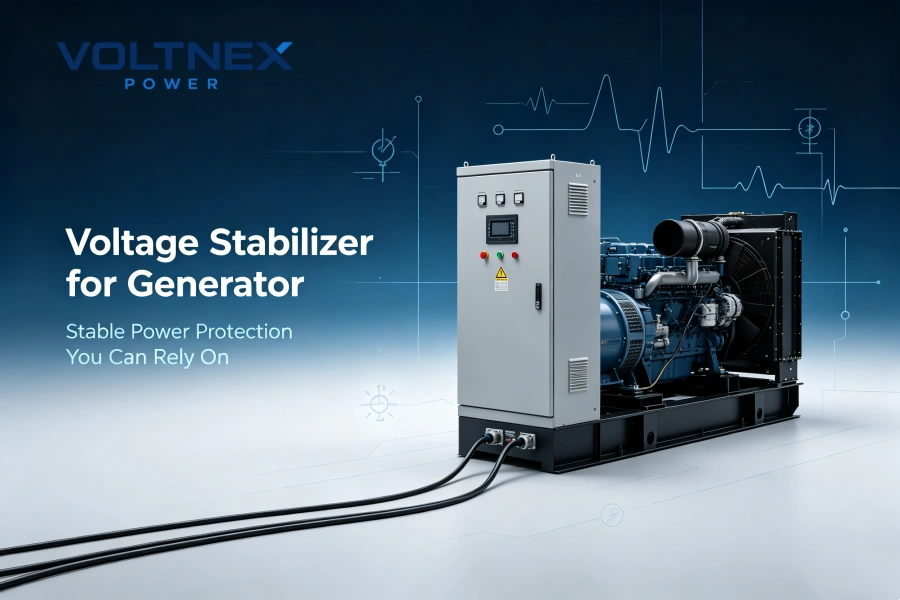
A voltage stabilizer for generator is an external power regulation device used to maintain stable AC voltage between a generator and connected electrical equipment. It can be used with diesel generators, gasoline generators, portable generators and standby generators when additional voltage regulation is required.
Most generators already have a built-in AVR (Automatic Voltage Regulator). However, generator output can still fluctuate when loads change suddenly, motors start, engine speed varies or the generator operates under heavy load. An external automatic voltage stabilizer provides an additional stage of voltage regulation to help protect sensitive equipment and maintain a more stable power supply.
Why Does Generator Voltage Fluctuate?
Generator voltage can change because of the generator itself and the connected load.
Common causes include:
- Sudden starting of motors, pumps or compressors
- Large changes in connected load
- Generator engine speed fluctuations
- Overloaded or aging generators
- Unbalanced three-phase loads
- Long cables and voltage drops
- Welding equipment and other high-inrush loads
These voltage variations may cause electronic equipment to shut down, motors to operate inefficiently, or sensitive electrical components to experience additional stress.
For equipment that requires stable voltage, adding a suitable generator voltage stabilizer can provide an extra level of protection.

How Does a Voltage Stabilizer Work with a Generator?
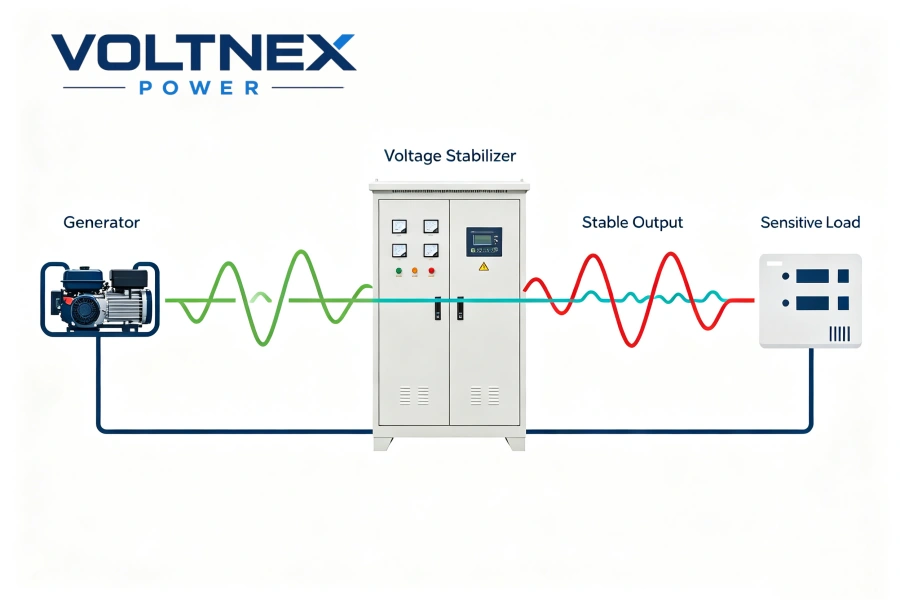
The stabilizer continuously monitors the generator’s output voltage and automatically corrects fluctuations before the power reaches the connected load.
It generally works by:
- Boosting voltage when the generator output is too low
- Reducing voltage when the generator output is too high
- Monitoring voltage continuously
- Protecting the load against abnormal operating conditions
The external stabilizer does not normally replace the generator’s built-in AVR. Instead, it works downstream as an additional voltage regulation device.
Types of Voltage Stabilizers for Generators
Different generator loads require different voltage stabilization technologies.
Servo Voltage Stabilizer
A servo voltage stabilizer uses a motor-driven mechanism to provide smooth and relatively high-accuracy voltage regulation. It is suitable for CNC machines, automation equipment, medical equipment, communication systems and other applications requiring stable voltage.
Static Voltage Stabilizer
A static voltage stabilizer uses electronic control technology for fast voltage correction. It can be suitable for servers, data centers, communication equipment and sensitive electronic loads where rapid response is important.
Relay Voltage Stabilizer
A relay voltage stabilizer adjusts transformer taps in discrete steps. It is a practical and economical solution for residential generators, commercial equipment and general electrical loads where extremely high regulation precision is not required.
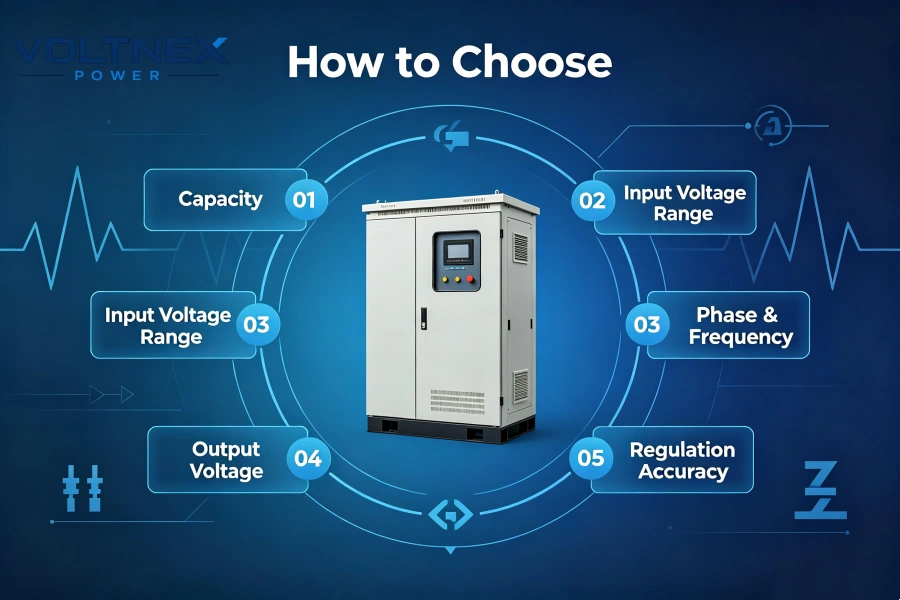
How to Choose a Voltage Stabilizer for a Generator
The stabilizer should be selected according to both the generator and the connected load.
1. Capacity
Check the generator’s rated kVA and actual connected load. Allow additional capacity for motor starting currents, compressors, pumps and other inductive loads.
2. Input Voltage Range
The stabilizer’s input range must cover the voltage fluctuations produced by the generator.
3. Output Voltage
Choose the required output voltage according to the electrical equipment, such as 120 V, 220 V, 230 V, 380 V, 400 V, 415 V, 440 V or other customized voltages.
4. Phase and Frequency
Confirm whether the generator is single-phase or three-phase and whether the system operates at 50 Hz or 60 Hz.
5. Regulation Accuracy
Relay models can meet general load requirements, while servo or static voltage stabilizers can be selected when tighter voltage regulation or faster correction is required.
Typical Applications
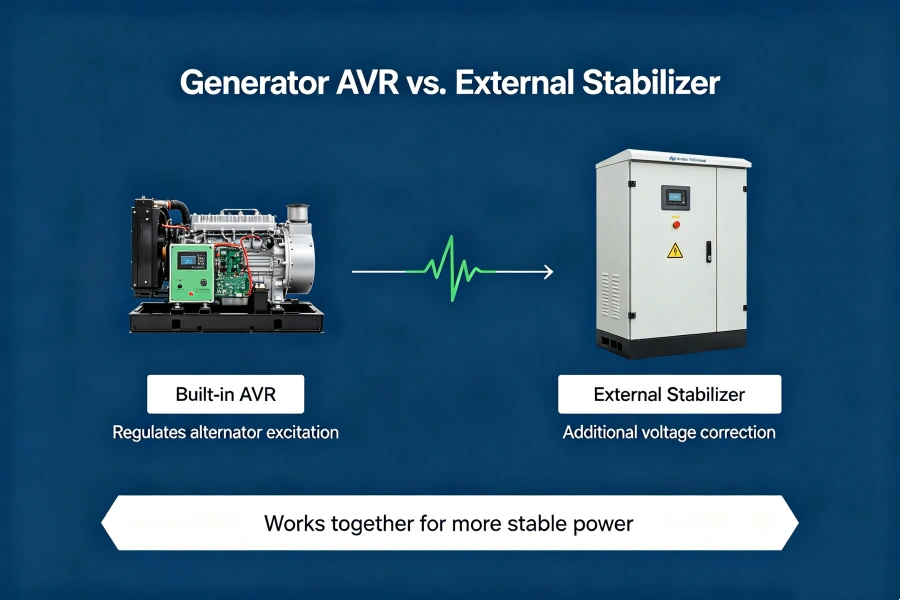
Generator AVR vs. External Voltage Stabilizer
A generator’s built-in AVR and an external voltage stabilizer have related but different functions.
The generator AVR regulates the alternator’s excitation to help maintain generator output voltage. An external voltage stabilizer is installed between the generator and the load to provide additional voltage correction.
An external stabilizer may be useful when:
- Generator voltage fluctuations are relatively large
- The load contains sensitive electronics
- Large motors cause voltage drops during starting
- The application requires tighter voltage regulation
- Additional centralized power protection is required
However, the stabilizer must be compatible with the generator’s voltage, frequency, waveform, neutral configuration and load characteristics.
Installation & Safety
For reliable operation:
- Install the stabilizer between the generator and protected load when required by the system design.
- Select a capacity suitable for the maximum load and starting current.
- Provide proper grounding and electrical protection.
- Install the stabilizer in a dry and well-ventilated location.
- Avoid continuous operation above the rated capacity.
- Check phase balance for three-phase systems.
- Use a qualified electrician for large-capacity installations.
For critical or industrial applications, the generator, stabilizer and connected equipment should be evaluated as one complete power system.
Voltnex Power Generator Voltage Stabilizer
Voltnex Power manufactures automatic voltage stabilizers and AC voltage regulators for residential, commercial and industrial generator applications.
We provide single-phase and three-phase solutions with customizable kVA capacity, input voltage, output voltage, regulation accuracy, frequency, control method and protection functions.
Our voltage stabilizers can be supplied for diesel generators, standby generators, portable generators, industrial machinery, CNC equipment, commercial buildings and sensitive electrical equipment.
As a China manufacturer and factory supplier, Voltnex Power supports OEM/ODM projects, customized specifications, wholesale orders and international power equipment supply.
Read More:Whole House Voltage Stabilizer: Complete Guide for Home Voltage Protection
Conclusion
A voltage stabilizer for generator can provide additional voltage regulation when generator output is affected by load changes, motor starting, engine speed variations or other operating conditions.
The correct stabilizer depends on the generator capacity, voltage, phase, frequency, load type and required regulation accuracy. Relay, servo and static technologies can be selected for different applications.
Need a Voltage Stabilizer for Your Generator?
Send us your generator kVA, input/output voltage, single-phase or three-phase configuration, 50/60 Hz frequency and main load type.
Voltnex Power can recommend a suitable generator voltage stabilizer, provide customized specifications and prepare a factory-direct quotation for your project.
Contact us today for technical consultation, OEM/ODM solutions or wholesale pricing.
FAQ
Q1: Does a generator need an external voltage stabilizer?
Not always. A generator with a properly functioning AVR may provide sufficient regulation for general loads. An external stabilizer is useful when additional voltage accuracy or power conditioning is required.
Q2: Can I use a voltage stabilizer with a diesel generator?
Yes. Voltage stabilizers can be used with diesel generators when the voltage, frequency, phase and capacity are correctly matched.
Q3: What size voltage stabilizer do I need for my generator?
The required size depends on the generator rating and connected load. Motor starting currents and other inrush loads should also be considered when selecting the stabilizer capacity.
Q4: Which stabilizer is better for a generator, relay or servo?
Relay stabilizers are economical and suitable for general loads. Servo stabilizers provide smoother and more precise regulation and are better suited to applications requiring tighter voltage control.
Q5: Can Voltnex Power customize a generator voltage stabilizer?
Yes. Voltnex Power can customize capacity, input and output voltage, phase, frequency, regulation accuracy, protection functions and enclosure configuration according to project requirements.