

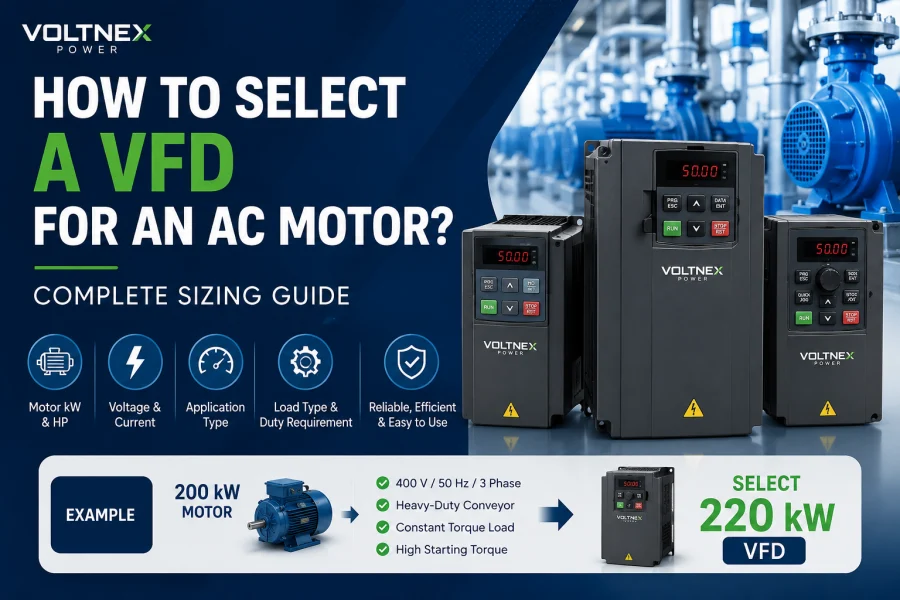
Choosing the correct Variable Frequency Drive (VFD) for an AC motor is essential for reliable motor control, stable operation, energy efficiency, and long equipment life. A properly selected VFD can control motor speed, provide smooth starting and stopping, reduce mechanical stress, and protect the motor against common electrical faults.
However, selecting a VFD is not as simple as matching the VFD kW rating to the motor kW rating.
A proper VFD sizing process should consider the motor’s power, horsepower, voltage, rated current, frequency, application type, load characteristics, starting torque, overload requirements, speed range, and operating environment.
For example, a 200 kW motor driving a centrifugal pump may require a different VFD configuration from a 200 kW motor driving a heavy-duty conveyor.
This guide explains how to choose a variable frequency drive for an AC motor and how to determine the appropriate VFD rating for different industrial applications.
What Information Do You Need to Choose a VFD?
Before selecting a VFD, collect the motor nameplate information.
The most important parameters are:
- Motor power in kW
- Motor horsepower in HP
- Rated voltage
- Rated current
- Frequency
- Motor speed
- Number of phases
- Motor type
- Application
- Load type
- Required speed range
- Starting torque
- Overload requirements
For most industrial VFD projects, the motor nameplate is the best starting point.
A useful rule is:
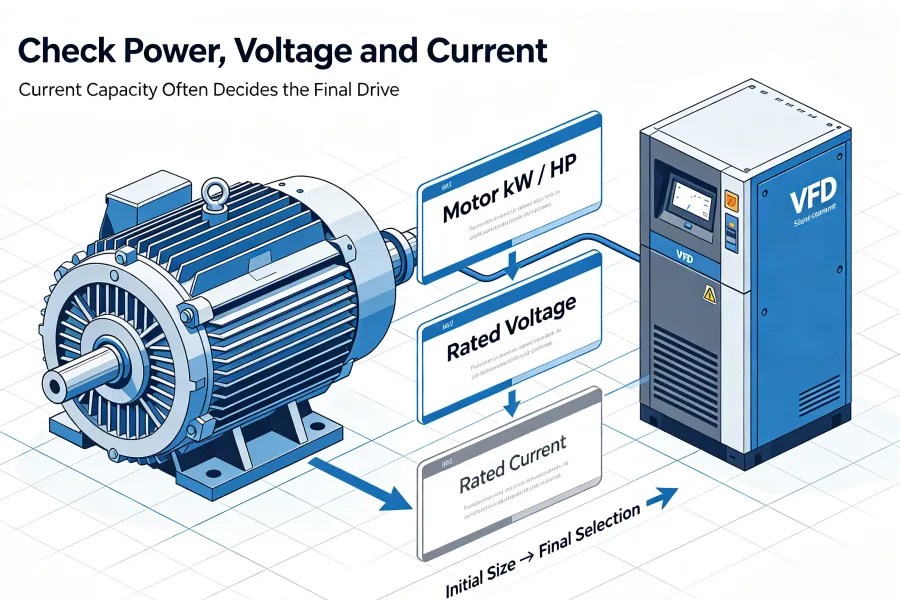
Motor kW determines the initial VFD size, but motor current and application duty determine the final VFD selection.
Step 1: Check the Motor kW
The first step in VFD sizing is identifying the motor’s rated power.
Common industrial motor ratings include:
| Motor Power | Approx. HP |
|---|---|
| 0.75 kW | 1 HP |
| 1.5 kW | 2 HP |
| 2.2 kW | 3 HP |
| 5.5 kW | 7.5 HP |
| 11 kW | 15 HP |
| 22 kW | 30 HP |
| 37 kW | 50 HP |
| 55 kW | 75 HP |
| 75 kW | 100 HP |
| 110 kW | 150 HP |
| 160 kW | 215 HP |
| 200 kW | 268 HP |
| 220 kW | 295 HP |
| 315 kW | 422 HP |
| 500 kW | 670 HP |
| 1000 kW | 1341 HP |
The approximate conversion is:
1 kW = 1.341 HP
1 HP = 0.746 kW
Motor kW or HP provides the first indication of the required VFD capacity. However, the final drive should be selected after checking current and duty requirements.
Step 2: Check the Motor Voltage
The VFD output voltage must be compatible with the motor.
Common industrial AC motor voltages include:
- 220 V
- 230 V
- 380 V
- 400 V
- 415 V
- 440 V
- 460 V
- 480 V
- 575 V
- 600 V
- 690 V
For example, a motor nameplate may specify:
400 V / 50 Hz / 3 Phase
The selected VFD should provide a compatible three-phase output.
The VFD input voltage must also match the available electrical supply.
For example:
380–480 V AC input
→ Three-phase VFD
→ 400 V AC motor
can be a typical industrial configuration.
Always verify both the VFD input voltage and VFD output voltage before selecting the drive.
Step 3: Check the Motor Rated Current
Motor rated current is one of the most important parameters in VFD selection.
Suppose a motor nameplate shows:
- Power: 200 kW
- Voltage: 400 V
- Frequency: 50 Hz
- Rated Current: 350 A
- Speed: 1480 RPM
The VFD must provide sufficient output current for the motor.
This is why simply matching:
200 kW motor → 200 kW VFD
is not always sufficient.
Different 200 kW motors can have different rated currents because of differences in:
- Efficiency
- Power factor
- Motor design
- Voltage
- Manufacturer
- Operating conditions
Therefore:
Always compare the motor nameplate current with the VFD rated output current.
For demanding applications, VFD current capacity can be more important than the nominal kW label.
Step 4: Identify the Application
The application tells you how the motor will actually operate.
Typical VFD applications include:
- Water pumps
- HVAC fans
- Industrial blowers
- Air compressors
- Refrigeration systems
- Belt conveyors
- Screw conveyors
- Mixers
- Extruders
- CNC machines
- Textile machinery
- Crushers
- Mining equipment
- Production lines
The same motor power can require different VFD ratings depending on the application.
For example:
100 kW centrifugal pump
and
100 kW crusher
do not necessarily have the same VFD requirements.
The pump may operate as a variable-torque load, while the crusher can require high starting torque and heavy-duty overload capacity.
Read More:Industrial VFD Applications: Pumps, Fans, Compressors and Automation Systems
Step 5: Determine the Load Type
The next step is to determine whether the motor operates a variable-torque, constant-torque, or heavy-duty load.
Variable Torque Loads
Typical examples include:
- Centrifugal pumps
- Centrifugal fans
- HVAC fans
- Blowers
- Cooling tower equipment
For these applications, torque generally decreases as speed decreases.
Variable-speed operation can therefore provide significant energy savings, particularly when the system does not need to operate continuously at full speed.
Important VFD features may include:
- PID control
- Pressure control
- Flow control
- Sleep/wake function
- Energy-saving functions
- Motor protection
Constant Torque Loads
Typical examples include:
- Conveyors
- Mixers
- Agitators
- Extruders
- Positive-displacement pumps
- Material handling equipment
Constant-torque applications generally require more torque throughout the operating speed range.
The VFD should therefore have adequate continuous output current and overload capacity.
Heavy-Duty Loads
Heavy-duty applications can require particularly high starting torque and overload capability.
Examples include:
- Crushers
- Mining conveyors
- Heavy mixers
- Hoists
- Elevators
- Cement equipment
- Large extruders
For these applications, a heavy-duty VFD may be required even when the motor’s kW rating appears to match a standard-duty drive.
Step 6: Determine the Starting Torque
Starting torque is critical when the motor starts under load.
A centrifugal pump may start with relatively moderate torque requirements.
A loaded conveyor may require substantially more torque to accelerate the belt and material.
Similarly, crushers, mixers and other heavy machinery can experience high starting resistance.
Before selecting the VFD, determine:
- Does the motor start under load?
- How much starting torque is required?
- What is the machine inertia?
- How quickly must the motor accelerate?
- Are there frequent starts and stops?
- Does the load change significantly during operation?
If high starting torque is required, consider a VFD with appropriate heavy-duty overload capability and vector control.
Step 7: Check the VFD Overload Rating
VFDs are available with different overload capabilities depending on their duty class.
The application may require:
- Normal-duty operation
- Variable-torque operation
- Constant-torque operation
- Heavy-duty operation
For example, a conveyor may normally operate at 80% load but require considerably more current during startup.
If the VFD does not have sufficient overload capacity, it may trip during acceleration even though the motor operates normally at steady speed.
When comparing VFDs, check:
Continuous output current
Overload current
Overload duration
Starting capability
Duty rating
This is particularly important for large industrial motors.
Step 8: Determine the Required Speed Range
One of the main advantages of a VFD is the ability to control motor speed by changing frequency.
A typical 50 Hz motor might operate at:
- 20 Hz
- 30 Hz
- 40 Hz
- 50 Hz
The actual motor speed depends on motor pole count and slip.
For example, a pump may require a speed range of:
30–50 Hz
while a conveyor may require:
10–50 Hz
A specialized machine may require an even wider speed range.
The required minimum and maximum speed should be confirmed before selecting the VFD.
Learn More:VFD vs Soft Starter vs DOL Starter: Which Motor Control Method Is Best?
Step 9: Consider Low-Speed Motor Operation
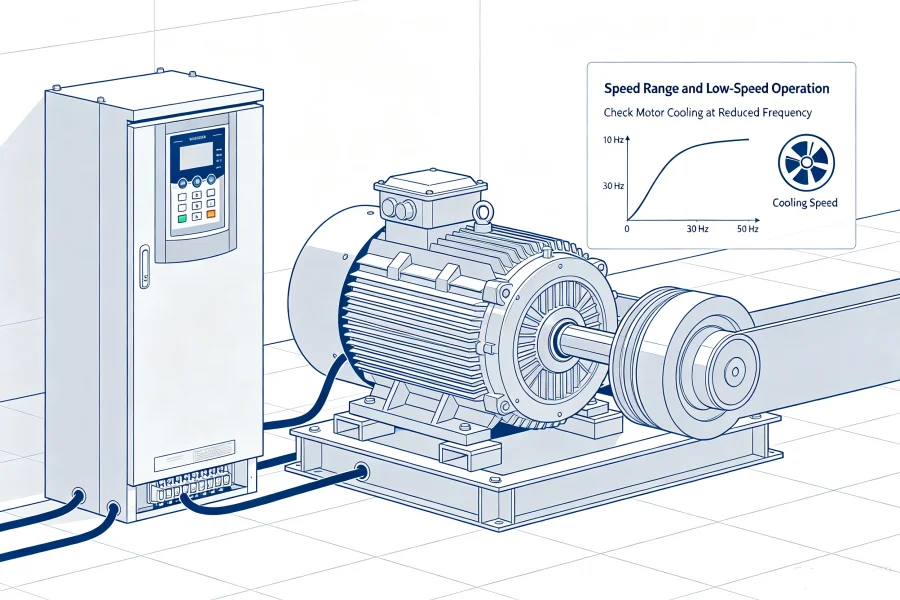
Low-speed operation can affect motor cooling.
Many standard AC motors use shaft-mounted fans. When motor speed decreases, the cooling fan also rotates more slowly.
This can reduce cooling performance during continuous low-speed operation.
If the application requires:
Low speed + high torque + continuous operation
additional cooling may be required.
Possible solutions include:
- Independent cooling fan
- Forced ventilation
- VFD-rated motor
- Motor derating
- Special motor design
This should be considered when the VFD is expected to operate the motor continuously at low frequency.
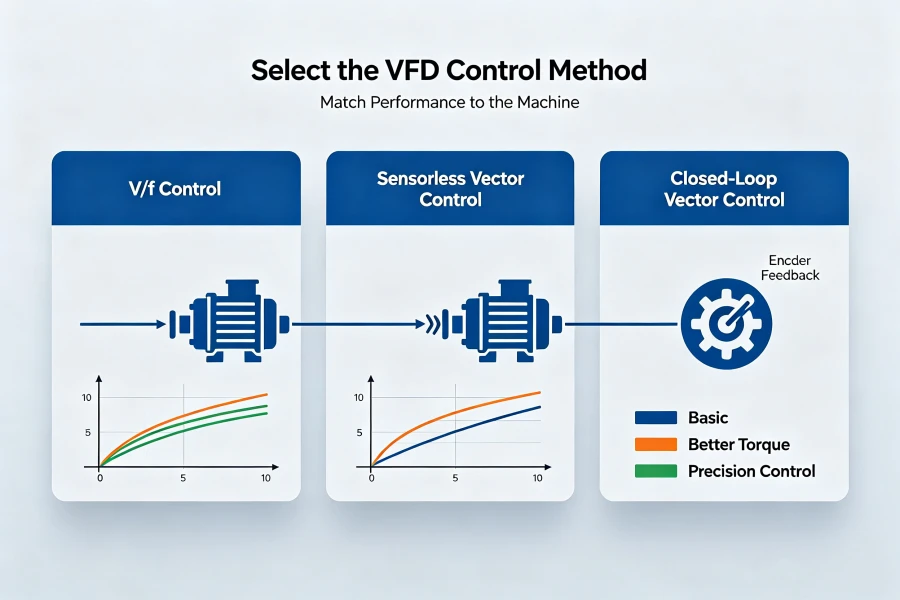
Step 10: Select the VFD Control Method
The required control performance determines which VFD control method is appropriate.
V/f Control
V/f control is a simple and economical method for many general-purpose applications.
Typical applications include:
- Pumps
- Fans
- Blowers
- Basic conveyors
- General machinery
Sensorless Vector Control
Sensorless vector control can provide better torque and speed regulation than basic V/f control.
It may be suitable for:
- Conveyors
- Mixers
- Compressors
- Machine equipment
- Material handling
Closed-Loop Vector Control
Closed-loop vector control uses feedback from an encoder or other sensor.
It can provide improved speed accuracy and torque control for demanding applications.
Typical applications include:
- Hoists
- Elevators
- Precision machinery
- Winding systems
- High-performance conveyors
Step 11: Check Acceleration and Deceleration
Acceleration and deceleration requirements should also be considered.
For example:
0 → 50 Hz in 30 seconds
may be appropriate for a large conveyor.
Another machine may require:
0 → 50 Hz in 5 seconds
A high-inertia load generally requires more careful acceleration and deceleration control.
Rapid deceleration can also produce regenerative energy that flows back toward the VFD DC bus.
Depending on the application, the system may require:
- Braking resistor
- Dynamic braking unit
- Regenerative drive
- Longer deceleration time
This is particularly important for hoists, elevators, centrifuges and other high-inertia equipment.
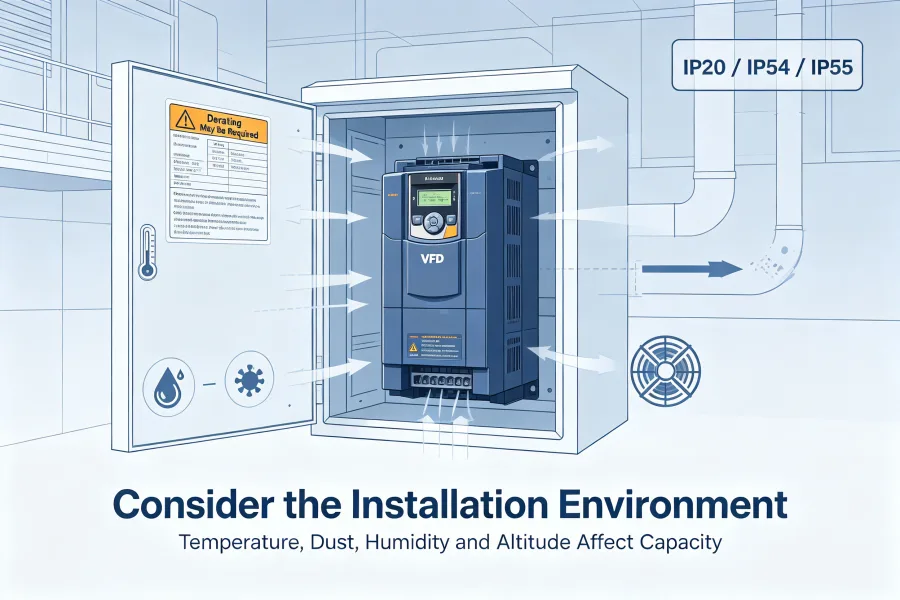
Step 12: Consider the Installation Environment
The installation environment can affect VFD performance and capacity.
Consider:
- Ambient temperature
- Altitude
- Humidity
- Dust
- Corrosive gases
- Cabinet temperature
- Ventilation
- Cooling
- Enclosure protection
For example, a VFD installed in a high-temperature electrical cabinet may require derating.
Industrial environments with dust or moisture may also require an appropriate electrical enclosure.
Common enclosure protection levels include:
- IP20
- IP21
- IP54
- IP55
The appropriate enclosure depends on the installation location and electrical cabinet design.
200 kW Motor VFD Sizing Example
Consider a 200 kW AC motor used to drive a heavy-duty conveyor.
The motor specifications are:
| Parameter | Specification |
|---|---|
| Motor Power | 200 kW |
| Approx. HP | 268 HP |
| Voltage | 400 V |
| Frequency | 50 Hz |
| Phase | 3 Phase |
| Application | Heavy Conveyor |
| Load Type | Constant Torque |
| Starting | Loaded |
| Control | Vector Control |
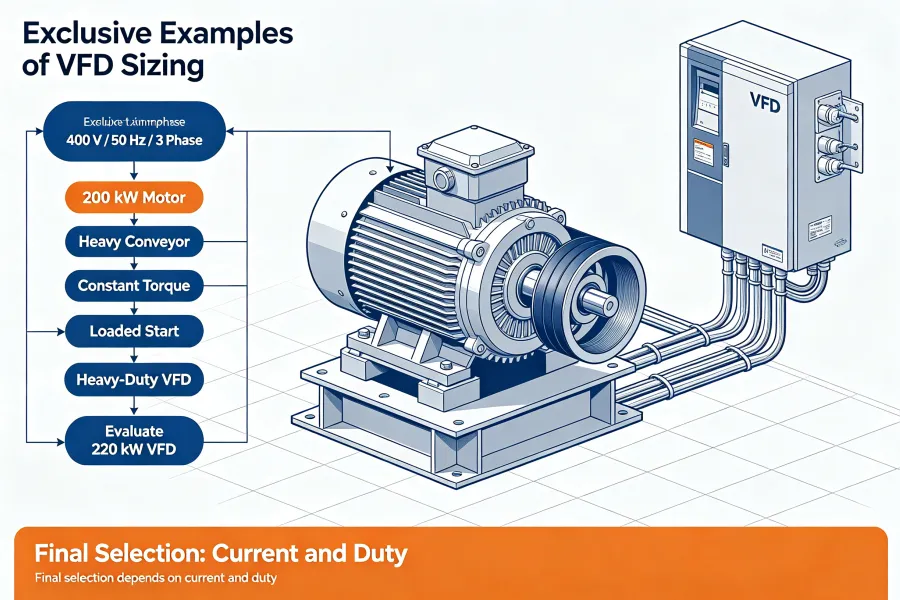
The initial selection process is:
200 kW Motor
↓
400 V / 50 Hz / 3 Phase
↓
Heavy-Duty Conveyor
↓
Constant Torque
↓
Loaded Starting
↓
High Starting Torque
↓
Heavy-Duty VFD
↓
Evaluate 220 kW VFD
A 220 kW VFD may be suitable if its rated output current and overload capability meet the requ