

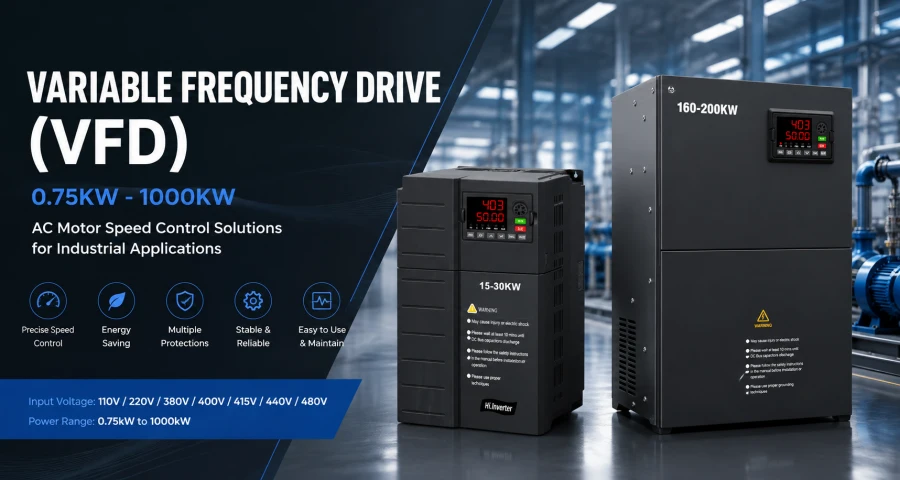
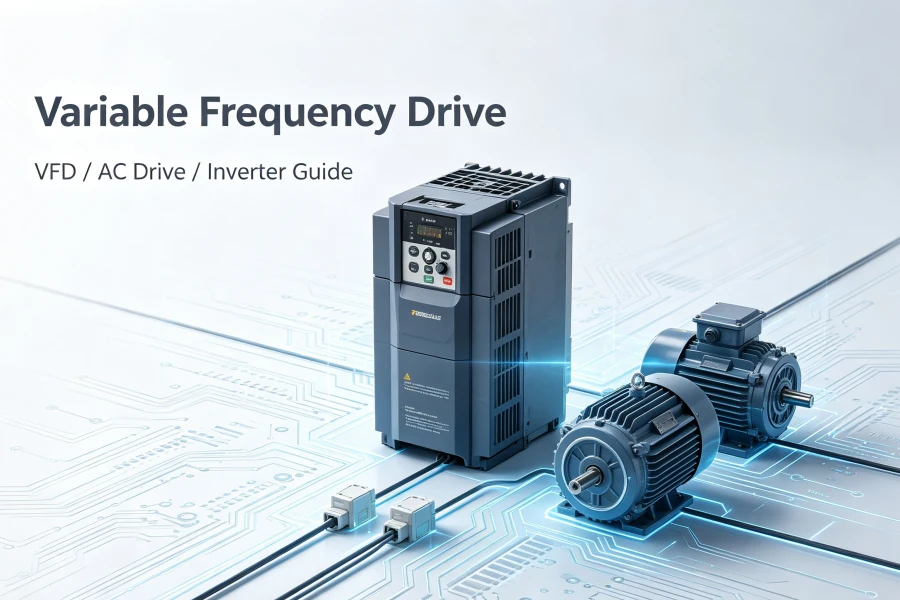
A Variable Frequency Drive (VFD) is an electronic motor control device that regulates the speed, torque, acceleration, and operating frequency of an AC motor. By controlling the frequency and voltage supplied to the motor, a VFD allows industrial equipment to operate at the speed required by the process instead of running continuously at a fixed speed.
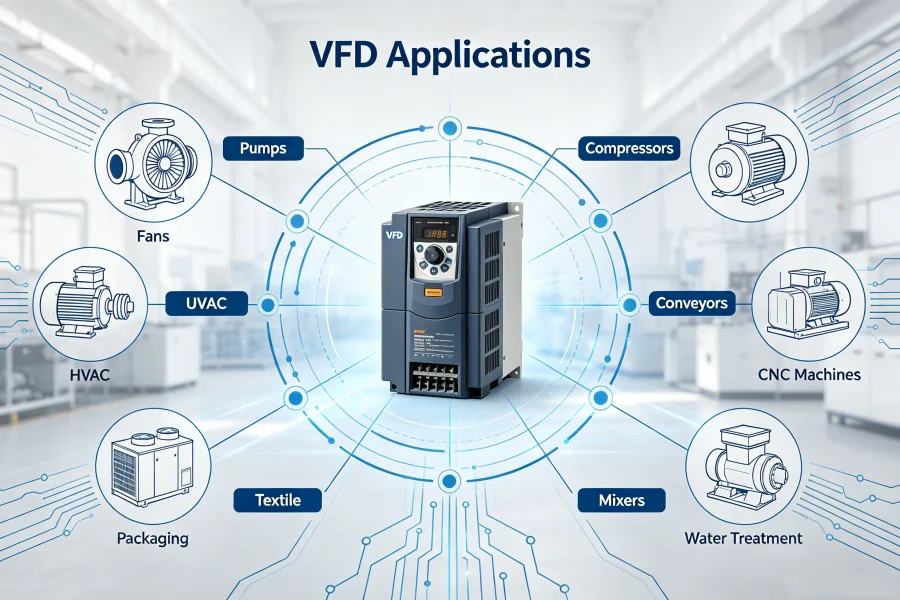
A VFD is also commonly called an AC drive, variable speed drive, or inverter in industrial applications. It is widely used for pumps, fans, compressors, conveyors, CNC machines, HVAC equipment, manufacturing machinery, and automated production systems.
The basic operating principle is straightforward:
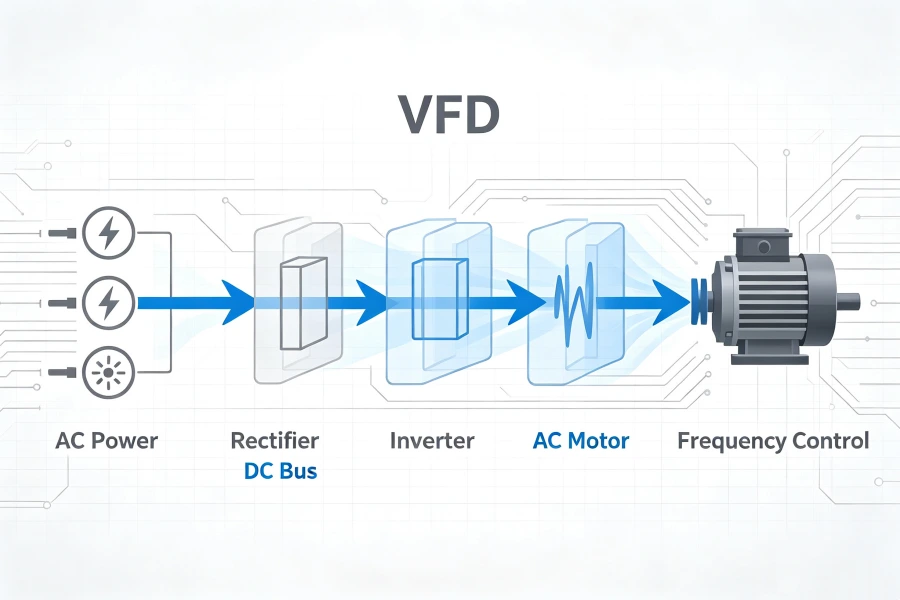
AC Power → Rectifier → DC Bus → Inverter → AC Motor
The VFD first converts incoming AC electricity into DC power and then converts the DC power back into controlled AC power with the required frequency and voltage. This gives the drive precise control over motor operation.
This guide explains what a VFD is, how a variable frequency drive works, why industries use VFDs, where they are applied, how VFD ratings and types differ, and what to consider when selecting a VFD for an industrial motor.
What Is a VFD and Why Is It Used?
VFD stands for Variable Frequency Drive. It is a power electronic device designed primarily to control the speed and torque of an AC motor by varying the frequency and voltage supplied to the motor.
The key idea is simple: motor speed is related to electrical frequency.
A conventional motor connected directly to a fixed-frequency power supply generally operates close to its designed speed. If the motor is supplied through a VFD, however, the frequency can be adjusted according to the requirements of the machine or process.
For example, a motor operating at approximately 50 Hz can be commanded to operate at lower frequencies when lower speed is required:
Actual motor speed will vary because of motor design and slip, but the relationship clearly shows why frequency control is so useful.
A VFD therefore allows a motor-driven machine to respond to changing production requirements rather than operating at maximum speed all the time.
This can improve process control, starting performance, operational flexibility, and energy efficiency, particularly in applications where the required motor speed changes during normal operation.
VFD, AC Drive and Inverter: Are They the Same?
You may encounter several terms when searching for motor control equipment:
- Variable Frequency Drive
- VFD
- AC Drive
- Variable Speed Drive
- AC Drive Inverter
- Inverter Drive
In industrial motor-control applications, these terms are often used interchangeably. A VFD specifically emphasizes the use of variable frequency to control an AC motor, while “AC drive” is a broader industry term.
The word “inverter” can describe many types of power electronic equipment, but in industrial motor applications it is frequently used to refer to a VFD.
How Does a Variable Frequency Drive Work?
The easiest way to understand a VFD is to follow the electrical power through its main stages:
AC Power
   ↓
Rectifier
   ↓
DC Bus / DC Link
   ↓
Inverter
   ↓
Variable-Frequency AC Output
   ↓
Motor
Although the internal electronics can be sophisticated, the basic concept is an AC-to-DC-to-AC conversion process.
The VFD does not simply reduce the incoming voltage to slow down a motor. Instead, it creates a controlled output waveform with the frequency and voltage required by the motor.
1. AC Input and Rectification
The VFD receives AC electrical power from the incoming supply. Depending on the drive, this may be single-phase or three-phase input.
Common industrial voltage classes include 220V, 230V, 380V, 400V, 415V, 440V, 460V, and 480V, although the actual supported voltage depends on the specific VFD.
The incoming AC power passes through the rectifier, which converts AC into DC.
AC Input
   ↓
Rectifier
   ↓
DC Power
The rectifier may use diode bridges or more advanced power conversion technologies depending on the drive design.
2. DC Bus or DC Link
The rectified DC power enters the DC bus, also called the DC link.
The DC bus typically includes capacitors and other filtering components that smooth the rectified power and provide a stable intermediate DC voltage for the inverter.
The DC link therefore acts as the bridge between the input rectifier and output inverter.
AC
 ↓
Rectifier
 ↓
DC Bus
 ├── Filtering
 ├── Capacitors
 └── Energy Storage
 ↓
Inverter
3. Inverter and PWM Control
The inverter converts DC power back into controlled AC power.
Modern VFDs commonly use high-speed semiconductor switching devices such as IGBTs (Insulated Gate Bipolar Transistors).
The control system rapidly switches these devices according to a programmed control strategy. One widely used technique is Pulse Width Modulation (PWM).
Through this switching process, the VFD can produce an AC output with controlled:
- Frequency
- Voltage
- Current
- Motor speed
- Torque response
The output is not simply the same AC waveform as the input. The VFD electronically synthesizes an output suitable for controlling the motor.
4. Controlled AC Output to the Motor
The final stage sends controlled AC power to the motor.
When the VFD increases or decreases the output frequency, the motor speed changes accordingly.
This is the fundamental reason a variable frequency drive can provide adjustable motor speed.
Learn More:VFD vs Soft Starter vs DOL Starter: Which Motor Control Method Is Best?
How Does a VFD Control Motor Speed?
The relationship between frequency and motor speed can be demonstrated using the synchronous-speed equation:
Synchronous Speed = 120 × Frequency ÷ Number of Poles
Consider a four-pole motor:
An induction motor normally operates slightly below synchronous speed because of slip.
The practical relationship is therefore:
Lower frequency → Lower motor speed
Higher frequency → Higher motor speed
The VFD also adjusts voltage along with frequency according to the selected control method. This helps maintain appropriate motor magnetic conditions and torque performance across the operating range.
For simple applications, the VFD may use basic V/f control. More advanced applications may use sensorless vector control or other motor-control algorithms when improved torque response and speed regulation are required.
What Are the Main Benefits of a VFD?
The ability to change motor speed is only one reason VFDs are widely used. A properly selected variable frequency drive can improve the way an entire motor-driven system operates.
Variable Speed Control
The most obvious advantage is the ability to adjust motor speed according to the actual process requirement.
A pump may not need to operate at full speed when water demand is low. A conveyor may need different speeds for different production stages. A fan may need to reduce speed when less airflow is required.
Instead of controlling the process by wasting energy through throttling, bypassing, or mechanical adjustments, a VFD can directly control motor speed in suitable applications.
Soft Starting and Stopping
A VFD can gradually increase motor frequency and voltage during startup rather than immediately applying full operating conditions.
This can help reduce:
- Starting current
- Mechanical shock
- Belt and coupling stress
- Pressure surges
- Sudden acceleration
Controlled deceleration can also help reduce mechanical shock when stopping the equipment.
Potential Energy Savings
VFDs can provide significant energy-saving opportunities when used with variable-speed loads.
This is particularly relevant to centrifugal pumps and fans, where the relationship between speed and power is highly nonlinear.
For idealized centrifugal systems:
Flow ∝ Speed
Pressure ∝ Speed²
Power ∝ Speed³
Therefore, reducing motor speed can potentially produce a substantial reduction in power demand.
Actual savings depend on the equipment, operating point, system resistance, motor efficiency, VFD efficiency, and control strategy. A VFD does not automatically reduce energy consumption in every application.
Improved Process Control
A VFD can be connected to sensors, PLCs, HMIs, or other control systems so that motor speed responds to process conditions.
For example:
Pressure Sensor → Controller → VFD → Pump
or:
Temperature Sensor → Controller → VFD → Fan
This allows the motor to respond automatically as operating conditions change.
Motor and Drive Protection
Depending on the model, a VFD may provide functions such as:
- Overcurrent protection
- Overload protection
- Overvoltage protection
- Undervoltage protection
- Overtemperature protection
- Stall protection
- Phase-loss monitoring
- Fault detection
These features can help protect the drive and connected motor from abnormal operating conditions. They should, however, be considered part of a complete electrical protection system rather than a replacement for external protection where required.
Where Are Variable Frequency Drives Used?
VFDs are used anywhere an AC motor needs controlled speed, torque, starting, or process operation.
The most common applications include pumps, fans, compressors, conveyors, CNC machinery, HVAC systems, manufacturing equipment, and automated production lines.
Pumps
Pumps are one of the most common VFD applications.
A variable frequency drive can adjust pump speed based on pressure, flow, water demand, or process requirements.
Typical applications include:
- Water treatment
- Water supply
- Irrigation
- Industrial circulation
- Cooling systems
- HVAC
Fans and Blowers
VFDs can regulate fan and blower speed according to airflow or temperature requirements.
Applications include:
- HVAC
- Factory ventilation
- Industrial exhaust
- Cooling systems
- Air-handling equipment
Compressors
Compressors often operate under changing demand. A compatible VFD can adjust compressor motor speed according to the required capacity and operating conditions.
VFD-controlled compressors are commonly found in industrial compressed-air and process systems, although the suitability depends on compressor design.
Conveyors
Conveyors often require different operating speeds depending on production requirements.
A VFD can provide controlled acceleration, adjustable speed, controlled stopping, and synchronization with other production equipment.
CNC and Machine Tools
VFDs can be used for compatible machine-tool and spindle applications where adjustable motor speed is required.
The required control performance depends on the machine design and spindle motor.
Learn More:Industrial VFD Applications: Pumps, Fans, Compressors and Automation Systems
VFD Types and Power Ratings
Variable frequency drives are available in many configurations because motor-control requirements vary significantly between applications.
One basic classification is by input power.
Single-Phase VFD
Single-phase input VFDs are designed for applications where the available electrical supply is single phase, subject to the drive’s specifications and motor compatibility.
Three-Phase VFD
Three-phase VFDs are widely used in industrial applications and are commonly paired with compatible three-phase AC motors.
For industrial machinery, three-phase VFDs are available across a very broad power range.
General-Purpose VFD
General-purpose drives are suitable for common applications such as:
- Fans
- Pumps
- Conveyors
- General machinery
Heavy-Duty VFD
Heavy-duty applications can require higher overload capacity and more demanding motor-control performance.
Examples include:
- Crushers
- Heavy conveyors
- Hoists
- Extruders
- Material-handling equipment
The correct drive should be selected based on actual load characteristics rather than simply choosing the largest available power rating.
VFD Power Range
Industrial VFDs can range from small drives for compact machinery to high-power drives for large industrial motors.
A typical industrial range may include:
0.75kW to 1000kW
Common ratings include 0.75kW, 1.5kW, 2.2kW, 4kW, 5.5kW, 7.5kW, 11kW, 15kW, 18.5kW, 22kW, 30kW, 37kW, 45kW, 55kW, 75kW, 90kW, 110kW, 132kW, 160kW, 185kW, 220kW, 250kW, 315kW, 355kW, 400kW, 450kW, 500kW, 630kW, 710kW, 800kW, 900kW, and 1000kW.
The available ratings vary between manufacturers and product series.
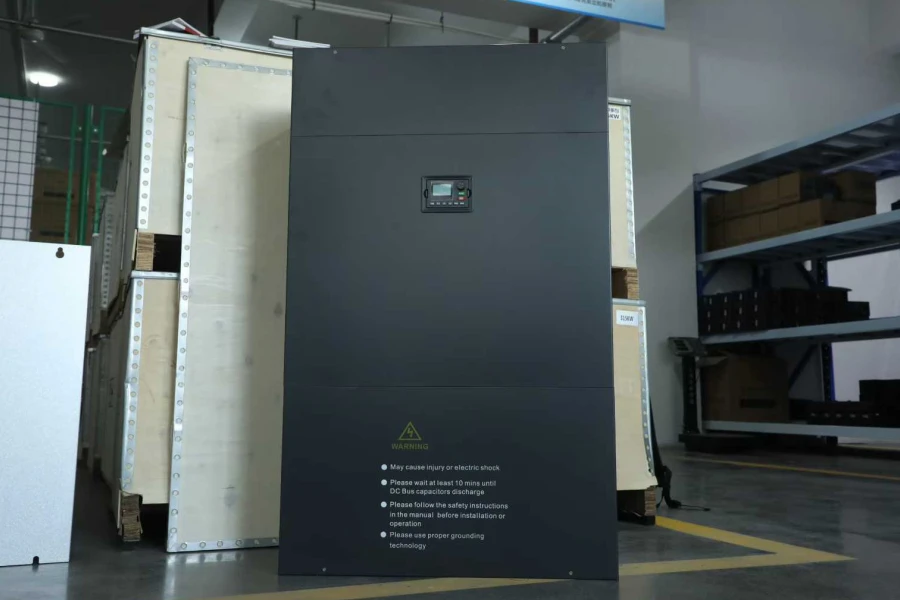
For larger motors, VFD selection should pay particular attention to rated output current, overload capability, cooling, enclosure requirements, braking, and installation conditions.
How to Choose the Right VFD?
Selecting a VFD should not be based on motor kW alone.
A basic selection process starts with the motor nameplate and application requirements.
1. Check Motor Power
Determine the motor’s rated:
- kW
- HP
For example, a 30kW motor is approximately equivalent to a 40 HP motor.
However, the VFD should not be selected solely by matching “30kW” with a “30kW VFD.”
2. Check Motor Rated Current
Motor rated current is one of the most important selection parameters.
Two motors with the same kW rating may have different rated currents because of differences in voltage, efficiency, power factor, and motor design.
The VFD’s rated output current should therefore be compared with the motor’s nameplate current.
3. Check Voltage
The VFD input and output voltage must be compatible with the electrical system and motor.
Common industrial voltage classes include:
- 220V
- 230V
- 380V
- 400V
- 415V
- 440V
- 460V
- 480V
Always check the manufacturer’s actual voltage specifications.
4. Identify the Load Type
The load is just as important as the motor.
A centrifugal pump has different requirements from a conveyor, crusher, hoist, or extruder.
Common categories include:
Variable Torque
- Pumps
- Fans
- Blowers
Constant Torque
- Conveyors
- Mixers
- Many production machines
Heavy-Duty Loads
- Crushers
- Hoists
- Extruders
- Heavy material-handling equipment
5. Consider Speed and Control Requirements
Ask:
- What is the minimum required speed?
- What is the maximum speed?
- Is high starting torque required?
- How frequently does the motor accelerate?
- How frequently does it decelerate?
- Is braking required?
- Is precise speed regulation required?
- Is communication with a PLC required?
The answers determine which VFD control technology and specifications are appropriate.
Get More:How to Select a VFD for an AC Motor? Complete Sizing Guide
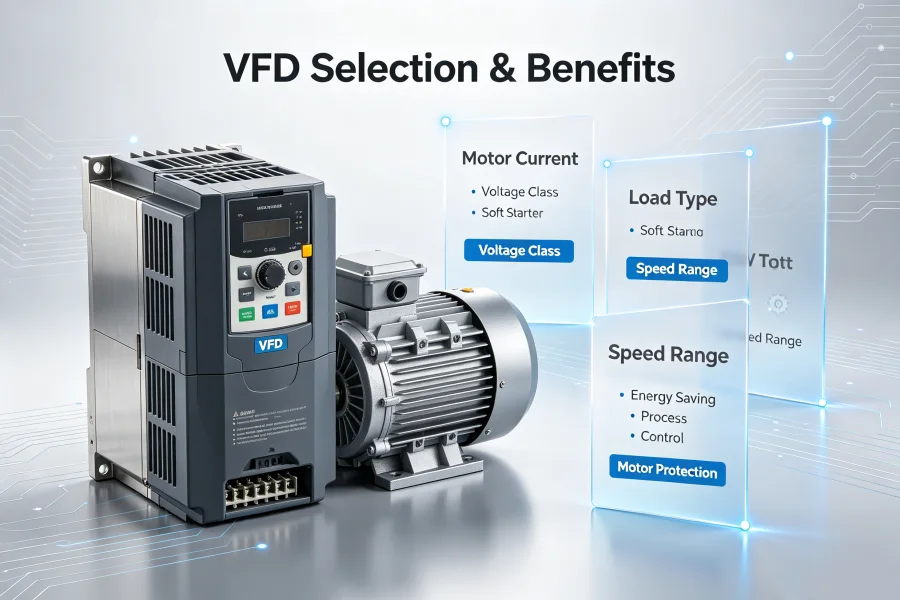
VFD vs Soft Starter vs AC Drive vs Inverter
These technologies and terms are often confused.
A soft starter is primarily used to control motor starting and stopping.
A VFD can control motor speed continuously during operation.
Meanwhile, AC drive is commonly another name for a VFD in industrial motor-control applications.
If the application only needs a smoother motor startup, a soft starter may be sufficient. If the application requires continuous variable speed, a VFD is generally the more appropriate technology.
Can a VFD Save Energy?
A VFD can save energy when the motor does not need to operate at full speed continuously.
This is especially important for variable-torque applications such as pumps and fans.
For example, if a ventilation system requires less airflow, reducing fan speed with a VFD can reduce the power required by the motor.
However, energy savings should be evaluated based on the complete system.
Factors include:
- Motor efficiency
- VFD efficiency
- Load profile
- Operating hours
- Required speed
- System resistance
- Control strategy
- Mechanical efficiency
Installing a VFD on a fixed-speed constant-power application does not automatically guarantee significant energy savings.
The greatest benefit often comes when the process itself allows motor speed to vary.
Basic VFD Installation Considerations
Correct installation has a direct impact on VFD performance and service life.
The installation should consider:
Electrical Grounding
Proper grounding is essential for safe operation and electromagnetic compatibility.
Cooling and Ventilation
VFD power electronics generate heat. The enclosure should provide adequate ventilation or cooling for the expected operating load and ambient temperature.
Motor Cable
Motor cable selection, routing, shielding, and length can affect EMC and system performance.
Input and Output Connections
Incoming AC power must be connected to the designated VFD input terminals, while the motor must be connected to the designated output terminals.
The exact terminal arrangement depends on the VFD model.
Motor Parameters
Motor nameplate information should be entered correctly into the drive where required.
Typical parameters include:
- Rated voltage
- Rated current
- Rated frequency
- Rated speed
- Rated power
Environmental Conditions
The VFD installation should account for:
- Ambient temperature
- Humidity
- Dust
- Altitude
- Vibration
- Enclosure protection
Always follow the manufacturer’s installation instructions and applicable electrical standards.
Common VFD Problems
Understanding basic VFD faults can help identify potential problems.
Overcurrent
Possible causes include excessive load, acceleration that is too fast, mechanical blockage, incorrect parameters, or motor problems.
Overvoltage
Possible causes include excessive input voltage or regenerative energy during rapid deceleration.
Overload
Possible causes include excessive motor load, incorrect drive sizing, or prolonged operation above the rated capacity.
Overtemperature
Possible causes include insufficient ventilation, high ambient temperature, blocked cooling passages, excessive loading, or cooling fan problems.
Motor Does Not Run
Possible causes include incorrect wiring, incorrect control commands, active fault conditions, incorrect parameters, or external interlocks.
The correct troubleshooting procedure depends on the VFD model and fault code. The manufacturer’s manual should always be consulted before changing electrical parameters or wiring.
Frequently Asked Questions About VFDs
What is a VFD?
A VFD, or Variable Frequency Drive, is an electronic device used to control the speed and operation of an AC motor by adjusting the frequency and voltage supplied to the motor.
What does VFD stand for?
VFD stands for Variable Frequency Drive.
How does a VFD work?
A VFD converts incoming AC power into DC through a rectifier, smooths the power through a DC bus, and then converts the DC back into controlled AC through an inverter.
Can a VFD control motor speed?
Yes. A VFD primarily controls AC motor speed by changing the output frequency and adjusting voltage according to the selected control method.
Can a VFD save electricity?
Yes, particularly in variable-speed applications such as centrifugal pumps and fans. Actual savings depend on the complete system and operating conditions.
What is the difference between a VFD and a soft starter?
A VFD provides continuous variable-speed control, while a soft starter primarily controls motor starting and stopping.
Can a VFD be used with a single-phase motor?
A standard industrial VFD should not automatically be assumed compatible with every single-phase motor. Most industrial VFDs are designed for compatible AC motor types, particularly three-phase motors. Motor and drive compatibility should be confirmed before installation.
What size VFD do I need?
VFD selection should consider motor power, rated current, voltage, load type, overload requirements, speed range, braking requirements, and operating environment.
What is the difference between a VFD and an inverter?
In industrial motor-control applications, the terms are often used interchangeably. However, “inverter” can also describe other power-electronic equipment outside motor control.
What are the most common VFD applications?
Common applications include pumps, fans, compressors, conveyors, HVAC systems, CNC machines, textile machinery, packaging equipment, manufacturing machinery, and industrial automation.
Industrial Variable Frequency Drives from 0.75kW to 1000kW
Voltnex Power provides industrial Variable Frequency Drive solutions from 0.75kW to 1000kW for single-phase and three-phase motor-control applications.
The product range is designed for applications including pumps, fans, compressors, conveyors, CNC machinery, manufacturing equipment, textile machinery, HVAC systems, and other industrial motor-driven equipment.
VFD selection can be configured according to the motor’s power, rated current, voltage, load type, speed range, overload requirements, control method, and operating environment.
For industrial equipment manufacturers, distributors, system integrators, and project contractors, customized VFD solutions can also be developed according to specific motor-control and equipment requirements.
Conclusion: Why Is a VFD Important?
A Variable Frequency Drive provides a practical way to control AC motor speed, torque, acceleration, and operating frequency.
Its basic operating principle is:
AC Power → Rectifier → DC Bus → Inverter → Motor
By controlling the frequency and voltage supplied to an AC motor, a VFD can provide adjustable speed, smoother starting and stopping, improved process control, and potential energy savings in suitable applications.
From relatively small 0.75kW motor-control applications to high-power 1000kW industrial systems, VFD technology can be applied to a wide variety of machines and processes.
The most important point when selecting a VFD is that the drive should be matched not only to motor power, but also to motor current, voltage, load characteristics, speed requirements, overload duty, braking requirements, and operating environment.
For applications requiring reliable industrial motor speed control, understanding these factors is the foundation for selecting the right variable frequency drive.