

Automatic Voltage Regulator (AVR) and voltage stabilizer are two commonly used terms for equipment that corrects fluctuations in AC power and provides a more stable voltage to electrical loads.
If you are searching for an industrial AVR, AC voltage stabilizer, servo voltage regulator, or automatic voltage stabilizer, you may notice that manufacturers often use these terms for similar products. So, are an automatic voltage regulator and a voltage stabilizer actually different?
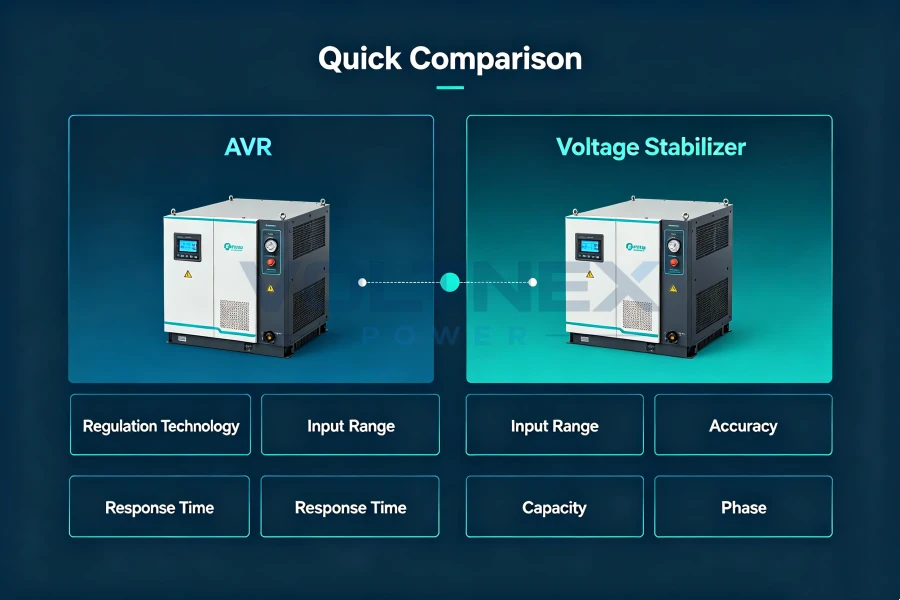
In many applications, they perform essentially the same basic function. The more important differences are usually found in the regulation technology, input voltage range, output accuracy, response time, capacity, and application requirements.
This guide explains the terminology and the specifications that matter when selecting an AVR or voltage stabilizer for industrial and commercial power systems.
Automatic Voltage Regulator vs Voltage Stabilizer
The key point is that AVR and voltage stabilizer are not necessarily two separate classes of equipment. An industrial voltage stabilizer can be an automatic voltage regulator, and the same product may be marketed as an Automatic Voltage Regulator AVR, AC Voltage Stabilizer, or Automatic Voltage Stabilizer.
Therefore, the product specifications are more important than the name.
Is an AVR the Same as a Voltage Stabilizer?
In many industrial and commercial applications, yes.
An Automatic Voltage Regulator is designed to automatically detect changes in the incoming voltage and correct the output. A voltage stabilizer is also designed to compensate for voltage fluctuations and provide a more stable output.
The terminology often reflects how the manufacturer positions the product.
“Automatic Voltage Regulator” emphasizes the regulation function.
“Voltage Stabilizer” emphasizes the result: maintaining a stable voltage.
For example, a manufacturer may offer a three-phase servo system under the name Three Phase Automatic Voltage Regulator, while another manufacturer may call a similar product a Three Phase Servo Voltage Stabilizer.
This does not mean that every AVR and every voltage stabilizer has identical performance. Different products can use different technologies and have very different specifications.
For purchasing decisions, always compare the actual electrical parameters rather than selecting a product based only on its name.
Read More:What Is an Automatic Voltage Regulator (AVR)? Working Principle, Benefits and Applications

What Are the Real Differences?
The most useful comparison between an AVR and a voltage stabilizer is based on how the equipment regulates voltage.
Regulation Technology
Voltage regulation equipment can use several different technologies.
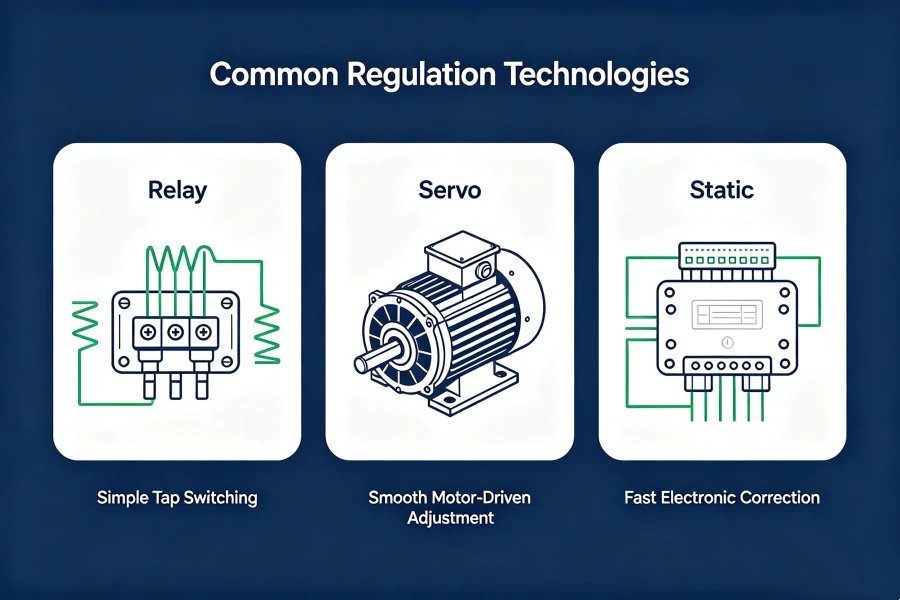
Relay voltage stabilizers use transformer taps and switching relays to adjust the output. They are generally suitable for applications where moderate regulation accuracy and cost-effective voltage correction are required.
Servo voltage regulators use a servo motor and variable transformer to continuously adjust the voltage. Servo systems are widely used in industrial applications and can provide relatively high regulation accuracy.
Static voltage regulators use electronic switching and semiconductor technology rather than mechanical movement. They can respond rapidly to voltage changes and are suitable for applications where fast correction is important.
Therefore, the words AVR and voltage stabilizer do not tell you the internal technology. Always check whether the proposed equipment is relay, servo, static, SCR-controlled, or another type.
Voltage Regulation Accuracy
Another important specification is output regulation accuracy.
Industrial AVR and voltage stabilizer systems may commonly be specified at:
- ±1%
- ±2%
- ±3%
A tighter regulation specification means the output voltage can be maintained closer to its nominal value under specified operating conditions.
However, higher accuracy is not automatically necessary for every application. General electrical loads may tolerate wider voltage variation, while CNC equipment, automation systems, precision machinery, medical equipment, and sensitive electronic loads may require tighter control.
The required accuracy should therefore be determined from the load manufacturer’s requirements and the actual power conditions at the installation site.
Input Voltage Range
The input voltage range is often more important than the product name.
Suppose an industrial facility has a nominal three-phase supply of 400V, but measurements show that the actual voltage can vary from 340V to 450V.
The selected regulator must be designed to operate within the required input range and provide the specified output.
If the input range is too narrow, the regulator may not be able to compensate for severe undervoltage or overvoltage conditions.
Before purchasing a high-capacity AVR or stabilizer, it is therefore useful to measure the actual voltage at the installation location, including periods when heavy equipment starts or stops.
Response Time
Response time describes how quickly the voltage regulator reacts when the input voltage changes.
Servo voltage regulators use mechanical movement and therefore have a different response characteristic from static electronic systems.
Static AVR systems can provide very fast electronic correction because they do not rely on mechanical movement.
For equipment exposed to rapid voltage fluctuations, response time should be evaluated together with regulation accuracy and load characteristics.
Capacity
AVR and voltage stabilizer capacity is commonly specified in kVA.
Choosing the correct capacity requires more than adding the rated power of all connected equipment.
Industrial systems may contain motors, pumps, compressors, transformers, welding equipment, CNC machines, VFDs, and other loads with starting or inrush currents.
A regulator that is correctly sized for the normal running load may still be undersized if significant starting current is present.
For this reason, the total load, power factor, starting characteristics, operating pattern, and future expansion should be considered when selecting the kVA rating.
Servo AVR vs Static AVR
For industrial buyers, the comparison between servo AVR and static AVR can be more useful than comparing the words AVR and voltage stabilizer.
A servo AVR can be a practical solution for conventional industrial voltage stabilization where a wide input range and accurate voltage correction are required.
A static AVR may be considered when rapid voltage correction is a major requirement.
Neither technology is universally suitable for every application. The correct choice depends on the power supply and load.
How to Choose an AVR or Voltage Stabilizer
When selecting an automatic voltage regulator or voltage stabilizer, start with the electrical requirements rather than the product name.
First, determine the nominal input voltage and measure the actual fluctuation range.
Next, specify the required output voltage and acceptable regulation accuracy.
Then determine the required kVA capacity, taking into account motors, transformers, compressors, VFDs, and other loads with starting or inrush current.
You should also confirm whether the system requires:
- Single-phase or three-phase operation
- 50Hz or 60Hz frequency
- ±1%, ±2%, or ±3% regulation
- Servo or static technology
- Specific input voltage range
- Specific output voltage
- Indoor or outdoor installation
- IP20, IP23, IP54, or other enclosure requirements
- Communication functions such as RS485 or Modbus
- Bypass and protection functions
For a custom industrial project, these specifications should be confirmed before the AVR or stabilizer is manufactured.
AVR vs Voltage Stabilizer vs UPS
An AVR or voltage stabilizer should not be confused with a UPS.
A conventional AVR or voltage stabilizer does not normally provide battery backup.
If the application requires stable voltage as well as uninterrupted power during an outage, a UPS or another backup power source may be required.
An AVR can also be combined with an isolation transformer when the system requires both voltage regulation and electrical isolation.
Industrial Automatic Voltage Regulator Solutions
Voltnex Power provides Automatic Voltage Regulator and AC Voltage Stabilizer solutions for industrial and commercial applications.
Available configurations can cover approximately 1kVA to 3500kVA, with single-phase and three-phase systems, 110V–600V applications, and typical voltage regulation specifications of ±1% to ±3%, depending on the selected design.
Solutions can be configured for industrial machinery, CNC equipment, automation systems, manufacturing facilities, generator power systems, commercial buildings, and other electrical loads requiring controlled AC voltage.
Depending on the application, Voltnex Power can provide servo or static voltage regulation technology, customized input and output voltages, enclosure configurations, communication functions, and other project-specific requirements.
OEM and ODM solutions are also available for customers requiring customized industrial power equipment.
Frequently Asked Questions
Is an automatic voltage regulator the same as a voltage stabilizer?
In many applications, yes. Both terms can describe equipment that automatically corrects voltage fluctuations. However, the actual technology and performance can vary between products.
Which is better, AVR or voltage stabilizer?
The product name alone does not determine suitability. Compare the input range, output voltage, kVA capacity, regulation accuracy, response time, phase configuration, and load characteristics.
Is a servo voltage stabilizer an AVR?
A servo voltage stabilizer can be an automatic voltage regulator when it automatically senses and corrects the output voltage using a servo-controlled regulation system.
Can an AVR be used with a generator?
Yes. An external AVR or voltage stabilizer can be installed downstream of a generator when additional voltage correction is required. This is different from the generator’s internal AVR, which regulates generator excitation.
How much AVR capacity do I need?
The required capacity depends on the connected load, power factor, starting current, inrush current, and operating conditions. Industrial applications should be sized according to the actual load profile rather than nominal running power alone.
Conclusion
Automatic Voltage Regulator and Voltage Stabilizer are closely related terms, and in many applications they refer to equipment with the same basic purpose: automatically correcting voltage fluctuations and providing a more stable AC output.
The important difference is not the name itself, but the equipment’s regulation technology, input voltage range, output accuracy, response time, kVA capacity, phase configuration, and suitability for the connected load.
For industrial applications, carefully matching these specifications is essential for reliable voltage regulation.
Whether the equipment is marketed as an Automatic Voltage Regulator, AVR, AC Voltage Stabilizer, or Automatic Voltage Stabilizer, the right solution should always be selected according to the actual electrical requirements of the system.