

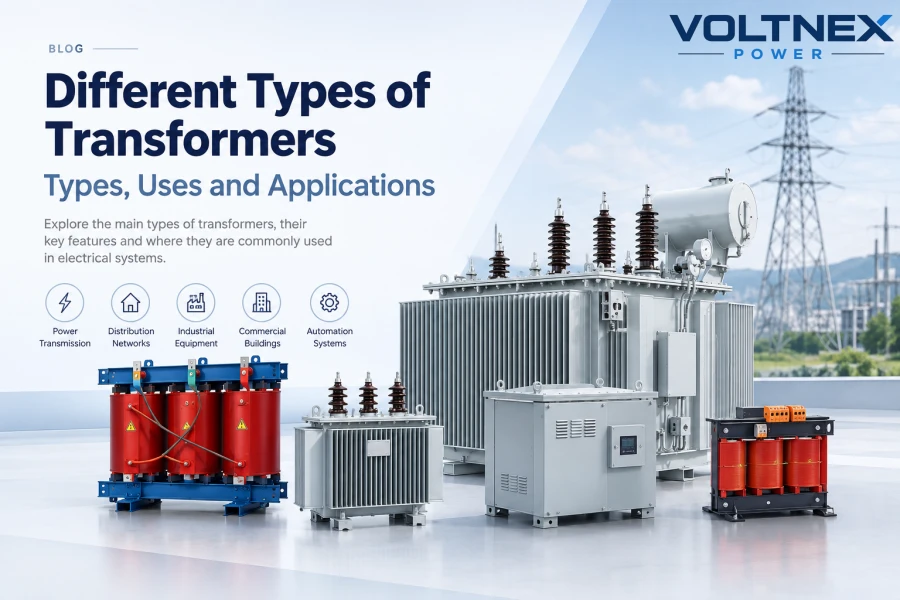
Transformers are essential electrical devices used to transfer AC electrical energy from one circuit to another while changing voltage and current levels. They are widely used in power generation, transmission, distribution, industrial equipment, commercial buildings, automation systems and electrical machinery.
There are many different types of transformers, and they can be classified according to their application, construction, voltage function, phase, insulation method and winding configuration. A transformer may also belong to several categories at the same time. For example, a three-phase dry-type isolation transformer can be classified by phase, construction and function.
Understanding the main types of transformers helps engineers, contractors and electrical equipment buyers select the right transformer for a specific power system or industrial application.
What Are the Different Types of Transformers?
The most common transformer types include power transformers, distribution transformers, step-up transformers, step-down transformers, isolation transformers, dry-type transformers, oil-immersed transformers, control transformers and instrument transformers.
Transformers can also be classified as single-phase or three-phase, and distribution transformers can include pole-mounted transformers and pad-mounted transformers for different installation environments.
The main transformer types are explained below.
1. Power Transformer
A power transformer is designed for high-power electrical transmission and substations. It is mainly used to increase or decrease voltage between different stages of a power system.
Step-up power transformers can increase voltage at generating stations for long-distance transmission, while step-down power transformers reduce voltage at substations before electricity enters distribution networks.
Power transformers are generally designed for high capacity, efficient continuous operation and demanding electrical environments.
2. Distribution Transformer
A distribution transformer reduces electrical voltage to levels suitable for commercial buildings, industrial facilities, infrastructure and other end users.
Distribution transformers are commonly available in single-phase and three-phase designs, as well as dry-type and oil-immersed constructions. Their primary purpose is to provide a practical secondary voltage for downstream electrical loads.
Two common installation types are pole-mounted transformers and pad-mounted transformers.
Pole-Mounted Transformer
A pole-mounted transformer is installed on an electrical utility pole and is commonly used in overhead power distribution systems. These transformers are designed to step down medium-voltage distribution power to a lower voltage suitable for local consumers.
Pole-mounted transformers are widely used in residential areas, rural power networks, utility distribution systems and locations where overhead electrical infrastructure is preferred.
Their elevated installation helps save ground space and integrates directly with overhead distribution lines.
Pad-Mounted Transformer
A pad-mounted transformer is installed on a concrete pad or other suitable foundation at ground level. It is typically used with underground electrical distribution systems.
Pad-mounted transformers are common in commercial developments, industrial facilities, residential communities, utility networks and infrastructure projects where overhead power lines are not preferred.
The enclosed cabinet provides protection for the transformer and helps create a clean ground-level installation. Depending on the project, pad-mounted transformers can be specified with different voltage ratings, capacities, connection configurations and enclosure requirements.
The choice between a pole-mounted transformer and pad-mounted transformer mainly depends on the distribution network, installation environment, available space, safety requirements and whether the electrical system uses overhead or underground distribution.
3. Step-Up Transformer
A step-up transformer increases the secondary voltage compared with the primary voltage. It normally has more turns on the secondary winding than on the primary winding.
Step-up transformers are widely used in power generation and transmission systems. Increasing voltage allows electrical power to be transmitted over long distances with lower current and reduced line losses.
They can also be designed for specialized industrial applications where a higher AC voltage is required.
4. Step-Down Transformer
A step-down transformer reduces voltage from the primary side to a lower secondary voltage.
This is one of the most widely used types of electrical transformers because industrial machinery, commercial equipment, control systems and electrical loads often require a lower voltage than the available utility supply.
For example, a transformer may convert 480V to 240V, 208V, 120V or another required voltage according to the application.
5. Isolation Transformer
An isolation transformer provides electrical separation between the primary and secondary circuits. A 1:1 isolation transformer can maintain approximately the same voltage while providing galvanic isolation between the two circuits.
Isolation transformers are widely used for industrial machinery, CNC equipment, automation systems, control panels, sensitive electrical equipment and other applications where electrical separation is required.
For industrial power systems, isolation transformers can also be designed with different voltage ratios, winding configurations, insulation classes and enclosure options according to the installation requirements.
6. Dry-Type Transformer
A dry-type transformer does not use liquid insulating oil around the core and windings. Instead, it uses solid insulation and air-based or forced-air cooling depending on the design.
Dry-type transformers are commonly installed inside factories, commercial buildings, data centers, control rooms, industrial facilities and other locations where liquid-free transformer construction is preferred.
Common applications include power distribution, isolation, machinery power supplies and industrial electrical systems.
7. Oil-Immersed Transformer
An oil-immersed transformer uses insulating liquid for electrical insulation and heat dissipation. The core and windings are immersed in transformer oil or another suitable insulating fluid.
Oil-immersed transformers are widely used in utility substations, outdoor power distribution and higher-capacity electrical systems.
The choice between a dry-type and oil-immersed transformer depends on transformer capacity, installation environment, cooling requirements, maintenance considerations and project specifications.
8. Control Transformer
A control transformer is designed to provide a suitable voltage for electrical control circuits rather than the main power supply.
Control transformers are commonly used in machine tools, CNC machines, PLC control panels, relay cabinets, contactor circuits, industrial automation systems, robotic equipment and conveyor systems.
Compared with large power transformers, control transformers are generally smaller and are selected according to the control voltage, continuous load and inrush requirements of the connected equipment.
9. Instrument Transformer
Instrument transformers are mainly used for electrical measurement, monitoring and protection.
The two common types are current transformers (CTs) and voltage transformers (VTs).
A current transformer converts a high current into a lower measurable current for meters, monitoring equipment and protective relays. A voltage transformer reduces high voltage to a suitable level for measurement and protection systems.
Instrument transformers are widely used in substations, industrial power systems and electrical protection equipment.
10. Single-Phase and Three-Phase Transformers
Transformers can also be classified according to the number of phases.
A single-phase transformer is used in single-phase electrical systems and is common in smaller equipment, lighting systems, control circuits and certain residential applications.
A three-phase transformer is designed for three-phase power systems and is widely used in industrial facilities, commercial buildings, power distribution networks and large electrical equipment.
The correct phase configuration depends on the incoming power supply and the requirements of the connected load.
Read More:Grounding Transformer: Working Principle, Types, Applications, Testing and How to Choose
How to Choose the Right Transformer Type
Choosing between different transformer types requires more than simply checking the voltage ratio. Important factors include:
- Primary and secondary voltage
- Transformer capacity in VA or kVA
- Single-phase or three-phase operation
- 50Hz or 60Hz frequency
- Dry-type or oil-immersed construction
- Isolation requirements
- Load characteristics and starting current
- Indoor or outdoor installation
- Cooling method
- Insulation and protection requirements
- Applicable electrical standards
- Installation and connection configuration
For distribution applications, the project should also determine whether a pole-mounted transformer or pad-mounted transformer is more appropriate for the electrical network and installation environment.
For industrial applications, transformer selection should be based on the actual load, operating conditions and required electrical characteristics rather than simply choosing a standard capacity.
Custom Transformer Solutions from Voltnex Power
Voltnex Power is a China-based manufacturer and supplier of industrial transformers and electrical power equipment, providing transformer solutions for industrial, commercial and power distribution applications.
Our transformer solutions can be customized according to required voltage, capacity, phase, frequency, winding configuration, insulation class, enclosure and installation requirements.
Product solutions include dry-type transformers, isolation transformers, industrial transformers, control transformers and distribution transformer solutions, with custom OEM, ODM and wholesale options available for international projects.
Whether you need a step-down transformer for industrial equipment, a dry-type isolation transformer for a CNC system, or a distribution transformer for a commercial or utility project, the transformer should be specified according to the actual electrical system and application requirements.
Conclusion
The different types of transformers serve different purposes across modern electrical systems. Power and distribution transformers support transmission and power distribution, while step-up and step-down transformers change voltage levels. Isolation transformers provide electrical separation, dry-type and oil-immersed transformers use different insulation and cooling approaches, and control and instrument transformers serve specialized applications.
Within distribution systems, pole-mounted transformers and pad-mounted transformers provide two common installation solutions for overhead and underground electrical networks.
Understanding the main types of transformers, transformer applications and construction options is the first step toward selecting the appropriate transformer for a specific electrical system. For customized industrial transformer requirements, factors such as voltage, kVA rating, phase, frequency, insulation, enclosure and installation environment should all be considered before manufacturing.