

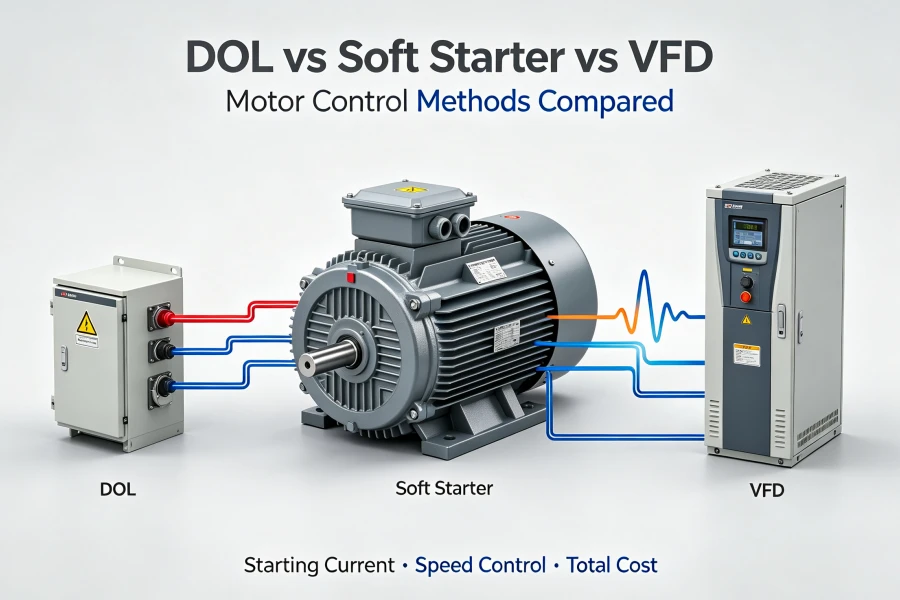
When selecting a motor control method for an industrial application, engineers often need to choose between a Direct Online (DOL) starter, soft starter, and Variable Frequency Drive (VFD).
All three methods can be used to start and operate AC induction motors, but they are designed for different requirements. A DOL starter provides the simplest and lowest-cost starting method. A soft starter reduces starting current and mechanical stress without providing full continuous speed control. A VFD provides complete control of motor speed, acceleration, deceleration, torque, and operating frequency.
Choosing the right motor control method therefore depends on more than the initial equipment price. Motor power, load characteristics, starting current, required speed range, energy consumption, process control requirements, installation conditions, and total cost of ownership should all be considered.
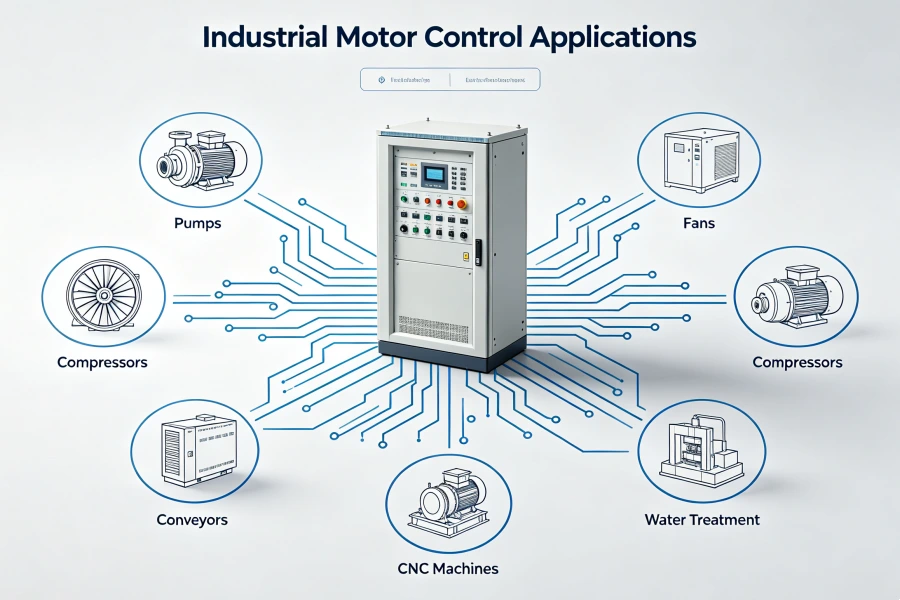
This guide compares VFD vs soft starter vs DOL starter and explains when each motor control method is most suitable for pumps, fans, compressors, conveyors, CNC machines, textile machinery, water treatment systems, and other industrial applications.
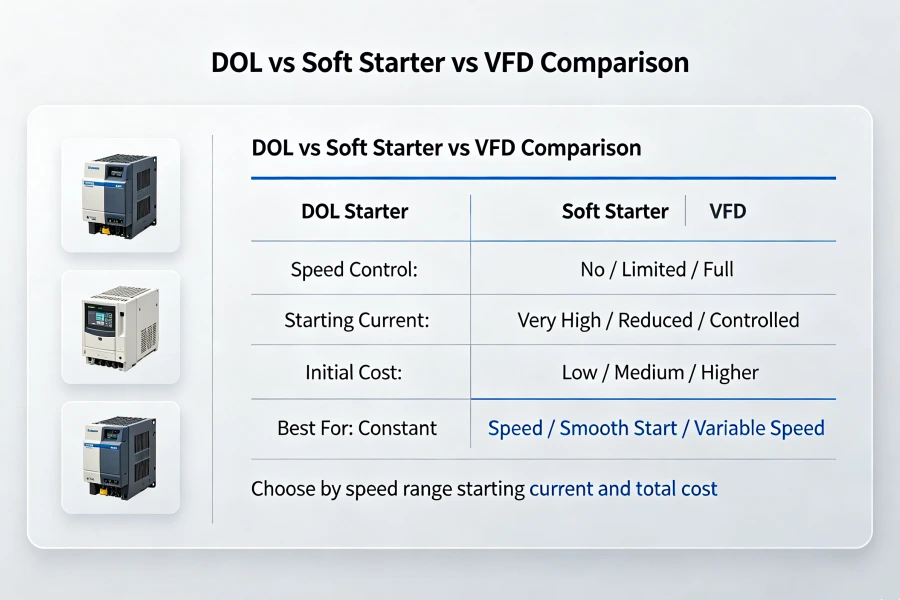
VFD vs Soft Starter vs DOL: Quick Comparison
The three motor control methods have significantly different capabilities.
| Feature | DOL Starter | Soft Starter | VFD |
|---|---|---|---|
| Full Name | Direct Online Starter | Soft Starter | Variable Frequency Drive |
| Starting Method | Direct voltage connection | Controlled voltage ramp | Variable voltage and frequency |
| Speed Control | No | Limited | Full |
| Starting Current | Very high | Reduced | Controlled |
| Starting Torque Control | Limited | Moderate | Excellent |
| Acceleration Control | No | Yes | Yes |
| Deceleration Control | No | Yes | Yes |
| Energy Saving | Low | Limited | High |
| Process Control | Low | Limited | Excellent |
| Motor Protection | Basic | Advanced | Advanced |
| Initial Cost | Low | Medium | Higher |
| Installation Complexity | Low | Medium | Higher |
| Maintenance | Low | Low to medium | Medium |
| Best Application | Simple constant-speed loads | Smooth starting | Variable-speed applications |
The most important difference is speed control.
A DOL starter connects the motor directly to the power supply. A soft starter controls the motor voltage during starting and stopping, but normally allows the motor to operate at approximately its normal line frequency after startup.
A VFD, on the other hand, continuously controls the output frequency and voltage supplied to the motor. This allows the motor speed to be adjusted according to the actual process requirement.
What Is a DOL Starter?
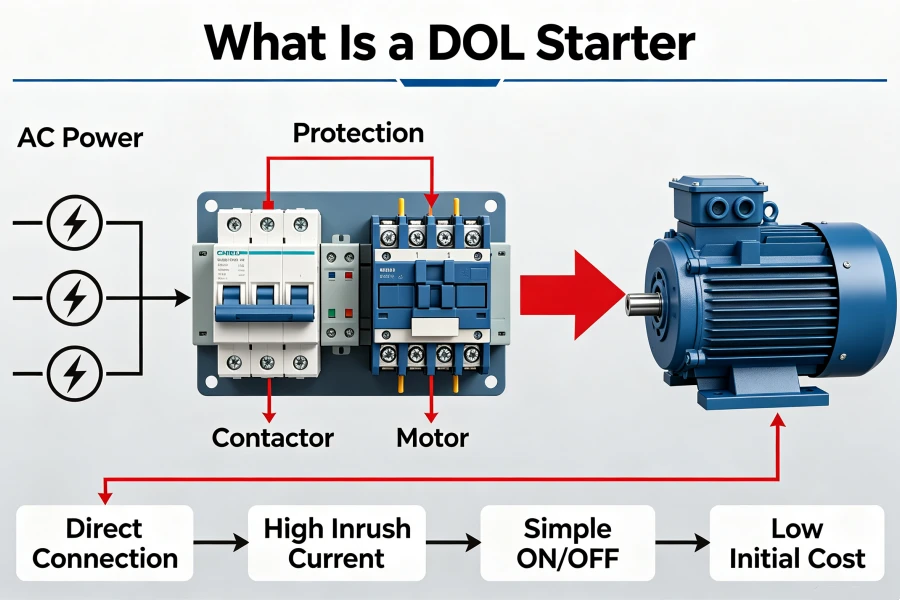
A Direct Online (DOL) starter is one of the simplest methods for starting a three-phase or single-phase AC motor.
With a DOL starter, the motor is connected directly to the electrical supply through switching and protection components such as a contactor, overload relay, circuit breaker, or fuse.
The basic power path can be represented as:
AC Power → Protection → Contactor → Motor
When the contactor closes, the motor receives the available supply voltage immediately and accelerates toward its operating speed.
Because there is no electronic voltage or frequency conversion, the DOL starter is simple, inexpensive, and easy to maintain.
How Does a DOL Starter Work?
When the start command is received, the contactor closes and connects the motor directly to the incoming AC supply.
The motor initially draws a high inrush current while accelerating. Once the motor reaches its normal operating speed, the current decreases toward its normal running value depending on the load.
A DOL starter therefore provides:
- Simple ON/OFF motor control
- Direct connection to the power supply
- High starting torque
- Fast starting
- Low equipment cost
- Easy troubleshooting
However, the high starting current can place additional stress on the electrical system and motor.
Advantages of DOL Starters
The main advantages of DOL motor starting include:
Low Initial Cost
DOL starters generally have the lowest initial equipment cost among the three methods.
Simple Installation
The electrical circuit is relatively straightforward, making installation and troubleshooting easier.
Easy Maintenance
Because there are fewer electronic components, maintenance requirements are generally low.
High Starting Torque
The motor receives full supply voltage during starting, allowing strong starting torque for applications where this characteristic is desirable.
Reliable Operation
For simple constant-speed applications, a properly selected DOL starter can provide reliable motor starting and stopping.
Limitations of DOL Starters
The primary disadvantage is high starting current.
Depending on the motor design, the starting current can be several times the rated full-load current. This can result in:
- Voltage dips
- Electrical system stress
- Mechanical shock
- High starting torque
- Increased stress on couplings and transmission systems
- Potential problems when starting large motors on weak electrical networks
A DOL starter also cannot provide variable motor speed.
Once the motor is running, its speed is primarily determined by the supply frequency, motor pole count, and load.
Typical DOL Applications
DOL starters are commonly considered for:
- Small industrial pumps
- Small fans
- Conveyors
- Compressors
- Machine tools
- Agricultural equipment
- Simple production machinery
- Constant-speed motors
DOL is particularly attractive when the motor is relatively small, the electrical supply can tolerate the starting current, and variable-speed control is not required.
Read More:Industrial Power Quality Problems and Solutions: Transformer, AVR, SVG and AHF
What Is a Soft Starter?
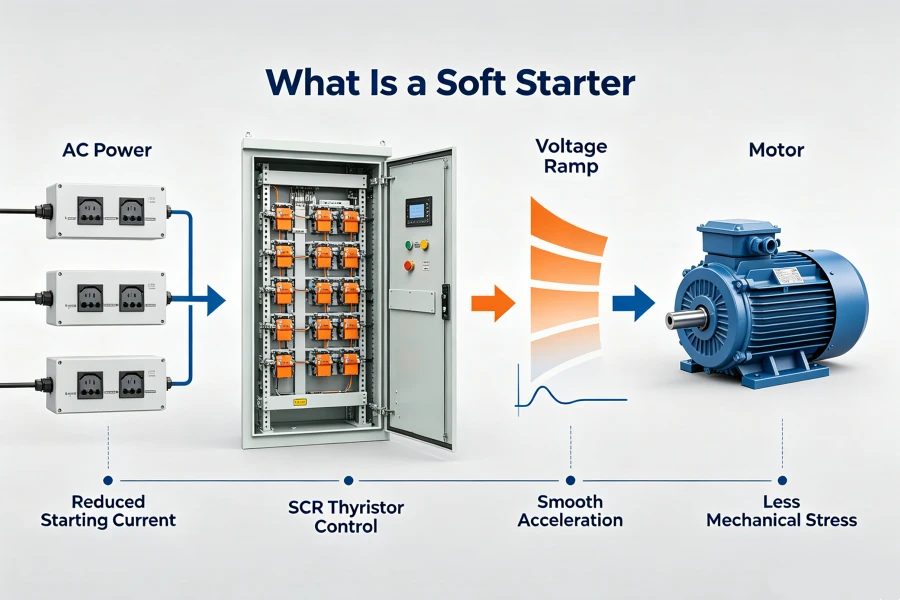
A soft starter is an electronic motor starting device designed primarily to control the voltage applied to an AC motor during starting and stopping.
Instead of applying full voltage immediately, the soft starter uses semiconductor devices, typically thyristors or SCRs, to gradually increase the voltage supplied to the motor.
The basic concept is:
AC Power → SCR/Thyristor Control → Motor
This controlled voltage ramp reduces the sudden electrical and mechanical impact associated with direct online starting.
How Does a Soft Starter Work?
During startup, the soft starter gradually increases the voltage applied to the motor.
The motor accelerates progressively rather than receiving full voltage immediately.
This can reduce:
- Starting current
- Mechanical shock
- Torque spikes
- Stress on belts and couplings
- Pressure surges in pumping systems
The soft starter can also control the stopping process in applications where a controlled deceleration is useful.
However, a soft starter is not equivalent to a VFD.
A soft starter primarily controls the motor’s voltage during starting and stopping. It does not normally provide continuous variable-frequency speed control.
Advantages of Soft Starters
Reduced Starting Current
A soft starter can significantly reduce the electrical impact of motor startup compared with DOL starting.
Smooth Acceleration
Controlled acceleration reduces sudden torque changes and mechanical shock.
Reduced Mechanical Stress
Smooth starting can help protect:
- Couplings
- Gearboxes
- Belts
- Shafts
- Pumps
- Conveyors
- Mechanical transmission systems
Reduced Water Hammer
For pump systems, controlled acceleration and deceleration can help reduce sudden pressure changes in the piping system.
Lower Cost Than a VFD
When continuous variable-speed operation is not required, a soft starter can provide controlled starting at a lower initial cost than a VFD.
Limitations of Soft Starters
The most important limitation is that a soft starter does not provide the same level of speed control as a VFD.
A soft starter is therefore generally suitable when:
The motor needs to start and stop smoothly but normally operates at a relatively constant speed.
If the process requires the motor to run at 30 Hz, 40 Hz, 50 Hz, or 60 Hz depending on production conditions, a VFD is normally the more appropriate solution.
Typical Soft Starter Applications
Soft starters are commonly considered for:
- Large pumps
- Fans
- Compressors
- Conveyors
- Crushers
- Centrifugal equipment
- Water treatment equipment
- Industrial machinery with high starting inertia
What Is a Variable Frequency Drive?
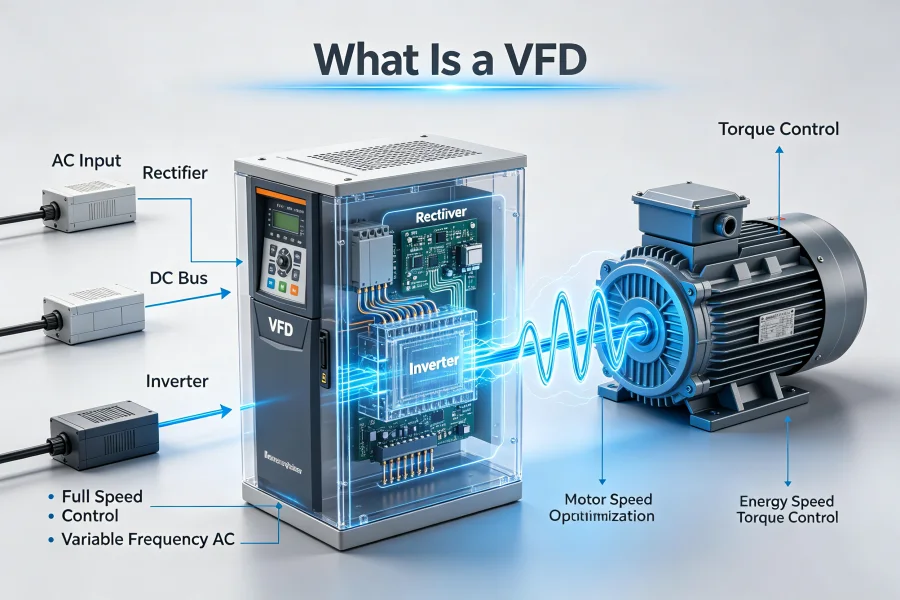
A Variable Frequency Drive (VFD) is an electronic motor controller that controls an AC motor by adjusting the frequency and voltage supplied to the motor.
Unlike a DOL starter or conventional soft starter, a VFD can control the motor during both starting and continuous operation.
A typical VFD power conversion process is:
AC Input → Rectifier → DC Bus → Inverter → Variable-Frequency AC Output → Motor
The inverter section generates an AC output with adjustable frequency and voltage.
By changing the output frequency, the VFD can control the operating speed of the motor.
How Does a VFD Control Motor Speed?
For an AC induction motor, synchronous speed is related to supply frequency and the number of motor poles.
The basic relationship is:
Synchronous Speed = 120 × Frequency / Number of Poles
Therefore, changing the frequency changes the motor’s operating speed.
For example, a motor designed for operation around 50 Hz can operate at a lower speed when the VFD reduces the output frequency.
This provides much greater flexibility than a DOL starter or soft starter.
Advantages of VFDs
Full Motor Speed Control
A VFD can adjust motor speed according to process requirements.
Controlled Starting
The motor can accelerate gradually, reducing starting current and mechanical shock.
Controlled Deceleration
The VFD can also provide controlled stopping and deceleration.
Energy Optimization
For variable-torque loads such as centrifugal pumps and fans, reducing motor speed can significantly reduce the power required by the application.
Improved Process Control
Motor speed can be linked to:
- Pressure
- Flow
- Temperature
- Production speed
- Conveyor speed
- Machine feedback
- PLC control signals
Advanced Motor Control
Depending on the VFD design, control methods can include:
- V/F control
- Sensorless vector control
- Closed-loop vector control
- Torque control
Limitations of VFDs
VFDs also have disadvantages that engineers should consider.
Higher Initial Cost
A VFD generally costs more than a DOL starter and may cost more than a soft starter.
More Complex Installation
VFD installations may require consideration of:
- Input protection
- Grounding
- EMC
- Cable selection
- Motor insulation
- Cooling
- Harmonics
- Output filters
- Communication systems
Harmonic Considerations
The power electronics inside a VFD can introduce harmonic currents into the electrical system.
For larger installations or sensitive electrical networks, harmonic mitigation may need to be considered.
Parameter Configuration
Correct motor parameters and control settings are important for reliable VFD operation.
VFD vs Soft Starter: What’s the Difference?
The most common comparison is VFD vs soft starter because both technologies can provide controlled motor starting.
However, their purposes are different.
| Parameter | Soft Starter | VFD |
|---|---|---|
| Starting control | Yes | Yes |
| Starting current reduction | Yes | Yes |
| Smooth acceleration | Yes | Yes |
| Smooth deceleration | Yes | Yes |
| Continuous speed control | No / Limited | Yes |
| Frequency control | No | Yes |
| Torque control | Limited | Advanced |
| Energy saving during variable-speed operation | Limited | High potential |
| Process control | Limited | Excellent |
| Initial cost | Lower | Higher |
| Installation complexity | Lower | Higher |
The simplest way to understand the difference is:
A soft starter controls how the motor starts. A VFD controls how the motor operates.
If a motor always needs to operate at approximately full speed, a soft starter may be sufficient.
If the motor needs to operate at different speeds according to the process requirement, a VFD is normally the better solution.
VFD vs DOL Starter: What’s the Difference?
The comparison between a VFD and DOL starter is even more significant.
| Feature | DOL Starter | VFD |
|---|---|---|
| Initial cost | Very low | Higher |
| Starting current | Very high | Controlled |
| Speed control | No | Yes |
| Acceleration control | No | Yes |
| Deceleration control | No | Yes |
| Torque control | Limited | Advanced |
| Energy optimization | Low | High potential |
| Process control | Basic | Advanced |
| Installation | Simple | More complex |
| Application flexibility | Low | High |
DOL is primarily a simple switching and starting solution.
VFDs are complete electronic motor control systems.
Therefore, the right choice depends on whether the application needs more than basic ON/OFF motor operation.
Which Motor Control Method Should You Choose?
There is no universal answer to the question of which motor starter is best.
The correct choice depends on the application.
Choose DOL When Cost and Simplicity Are the Priority
A DOL starter may be appropriate when:
- The motor operates at constant speed
- Starting current is acceptable
- The electrical supply is sufficiently strong
- The motor is relatively small
- The load can tolerate direct starting
- Variable-speed control is unnecessary
- The lowest initial cost is important
For a simple motor that only needs to turn ON and OFF, a DOL starter can be the most economical option.
Choose a Soft Starter When Smooth Starting Is Required
A soft starter is often a good choice when:
- The motor normally operates at constant speed
- Starting current must be reduced
- Mechanical shock needs to be minimized
- Smooth acceleration is required
- Smooth stopping is useful
- Continuous speed control is unnecessary
- A lower-cost alternative to a VFD is preferred
For example, a large pump that always operates near its normal speed may benefit from a soft starter rather than a VFD if speed adjustment is not required.
Choose a VFD When Variable Speed Is Required
A VFD is normally the preferred solution when:
- Motor speed needs to change
- Process flow must be controlled
- Pressure must be regulated
- Energy efficiency is important
- Acceleration and deceleration need precise adjustment
- Torque control is required
- Production speed needs to change
- The motor must integrate with a PLC or automation system
VFDs are particularly valuable when the motor does not need to operate continuously at full speed.
VFD vs Soft Starter vs DOL for Industrial Applications
Different industrial loads have different control requirements.
Pumps
For simple constant-speed pumps, DOL or soft starters may be suitable depending on motor size and starting requirements.
For variable-flow or variable-pressure pumping systems, a VFD is often more suitable because motor speed can be adjusted according to actual demand.
Typical VFD pump applications include:
- Water supply
- Water treatment
- Irrigation
- Industrial process water
- HVAC circulation
- Booster pump systems
Fans and Blowers
Fans often operate under changing airflow requirements.
If airflow can be controlled by adjusting motor speed, a VFD can provide better process control and potentially reduce energy consumption.
For simple constant-speed fans, DOL or soft starting may be sufficient.
Conveyors
A conveyor may require smooth acceleration to prevent:
- Belt shock
- Product movement
- Mechanical stress
- Excessive starting torque
A soft starter can be suitable for constant-speed conveyor systems.
A VFD is preferable when conveyor speed must be adjusted according to production requirements.
Compressors
Compressor applications vary considerably.
A soft starter can be suitable when the compressor operates at a relatively constant speed and the primary concern is reducing starting stress.
A VFD can be more suitable for variable-demand compressor systems where motor speed needs to follow air demand.
CNC Machines
CNC machine tools often require precise spindle speed control.
For this type of application, a VFD is generally much more suitable than a DOL starter or soft starter because the machine may require different operating speeds for different cutting operations.
Textile Machinery
Textile production frequently requires accurate and adjustable motor speed.
VFDs can be used for:
- Spinning machines
- Weaving machines
- Winding machines
- Textile processing equipment
- Material handling systems
The ability to adjust speed makes VFD technology particularly useful for these applications.
Water Treatment Systems
Water treatment systems often contain pumps, blowers, mixers, and other rotating equipment.
VFDs can help control:
- Water flow
- Pump pressure
- Blower output
- Process speed
Soft starters can also be appropriate where the equipment operates at a fixed speed and only smooth starting is required.
Does a VFD Save More Energy Than a Soft Starter?
This is an important question because the energy-saving benefits of a VFD are often misunderstood.
A soft starter primarily reduces electrical and mechanical stress during starting and stopping.
A VFD can reduce energy consumption during continuous operation by allowing the motor to operate at the speed actually required by the process.
This distinction is particularly important for variable-torque loads.
For example, centrifugal pumps and fans often do not need to operate at full speed all the time.
Instead of running a motor continuously at full speed and controlling the process with a valve or damper, a VFD can reduce motor speed to match the required flow or airflow.
Therefore:
A soft starter is primarily a starting-control device, while a VFD can be an energy-management and process-control device.
However, VFD energy savings are highly application-dependent. Not every motor will achieve significant energy savings simply because a VFD is installed.
The greatest opportunities generally occur when:
- Load demand varies
- Motor speed can be reduced
- The application is suitable for variable-speed operation
- The motor operates for significant periods at partial load
Motor Starting Current: DOL vs Soft Starter vs VFD
Starting current is another important engineering consideration.
A DOL starter applies the available supply voltage directly to the motor. This can result in a high inrush current.
A soft starter gradually increases motor voltage, reducing the current demand during acceleration.
A VFD controls both voltage and frequency during acceleration, allowing the motor to start in a highly controlled manner.
The general relationship is:
DOL → Highest Starting Current
Soft Starter → Reduced Starting Current
VFD → Controlled Starting Current
The actual current depends on motor design, load torque, acceleration time, control settings, and operating conditions.
Therefore, engineers should always select the motor control device based on the actual motor nameplate data and load characteristics rather than relying only on general rules.
Initial Cost vs Total Cost of Ownership
The cheapest motor starter is not always the cheapest solution over the life of the equipment.
A DOL starter normally has the lowest initial cost.
A soft starter has a higher initial cost but can reduce mechanical and electrical stress during starting.
A VFD normally has the highest initial investment but can provide:
- Variable-speed operation
- Process optimization
- Energy savings
- Advanced control
- Reduced starting stress
- Automation integration
When comparing solutions, engineers should consider the total cost of ownership (TCO) rather than only the purchase price.
Important factors include:
- Initial equipment cost
- Installation cost
- Energy consumption
- Maintenance
- Downtime
- Production efficiency
- Motor operating hours
- Expected equipment lifetime
- Process control requirements
For a simple motor that runs continuously at full speed, a VFD may provide little economic advantage.
For a variable-load pump running thousands of hours per year, however, the additional investment in a VFD may be justified by improved process control and lower energy consumption.
How to Select the Right Motor Control Method
Before selecting a DOL starter, soft starter, or VFD, engineers should evaluate several key parameters.
1. Motor Power
Check:
- Motor kW or HP
- Rated voltage
- Rated current
- Rated frequency
- Number of poles
- Motor type
2. Load Type
Determine whether the motor drives:
- Constant-torque load
- Variable-torque load
- High-inertia load
- Constant-power load
Load characteristics strongly influence the appropriate control method.
3. Starting Requirements
Consider:
- Required starting torque
- Maximum allowable starting current
- Acceleration time
- Mechanical limitations
- Electrical system capacity
4. Speed Range
If the motor only needs to run at one speed, a DOL starter or soft starter may be sufficient.
If the motor needs a wide operating speed range, a VFD should be considered.
5. Energy Requirements
For variable-load pumps, fans, and similar equipment, calculate whether reducing motor speed can provide meaningful energy savings.
6. Automation Requirements
If the motor needs to communicate with a PLC, HMI, SCADA, or industrial control system, a VFD may provide more advanced control and communication options.
7. Environment
Consider:
- Ambient temperature
- Dust
- Moisture
- Enclosure requirements
- Cooling
- Installation location
- Electrical noise
- Cable length
Learn More:How to Select a VFD for an AC Motor? Complete Sizing Guide
Final Decision Guide: DOL vs Soft Starter vs VFD
The following simplified guide can help engineers make an initial selection.
| Requirement | Recommended Method |
|---|---|
| Lowest initial cost | DOL |
| Simple ON/OFF operation | DOL |
| Constant-speed operation | DOL / Soft Starter |
| High starting current is acceptable | DOL |
| Reduced starting current | Soft Starter / VFD |
| Smooth acceleration | Soft Starter / VFD |
| Reduced mechanical shock | Soft Starter / VFD |
| Smooth pump starting | Soft Starter / VFD |
| Variable motor speed | VFD |
| Precise speed control | VFD |
| Variable flow control | VFD |
| Variable pressure control | VFD |
| Energy optimization at partial load | VFD |
| Advanced process control | VFD |
| PLC/automation integration | VFD |
| Wide speed range | VFD |
The basic decision can be summarized as follows:
Choose DOL when simplicity and low initial cost are the priority.
Choose a soft starter when the motor needs controlled starting and stopping but normally operates at a constant speed.
Choose a VFD when variable speed, energy optimization, precise control, or advanced process integration is required.
Frequently Asked Questions
What is the difference between a VFD and a soft starter?
A soft starter controls the voltage applied to the motor primarily during starting and stopping. A VFD controls both voltage and frequency and can continuously adjust motor speed during operation.
Is a VFD better than a soft starter?
Not necessarily. A VFD is better when variable-speed operation, energy optimization, or advanced motor control is required. A soft starter may be the better and more economical choice when the motor only needs smooth starting and stopping at a fixed operating speed.
Which is cheaper, a VFD or a soft starter?
A soft starter generally has a lower initial cost than a VFD. However, total cost should also consider installation, energy consumption, maintenance, and process requirements.
Can a soft starter control motor speed?
A conventional soft starter is primarily designed to control motor acceleration and deceleration rather than provide continuous variable-speed operation. For continuous speed adjustment, a VFD is normally the appropriate solution.
Can a VFD replace a DOL starter?
A VFD can provide motor starting, stopping, and speed control, so it can perform many functions associated with a DOL starter. However, the VFD must be correctly selected and configured for the motor and application.
Which motor starter saves the most energy?
A VFD generally provides the greatest energy-saving potential when the motor drives a variable-load application and motor speed can be reduced according to actual demand. A soft starter mainly provides benefits during starting rather than continuous operation.
When should I use a DOL starter?
A DOL starter is suitable when the motor can tolerate direct starting, the electrical supply can handle the starting current, variable speed is not required, and low initial cost and simple operation are important.
When should I use a soft starter instead of a VFD?
Consider a soft starter when the motor normally operates at constant speed and the main requirement is to reduce starting current and mechanical stress rather than control motor speed continuously.
Does a VFD reduce motor starting current?
Yes. A VFD can control motor acceleration and limit the current required during startup compared with direct online starting. The actual starting current depends on the VFD, motor, load, and control settings.
Which motor control method is best for pumps and fans?
It depends on the application. DOL may be suitable for simple constant-speed equipment, while a soft starter is useful when smooth starting is the main requirement. A VFD is often preferred when pump flow, pressure, or fan airflow needs to vary according to process demand.
Conclusion
DOL starters, soft starters, and VFDs all have an important role in industrial motor control, but they solve different problems.
A DOL starter provides the simplest and lowest-cost solution for basic constant-speed motor applications, but it produces high starting current and provides no variable-speed control.
A soft starter provides controlled acceleration and deceleration, reducing electrical and mechanical stress while keeping the motor primarily in a constant-speed operating mode.
A VFD provides the highest level of motor control by adjusting output frequency and voltage. It can control motor speed, acceleration, deceleration, torque, and process operation while offering significant energy-saving potential for suitable variable-load applications.
The best solution is therefore not simply the most advanced or the cheapest one. The right choice depends on the motor, load, starting requirements, operating profile, speed requirements, energy objectives, and total cost of ownership.
For industrial applications requiring variable-speed motor control, VoltNex Power provides single-phase and three-phase VFD solutions from 0.75kW to 1000kW for pumps, fans, compressors, conveyors, CNC machines, textile machinery, water treatment systems, and other industrial motor applications.
Need help selecting the right VFD for your motor? Review the motor power, voltage, rated current, load type, required speed range, overload requirement, and application conditions before choosing the VFD rating and control configuration.