


























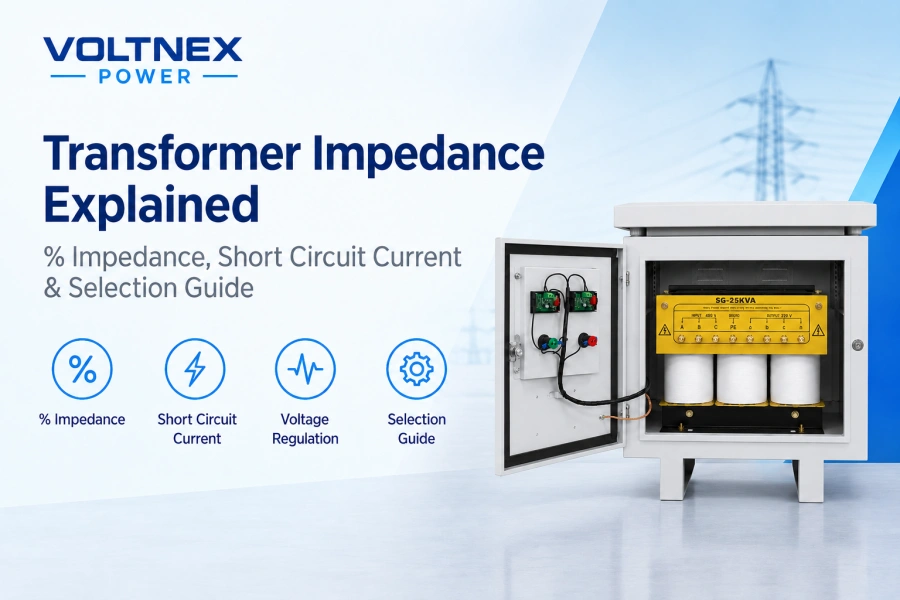
Transformer impedance is an important specification when selecting, sizing, or replacing a transformer for an industrial or commercial power system. It directly affects short-circuit current, voltage drop, voltage regulation, transformer paralleling, and system protection.
For engineers and electrical equipment buyers, understanding transformer impedance helps ensure that the transformer is compatible with the existing electrical system and provides the required performance under normal and fault conditions.
This guide explains transformer impedance, percentage impedance (%Z), short-circuit current, voltage regulation, and how to select the appropriate transformer impedance for an application.
What Is Transformer Impedance?
Transformer impedance is the internal opposition to current flow within a transformer. It mainly consists of the transformer’s resistance and leakage reactance.
In practical transformer specifications, impedance is commonly expressed as percentage impedance (%Z) rather than as an absolute value in ohms.
For example, a transformer may have:
- Rated power: 500 kVA
- Primary voltage: 480 V
- Secondary voltage: 208/120 V
- Frequency: 60 Hz
- Impedance: 5%
- Phase: 3-phase
The 5% impedance means that approximately 5% of the rated voltage is required to produce rated current when the secondary winding is short-circuited under the specified test conditions.
Transformer impedance is normally determined during the manufacturer’s routine or type testing process and is an important part of the transformer’s electrical design.
What Does Transformer % Impedance Mean?
Transformer % impedance (%Z) is a standardized way of expressing transformer impedance relative to its rated voltage.
A simplified relationship is:
%Z = (Impedance Voltage / Rated Voltage) × 100
For example, if a transformer has a rated voltage of 480 V and an impedance voltage of 24 V:
%Z = 24 / 480 × 100 = 5%
Therefore, the transformer has a 5% impedance.
Typical distribution and industrial transformers may have impedance values in the range of approximately 4% to 8%, although the actual value depends on transformer capacity, voltage level, construction, application, and manufacturer design.
A larger transformer does not automatically have the same impedance as a smaller transformer. The required impedance should be specified according to the electrical system and application.
Why Is Transformer Impedance Important?
Transformer impedance affects several important characteristics of a power system.
1. Short-Circuit Current
Transformer impedance has a direct relationship with the available short-circuit current.
As a simplified approximation:
Short-Circuit Current ≈ Full-Load Current / %Z (per unit)
For example, a transformer with 5% impedance has an approximate short-circuit current of:
100% / 5% = 20 times rated current
A transformer with 10% impedance would have approximately:
100% / 10% = 10 times rated current
Therefore:
Lower impedance → higher available fault current
Higher impedance → lower available fault current
This is one of the most important reasons engineers consider transformer impedance when selecting circuit breakers, fuses, busbars, cables, and other protection equipment.
2. Voltage Drop and Voltage Regulation
Transformer impedance also affects voltage drop when the transformer is loaded.
As the load increases, current flowing through the transformer’s internal impedance produces a voltage drop.
A transformer with relatively high impedance can experience greater voltage variation between no-load and full-load conditions.
For applications with sensitive equipment, motors, CNC machines, automation systems, or other voltage-sensitive loads, transformer impedance should therefore be considered together with the required voltage regulation.
3. Transformer Paralleling
When two or more transformers operate in parallel, their impedance values need to be compatible.
Transformers connected in parallel should generally have compatible:
- Voltage ratio
- Phase relationship
- Vector group
- Frequency
- Polarity
- Percentage impedance
- Impedance angle
- Rated power
If transformers with significantly different impedances are operated in parallel, the load may not be shared evenly.
The transformer with lower impedance can take a greater portion of the load, potentially resulting in overheating or overload.
For this reason, transformer impedance matching is an important consideration for parallel transformer operation.
How Does Transformer Impedance Affect Short-Circuit Current?
Short-circuit current is one of the most practical applications of transformer impedance calculations.
For a simplified three-phase system, the rated secondary current can be calculated as:
I = kVA × 1000 / (√3 × V)
For example, consider a:
500 kVA, 3-phase, 480 V transformer
Its approximate full-load current is:
I = 500,000 / (1.732 × 480)
≈ 602 A
If the transformer has 5% impedance, the approximate secondary short-circuit current at the transformer terminals would be:
602 / 0.05 ≈ 12,040 A
This is a simplified calculation. Actual fault-current calculations must also consider upstream utility impedance, cable impedance, motor contribution, generator sources, and other system components.
Nevertheless, it demonstrates an important principle:
Transformer impedance is directly related to the available fault current.
What Is a Typical Transformer Impedance?
There is no single impedance value suitable for every transformer.
Typical values depend on the transformer’s:
- Rated kVA or MVA
- Primary and secondary voltage
- Frequency
- Transformer type
- Ansøgning
- Construction
- Short-circuit requirements
- Voltage regulation requirements
- Parallel operation requirements
- Protection system
For many low-voltage industrial and commercial transformers, values such as 4%, 5%, 6%, or higher may be encountered.
However, engineers should not select a transformer simply because its impedance falls within a commonly used range.
The correct impedance should be determined from the requirements of the complete electrical system.
How to Select Transformer Impedance
When ordering a transformer, consider the following factors.
1. Determine the Transformer Rating
First confirm the required transformer capacity, such as:
The transformer’s rated capacity affects both full-load current and fault-current calculations.
2. Check the Available Short-Circuit Current
Determine the available fault current at the installation point.
The transformer impedance must be compatible with the downstream protection equipment and the required short-circuit withstand capability.
3. Check Voltage Regulation Requirements
If the transformer supplies sensitive industrial equipment, automation systems, motors, CNC machines, or electronic loads, voltage regulation may be an important consideration.
The transformer should be designed to provide acceptable voltage performance under the expected loading conditions.
4. Check Existing Transformer Specifications
For transformer replacement projects, it is usually important to match or carefully coordinate the new transformer’s:
- kVA rating
- Primary voltage
- Secondary voltage
- Frequency
- Fase
- Vector group
- % impedance
- Taps
- Kølemetode
This is particularly important when replacing a transformer in an existing industrial power system.
5. Consider Parallel Operation
If the transformer will operate in parallel with another transformer, impedance matching becomes especially important.
Provide the existing transformer nameplate data to the transformer manufacturer before placing an order.
Transformer Impedance for Industrial Applications
Transformer impedance is particularly important in industrial environments where electrical systems may include:
- CNC machinery
- VFDs
- Motors
- PLC control systems
- Automation equipment
- Welding equipment
- Production lines
- Data and control systems
- Renewable energy equipment
- Battery energy storage systems
For these applications, transformer selection should not be based only on kVA and voltage.
A properly engineered transformer should consider impedance, voltage regulation, fault current, harmonic loading, insulation level, temperature rise, and the characteristics of the connected equipment.
What Information Should You Provide When Requesting a Transformer Quote?
For a custom or replacement transformer, providing complete electrical information helps the manufacturer select the correct impedance and transformer design.
At minimum, provide:
- Transformer capacity (kVA)
- Enfaset eller trefaset
- Primary voltage
- Secondary voltage
- Frequency
- Required % impedance, if specified
- Vector group, if applicable
- Indoor or outdoor installation
- Enclosure/IP requirement
- Isoleringsklasse
- Load type
- Quantity
- Destination country
If the required impedance is not known, provide the existing transformer nameplate, system short-circuit data, or protection requirements. The manufacturer can then review the application and recommend a suitable design.
Transformer Impedance: Key Takeaways
Transformer impedance is more than just a number on a transformer datasheet. It directly affects fault current, voltage drop, voltage regulation, protection coordination, and transformer load sharing.
The key points are:
- % impedance (%Z) expresses transformer impedance as a percentage of rated voltage.
- Lower impedance generally results in higher short-circuit current.
- Higher impedance generally reduces available fault current but may increase voltage drop.
- Transformer impedance is important when paralleling transformers.
- The correct impedance depends on the complete electrical system, not only transformer capacity.
- Replacement transformers should be checked against the existing transformer’s impedance and other nameplate data.
- Industrial applications may require customized impedance based on load and protection requirements.
For custom industrial transformer projects, the transformer impedance should be confirmed during the technical design stage rather than selected only from a standard catalog value.
Voltnex Power manufactures standard and custom industrial transformers for voltage conversion, isolation, control, machinery, and industrial power applications. If you have the transformer kVA, primary/secondary voltage, frequency, and application requirements, our engineering team can review the specifications and recommend a suitable transformer design.
Request a transformer quotation with your electrical specifications and destination country.